How To Take A $300K Recruiter Past $500K.

 Spotify

 Apple Podcasts

 YouTube

 Castro

 RSS Feed

 Amazon Music

 TuneIn

 Audible
Key Takeaways
- Dante Nino explains how to break through the common $300K recruitment plateau and scale past $500K by focusing on strategic adjustments rather than simply making more cold calls.
- Tiello diagnoses recruiter stalls by identifying four core issues: being too generalist, being too transactional, lacking an ideal client profile, and failing to grow wallet share within existing accounts.
- Implementing structured weekly scoreboards—featuring 10 discovery calls a day, 5 submissions, 3 interviews, and 1 offer—creates predictable and repeatable desk performance.
- Recruiters can maximize their return on effort by cultivating 3 to 5 six-figure accounts rather than chasing a hundred low-value transactional clients.
- Tiello enforces strict pricing standards by starting fees at 30% of base salary plus guaranteed compensation to protect profitability and recruiter energy.
Finish the Year Strong 2026 kicks off Monday, September 28. It is free, it is virtual, and it runs through October 5. Register here: https://recruiters-finish-the-year-strong.heysummit.com/
This episode is brought to you by Atlas: https://recruitwithatlas.com/
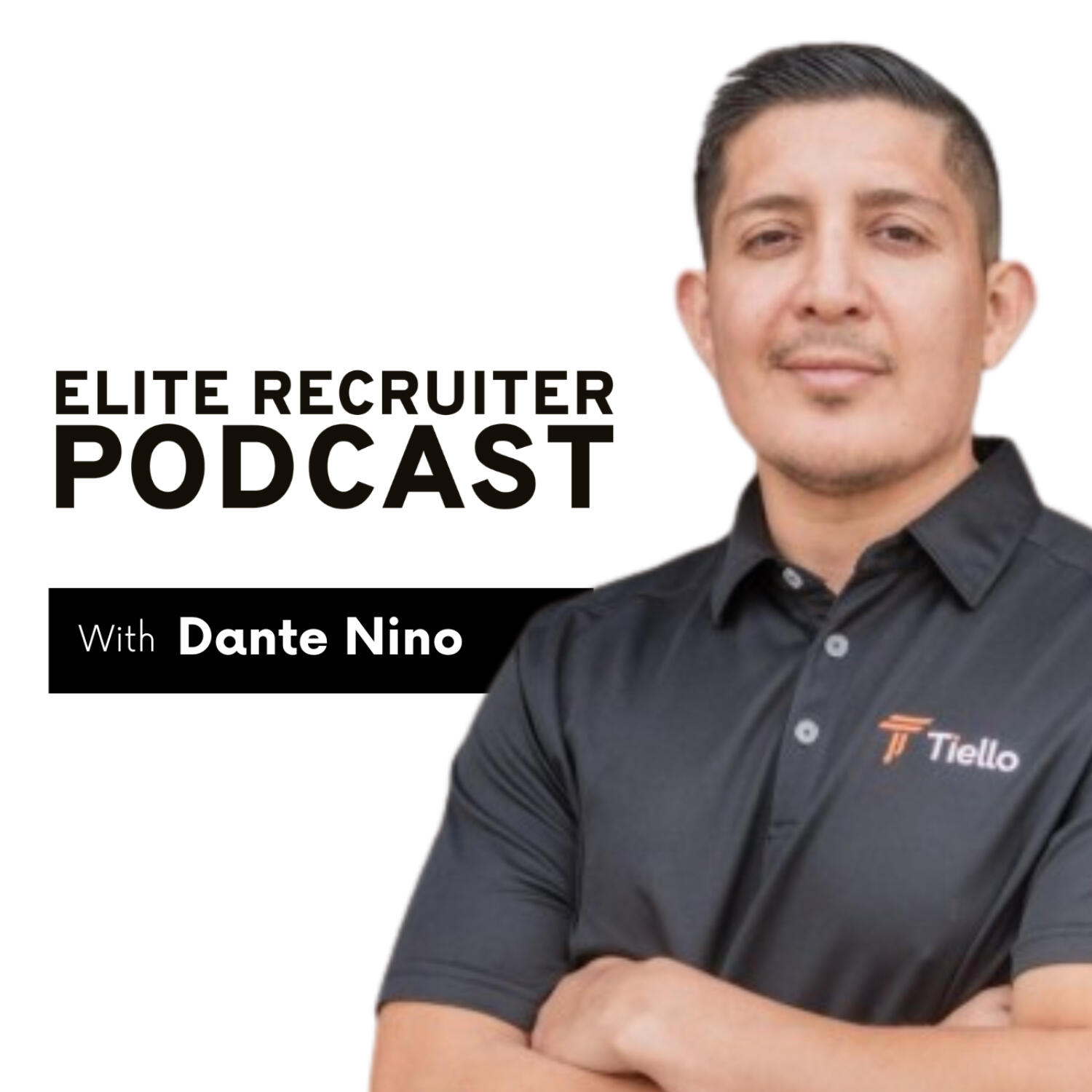
To give you a taste of what is coming, we pulled one of the most rewatched sessions from last year's Finish the Year Strong out of the Elite Recruiter Community Library. Dante Nino, co-founder and Managing Partner of Tiello, built his talk around one question: how do you take a recruiter who is stuck at $300K and get them past $500K?
Dante co-founded Tiello in 2019 with his college soccer teammate and roommate. At the time of this talk, Tiello was a fully remote, 25 person recruiting firm focused on architecture, engineering, and construction, with over 400 clients signed and more than 750 placements across 31 states, as Dante tells it. His focus is the recruiter who works hard, does everything right, and still plateaus.
His answer is not "make more calls." Before any system goes in, Tiello diagnoses the problem, and it is usually one of four: too generalist, too transactional, no ideal client profile, or failing to grow wallet share inside the accounts that already pay you. From there he walks through how Tiello fixes it: industry pods, a recruiter deal box every new hire fills out to define their ideal client, a simple weekly scoreboard of 10 discovery calls a day, 5 submissions, 3 interviews, and 1 offer, and quarterly billing tiers running from a $75K minimum to a $250K million dollar pace.
The client strategy section is where it gets sharp. Dante explains why a couple thousand dollars and two days on a client site can turn into a six figure year with that client, why you do not need 100 clients when 3 to 5 six figure accounts can carry a desk, and why Tiello starts at 30% of base plus guaranteed compensation. He shares the VP of Sales placement where $100K in guaranteed first year bonus was billed alongside a $170K base, and how a single job posting turned into a multi six figure client.
He closes with the million dollar mindset: return on effort over busywork, depth over breadth, skill stacking, running your desk like a business, and protecting your energy by saying no to clients who will not pay your fee.
Recorded October 2025, so "this year" on tape means 2025.
What You'll Learn
- The four reasons hard working recruiters stall at $300K
- How Tiello's recruiter deal box defines an ideal client profile
- The weekly activity benchmarks behind every Tiello desk
- How 3 to 5 six figure clients can carry a $500K desk
- Why Dante starts fees at 30% and bills on guaranteed compensation
- How to compare two $100K clients on return on effort, not revenue
If this is the kind of session you want more of, join us for Finish the Year Strong 2026, September 28 to October 5. Take one or two ideas from every talk, implement them, and finish the year strong.
🎟️ Finish the Year Strong 2026: https://recruiters-finish-the-year-strong.heysummit.com/
⚡ Atlas: https://recruitwithatlas.com/
🏛️ Firm Leaders Summit (Nov 16 to 18): https://firm-leaders-and-owners-recruiting-summit-2026.heysummit.com
🤝 Elite Recruiter Community: https://elite-recruiters.circle.so/checkout/elite-recruiter-community
📬 Newsletter: https://eliterecruiterpodcast.beehiiv.com/subscribe
🔗 Dante Nino on LinkedIn: https://www.linkedin.com/in/dante-nino/
Frequently Asked Questions
Who is Dante Nino on The Elite Recruiter Podcast?
Dante Nino is the co-founder and Managing Partner of Tiello, an architecture, engineering, and construction recruiting firm, who shared insights on scaling a recruiter from $300K to $500K.
What are the four reasons recruiters get stuck at $300K?
Recruiters typically plateau because they operate as too much of a generalist, stay too transactional, lack an ideal client profile, or fail to grow wallet share in their current accounts.
How many six-figure clients are needed to carry a $500K desk?
According to Dante Nino, focusing on just 3 to 5 six-figure clients who provide deep account penetration can successfully carry a $500K recruiting desk.
What weekly activity metrics does Tiello use for their desks?
Tiello tracks a simple weekly scoreboard consisting of 10 discovery calls per day, 5 submissions, 3 interviews, and 1 offer per week.
Benjamin Mena [00:00:00]:
We are pulling one last talk out of the Elite Recruiter Community Library from last year's Finish the Year Strong to share with you guys what it's going to look like of some of the sessions that you guys are coming into. And I can't wait. This session is awesome. And I really hope I can get him back in 2027 for another talk. But this firm owner does such a great job taking $200K to $300K billers And getting them to 500, 700, 1 million. I mean, talk about the incredible growth. Like people working hard, doing their best, doing everything that they're supposed to be doing. 200 to 300K, 200 to 300K.
Benjamin Mena [00:00:42]:
Switch into a new system, new processes. 500K, 600K, 700K. I know some of them have even had 200K months and 100K months and 150K months because of what this team and the magic that they've been putting together. So Dante is going to share some of that magic. And if you are in the Elite Recruiter Community, you've already had access to this, or you got the VIP replays from last year's summit. You've been able to watch this over and over. I think this one got watched about 156 times between the community and the VIP replays. So it is an awesome session, but can't wait for you guys to enjoy this.
Benjamin Mena [00:01:24]:
And make sure that you get registered for Finish the Year Strong, because I truly, truly believe a 90-day window of you going all in can completely change the direction of your life. This year is yours. Finish it strong.
Dante Nino [00:01:45]:
Welcome to the Elite Recruiter Podcast with your host Benjamin Mena, where we focus on what it takes to win in the recruiting game.
Benjamin Mena [00:01:53]:
We cover it all from sales, marketing, Mindset, money, leadership, and placements. Atlas is a CRMx, a CRM that actually understands context. It captures everything you say, hear, read, and write— every interview, client call, LinkedIn message, email, and WhatsApp automatically. Not because you spent the time entering it, it's because Atlas is always listening. Then it goes one step further and tells you the next action to take. So when you need to fill a role, People Search ranks the best candidates and tells you why. No digging required. The same memory turns BD into a shortlist of who to chase and why.
Benjamin Mena [00:02:31]:
So you win more clients. Need to see your pipeline? Speak to your dashboards and Atlas builds a view automatically tracking whatever matters to you. Whether you place permanent or contract, Atlas covers both with a new contract suite. That means you never have to chase a timesheet again and live margin visibility on every single placement. And with Its new MCP and API, Atlas plugs into your, your LLMs, Claude, ChatGPT, and the rest of your stack. The low-value work that keeps you from billing, Atlas does it for you. Atlas customers right now are saying that they're seeing a 50% higher candidate response rates, a 35% increase in new clients won, 15 hours saved every week. Monthly billing is jumping 85% and agencies hitting 150% of their annual revenue target by building their business with Atlas.
Benjamin Mena [00:03:15]:
If you want more information, Check out Recruit with Atlas. Real quick, I want to ask a question. Drop it in the chat. Have you ever heard of Dante before this summit? Yes or no? And I'm hoping it's a few nos because you guys are going to be in for a surprise. There's a few things I absolutely love about Dante. First of all, he constantly shares what's happening with his team and how this team is getting to the wins. Secondly, I remember my days when I first started recruiting at an agency. They were hard.
Benjamin Mena [00:03:45]:
Luckily, I got to a place where I was able to be with a few of the winners. But what I love about what he's been able to do is so many recruiters out there know how to hustle. They know how to work hard. They know how to recruit. They know how to sell. But so often they're stuck around that $200K to $300K billing mark. Dante is going to share how he's been able to get these recruiters on his team over that $500K mark. Over to the place where they can start becoming those million-dollar billers.
Benjamin Mena [00:04:13]:
So, Dante, so excited to have you, brother. The floor is yours.
Dante Nino [00:04:16]:
Yeah, thanks, Vina. Quite an introduction there. I want to give a huge shout out to Ben for putting this together. It's been a lot of great speakers. I've been tuning into quite a few and I've been able to get a lot of little nuggets from everyone, you know, either mindset, million-dollar billers, content, branding, automation, AI, just a lot of different things that I've been kind of I'm always on the lookout to learn something, and when I find something, I try to implement it with our recruiters desk here. So it's been kind of nice to kind of see that. But yeah, I mean, let's say— let's get started here. For those of you guys that don't know me, you know, why you should even listen to me, you know, who's this guy here talking, closing out the end of the week? I'll give you guys a brief introduction of who I am and what— and what I've been able to do with our company, what we're currently doing, so you could kind of have a better understanding there.
Dante Nino [00:05:09]:
So let me jump into this and share my screen. Awesome. So just a brief intro about me. I was a D1 student athlete, first-generation graduate from college. I founded Tielo in 2019 with my college teammate slash roommate, Simon Doherty, for those of you guys don't know.
Benjamin Mena [00:05:29]:
Hi.
Dante Nino [00:05:30]:
Noam, we're soccer teammates and we're both business-minded. And if you guys listen to Ben Mino's podcast, I talked a little more about me and him kind of got along. He was very business-minded. We ended up being roommates. And after being roommates, I worked at an agency and I figured out, hey, there's a lot of money in this industry. And, you know, I was doing well. So I was like, hey, we should start an agency. So we started in our early 20s and we were able to kind of kick off there.
Dante Nino [00:05:56]:
We're an AEC agency-focused industry, so architecture, engineering, construction. We are 25 staff members and we're fully remote. We used to have an office here in California, which was great. Now running a fully remote company has had its challenges, but we've been able to kind of double down on our technology data and kind of fine-tuning our hiring of the people that are going to be successful fully remote. Right now we're 2 managing partners, me and my business partner. We have 2 recruitment directors. One of the recruitment directors was with us, he was our second hire at the company. He's been here for almost 5 years going on to 6, so he's been able to kind of grow here with us.
Dante Nino [00:06:35]:
And we have both the recruitment directors are billing as well, 2 billing managers. We have 19 billing recruiters. We just brought in a director of learning and development. She's phenomenal, spent 12, 13 years at Robert Half, was doing their training, and this is something that was a big investment for us, but It's something that we want to invest in early on because this also helps me and my business partner kind of focus on different things within the company. And I think this is going to be phenomenal for us as we're moving between an MLS system now. So we're going to be also creating an e-learning platform so our recruiters could tune in and learn every single week from what's working and what's changing in the recruitment industry. And it's going to be really good. And we've been seeing the benefit from it right now.
Dante Nino [00:07:22]:
We also have one internal talent operations and marketing person. She's, she's great. She helped me put this together. She does a lot of the marketing. She makes our lives a lot easier. So she's also been a great addition to our team. We have over 400 clients signed here with our company. We've made over 750 placements made across 31 states.
Dante Nino [00:07:40]:
We set about a $25,000 average placement fee right now. It's been going up over the years as we've kind of raised our fees over the years. We were an Inc. 5000 recognized company here, 2010 and 2025. And, you know, something about me, I enjoy working out. I'm in Southern California, Newport Beach. I love being by the beach, and I have a dog and a cat, no kids, no family yet. So I feel like the business is kind of our priority right now.
Dante Nino [00:08:11]:
It's something I'm thankful just Because I know once we want to have kids or later on, it's going to change significantly there. But yeah, I mean, before we get started, I think for any recruiter that's looking to hit, you know, that $300, $400, $500 million goals, I think you should know what your billing goals are. And something that with our recruiters that come in, I really want to emphasize something was like, what are your billing goals? You know, why is that important to you? And are you willing to follow the plan and execute it every day to achieve your goal? I think a lot of people I know myself, it's like, hey, I want to build a lot. I want to make a lot of money, but what is it for? I think you have to dial in and know exactly what you're doing for, because there's going to be a lot of lows in recruitment. And when you're having a low, when you're having that bad day, you got to come to your why. Hey, this is why I'm doing it. And am I going to be following the plan? And am I going to execute every single day? Because Things are always going to go wrong in recruitment no matter what, but I think if you have your why, you definitely have something to work towards too. And after that, I mean, once you know your billing goals, some of the questions that you guys should all be asking for if you don't have these, yes, like, what are, you know, do you know your numbers? What is your average placement fee? What does it take to make one placement? How many calls or emails does it take to get one client? Are you tracking daily, weekly activity? For us, we keep it very, very simple.
Dante Nino [00:09:33]:
10 discovery calls, take 10 daily discovery calls a day, 5 weekly submissions, 3 interviews a week, and 1 offer a week. We have about, I would say, a 75% offer acceptance. You know, this week it's been a little bit tougher as we've seen the market shift in the construction industry. You know, we just had one of our recruiters lose out on an offer because he had 5 other offers on the table. So I, and we even discussed this, like I prefer to be in this industry where it's very, very, very hard to get good talent because, you know, that means that companies are busy and they're struggling to find talent. So I'd rather be in this market because now for us it's like, all right, how do we build better relationships? How do we get better talent in front of our clients fast and quickly? And I think these are some of the things that you guys should be kind of looking into. Our goal at TLO is to get our recruiters on Tribe to bill $75K a quarter at a minimum level. That's, uh, you know, one placement a month at a $25K placement fee.
Dante Nino [00:10:33]:
This is something that we strive for here at our company on a minimum level. Optimal level is $100K, $150K is a lead performer, and $250K is a million-dollar pacer. And this is something that we're working towards too. This year we're falling short on our first couple million-dollar billers, which I'm very, very— I would say pissed, but, uh, You know, it's something that I've learned this year, different things that we're going to be implementing next year to start getting those million-dollar billers now moving forward. Also, another goal is, you know, as an average and as a company, we're trying to get our recruiters to get to that $100K billing goal a quarter in 2026. Q3 2025, you know, we had an average of $90K per billing head. We're $10K off from what we want to be next year. So I feel like there's a lot of work that we're going to start implementing.
Dante Nino [00:11:22]:
to kind of hit those numbers here moving forward. Now, you know, to talk a little bit more about how we get our people there and things that we identify and things that I'm going to discuss here further, and we could definitely talk about a little more at the end. I'm going to go a little faster, Elise, because I realized that I actually have a lot in here and I kind of want to leave it at the end to answer a couple more questions. But some of the things that we do for people that we hire that are stuck at the $200K, $300K, $400K level, before we put in any systems, strategies, candidate flow, you know, anything, we have to identify the problem. You know, what is the problem? Why can't they get to that billing goal? It's not always about just, hey, do more, just make more calls, get more clients. That's how you're going to get billed more. Yeah, you can do that, but you're eventually going to burn out. So we've been able to identify a few problems and a few things that You know, what holds back recruiters there? And one of the things here, I'll touch base a little more on these, is they're too generalist, they're too transactional, they have no ideal client profile, and their failure to increase wallet share.
Dante Nino [00:12:29]:
That means get more market share per account. You know, to touch on the first one, they are too generalist, jack of all trades, master of none. We see this pretty often. Recruiters come out of their environment where they were taught to work on anything and all requisitions thrown at them, which is good if you can do that, great. But I've yet to meet someone that's very consistent with that year after year and has been able to, you know, help others build that as well too. So I think that the people that I talk to the most that have a business that make it a career are the ones that stick to something and kind of make something out of it. While the flexibility is a value of soft skill, where we see recruiters truly beat their billing goals is when they niche down, which is on the niches. Being too generic and willing to work on anything and everything often can dilute a recruiter's Azure market knowledge, your sector expertise, professional network, and requisitions would be much less specialized, resulting in much longer work.
Dante Nino [00:13:28]:
If you go to our company and see our recruiters, you'll see that they all specialize in one thing, whether it's commercial roofing, manufacturing, General construction, you'll be able to see that, okay, they focus on this, they focus on that. And once clients or candidates go into their profiles, like, yeah, I want to work with this recruiter. They know my space, they know what I do. And we see this very often. Too transactional. You know, we get a bad rep as recruiters. And even today, we had one of our recruiters post about she had, you know, got into a conversation with a candidate. Discussed the roles with the candidates, send it over to the client.
Dante Nino [00:14:07]:
The client said that his resume had been sent over already, and we're like, okay, well, you know, ask the candidate. Maybe, maybe he forgot he talked to someone. But no, the candidate got an email from a recruiter, and a recruiter got his resume, sent him out to multiple places. And I was like, okay, well, that's just— you're too transactional. You're not building rapport with candidates. You're going to burn companies. You're going to burn candidates, and it just gets a bad rep.
Benjamin Mena [00:14:32]:
So.
Dante Nino [00:14:33]:
I think recruiters, you know, they chase the quick buck and they should think less on the transactional side. I mean, you know, we're building teams, we're changing lives. We can't be too transactional. Keeping a human touch can keep you in a competitive market with technology, and an overuse of AI can often make relationships feel transactional. I know the talk of AI, we've had a lot, and, you know, we use different aspects of it, but at the end of the day, our top recruiters are the ones that are usually on the phone the most. They're talking to the most people, they're building the most connections, they're meeting clients as well too. Our clients need to know that we're advocating for them and that it's a long-term relationship, not just a commission check. Understand the why and listen to clients and candidates.
Dante Nino [00:15:14]:
I think sometimes as recruiters, yes, we want to make the quick buck, we want to make high billings, but we got to listen to people. We got to see what they want on the candidate side, on the clients too. It's like, you know, what problem are we solving, not what role can we fill? It's, you know, what problems can we solve and what value can we bring to them? I think that's where you could kick in and kind of give more there. The third one is very important. Know ideal client profile. If we want to break through our billing goals, we have to define what our ideal client profile looks like. Think about types of projects, hiring process, point of contact, communication standards. You know, in our company, we have recruiters complete a recruiter deal box when they start.
Dante Nino [00:15:53]:
The recruiter deal box is basically identifying their ideal client profile. For example, if I'm, um, I'm in Southern California here, if I did heavy civil construction, my clientele is anyone from 10 employees to 200 employees, revenues of $1 million to $50 million, and so on. I, you know, I already have one client that's doing $10 million a year, but I'm making 4 or 5 placements with them. Can I find more of those? Why am I going to chase the, the whale that has an in-house recruiting team and, you know, they work with multiple agencies and I just haven't had the best success, but they have the nice title, they have the big branding. Sometimes you got to figure out, look back at your desk and figure out who are my best clients right now and can I find more of those? I think that's where people see a lot of failure there. And this one, this is one of the most important things where we see recruiters fail to scale their book of business and kind of get more. Increase their wallet share. Most recruiters chase new logos instead of spending current ones.
Dante Nino [00:16:52]:
The easiest money is in accounts you already have paying you. Yet most recruiters obsess over new client acquisition. Your best clients already trust you, have budgets, and have internal referrals waiting for you. But only ask if you add value. I think this is good. I mean, we emphasize a lot on our current clients. I think we want to make sure if we're leaving money on the table there. I think one question that you could ask, and I'll go a little more into it here, but one question that you could ask is like, hey, How many placements have you guys made, you know, with agencies last year or this year? If they're making 20 placements with agencies and you're only making, you know, 2 or 3 a year, ask, like, you know, where can I improve in the process and how can I help you guys expand more and be more of a partner here? And you'll be surprised that some of them are willing to— if you've done a good job with them, some of them will tell you and they'll help you introduce you to other people.
Dante Nino [00:17:43]:
And that goes into the second one. They don't build real relations beyond the hiring manager. I think once you ask that question, you could kind of meet other departments, other divisions, and other offices. Every great client has 3 to 5 potential hiring managers that could use you, but only if you could do to trust to reach them. Don't conduct process review calls or ask for feedback. I think this is something that not a lot of recruiters do. Some of our recruiters hold weekly, biweekly, monthly check-ins with their clients of what's going on, what's changed, and so on. Some of our top recruiters have 2 or 3 clients that they do weekly meetings on.
Dante Nino [00:18:16]:
And things change on a weekly basis. But hey, they have a couple six-figure, multi-six-figure clients there, and that's all they need for the year to hit $500K or so. It's not so complicated. One other one is they don't position themselves as a true extension of the client. If you're going to charge fees, I think you need to do some investment too on visiting your clients. There's a lot of people that are fully remote right now, and that's the way that we're kind of going. I'm not saying it's the right way, I think if you have an office, and I think now that's a luxury, if you have an office and you're able to bring in people and train them and coach them, and you can visit local job sites, I think that's great. But as a remote recruiter, you shouldn't be investing in your clients that are paying you, especially if you're charging high fees.
Dante Nino [00:19:01]:
And if you're not charging high fees, then you should probably start charging higher fees because this is how you make the investment there. And, you know, for us, we had recruiters in Atlanta last week. We have recruiters going to Atlanta again next week. We have recruiters going to Tampa the week after. Like, we have recruiters flying everywhere to visit our clients. And I don't mind the investment. It's a couple thousand dollars, 1 or 2 days of visiting clients. But one of those 2 days and a couple thousand dollars can turn into 6-figure years with that client.
Dante Nino [00:19:33]:
So you really got to think on your return on investment there. And I think it's very valuable and not many recruiters do that. Proven systems. I'll touch a little bit on some of the systems that we have with our recruiters here at Tielo. Every recruiter has a defined ICP, an ideal client profile. We have recruiters separated into pods representing different industries. So when a recruiter comes in, it's not just, hey, go out and chase business. We're going to identify your ideal client profile.
Dante Nino [00:19:59]:
We're going to see what makes them a good client profile. There's enough human capital there. And, you know, what makes a good client, you know, their processes, interviews, point of contact, and so on. And we're going to put them into that so we could kind of help them get up and started. Each pod is built up of recruiters who know their industry. They are experts and have extensive networks and built a brand around themselves within their specialty. I know there's a lot of speakers that talk about branding and networking, and honestly, it does work. We've been doing it for years.
Dante Nino [00:20:28]:
I've been doing it for 6+ years. I remember when I held the camera first and I did a video, I was just like, man, this is bad. But I'm like, if this is what it's going to take for us to get the word out, you know, that I'm an industry expert, then let's do it. Then guess what? Uh, we started doing it with our company and now everyone in my company does videos. They want to do marketing. And guess what? Now we get a lot of inbound leads as well. And it works. Uh, it does.
Dante Nino [00:20:53]:
And especially if you want to build this as a career, people need to know who you are and what you recruit on. And if they think about it, for us, it's like, if they think about someone in commercial roofing, they already know a person. If they need someone in heavy civil, they know a person. And that's how we stand. So our recruiters, we back them up with that. That's something that we stand strong on. We support recruiters by equipping them with the frameworks and processes they need to be effective in setting up candidate pipelines, alerts that work for them on a daily basis. We provide job boards and add another layer of candidate insights.
Dante Nino [00:21:23]:
There's a lot of frameworks and processes that you could use. I think at the end of the day, whatever works for you. We keep it very simple. If you're starting in a new market, go out, find 20 companies. Out of those 20 companies that are in your ideal client profile, find 2 to 3 contacts that are hiring managers. Out of those 2 to 3 hiring managers, okay, we're going to do either a campaign or we're going to cold call all of them and we're going to go from there. And I'll touch a little bit about what our client strategy is once we kind of build that list of 20 companies, 2 to 3 contacts and so on. Our client strategy manages a white glove service that we set out to provide.
Dante Nino [00:22:00]:
We expand, not chase, and build long-lasting partnerships with our clients. Everyone talks about relationships and partnerships. You, you really have to dive in into that because once there's a bad market and there's not a lot of business, and your true clients that you built good relationships with are always going to be there and they're going to help you get through the tough times. So there's different ways that you could make that happen, and I think we've done a good job with— it's making us stand. This year we have a couple quarter-million-dollar clients and one that's going to be close to $400,000. For a client, for one of my recruiters. And this is all direct placement. And I know people say, hey, well, I don't want to charge my client too much.
Dante Nino [00:22:37]:
I think, or, you know, they're making a lot of, you know, they're going to think we're making a lot of money. But no, don't, don't think about it. Think about the value that you're providing to them. Think about, hey, you help them scale an office, a branch, with a branch manager, with a project manager, with a superintendent. They've been able to complete that project. You brought in an estimator. That estimator won a $12 million project for them. Think about the value that you're providing for them, not just the recruitment fees that you're charging.
Dante Nino [00:23:02]:
I think that's something that you should stand strong and start having that belief. Like, what is the value that you're providing? Don't think that you have to offer 10%, 12%, you know, 28% fees. Think about higher. I'll talk about fees more too, but we start at 30%. And it's not even just 30%. We start at 30% of the base salary. Plus annual compensation that includes vehicle allowance, relocation bonuses, and guaranteed bonuses. We just had a placement for a VP of Sales, $170K base plus $100K in guaranteed bonuses for the first year.
Dante Nino [00:23:35]:
We billed them out of $270K at 25%, and we made basically another placement on that placement. And, you know, that's what we do. But the client said, yeah, that's totally fine because they know the value that we put in. This candidate was 16 years at the same company. They brought in a lot of contacts, a lot of people, and they were going to transform the new branch that they were looking to open up. So, hey, you know, we are providing value. So don't feel bad when your fees are really high. I think those fees are going to transform your desk and you're going to, you know, they see you as a true recruitment partner there.
Dante Nino [00:24:07]:
Frameworks and processes. Your billing is only as good as the process you put into place and grow each quarter. Don't overcomplicate it or automate. Don't do something just because you heard it works for someone else. There's a lot of noise out there, especially with AI, different tools. Yes, they work, but use them as leverage. Don't use them as a solution for you. At the end of the day, you still have to do the work every single day, but you have to have a repeatable process for that.
Dante Nino [00:24:31]:
As you think about frameworks and processes that you are building for yourself or your team, ask yourself the following, or, you know, these are some things that actually came to mind. And these are some things that I've learned actually from the last year. One of them is for managing people. You can't manage what isn't measurable. And what that means is that you can't manage people, tell them what to do without putting benchmarks or metrics there. So every recruiter or even yourself, you have to have benchmarks or metrics to do that. For us, 10 discovery calls, 5 submissions, 3 interviews, 1 offer a week. If someone's not having 10 discovery calls a day, And their billing numbers are there, they simply have to do more.
Dante Nino [00:25:10]:
If they have 15 discovery calls a day and their billing numbers are not there, then we have to see the type of calls they're having, the type of submissions they're having, because there's something missing there. You have to be very data-driven there once you have a desk and you're managing people. And this was for owners or people that are looking to scale their business, bring in people and kind of grow, is that people build the business, systems scale the business. When we were a 1 to 5 recruitment firm, me and my business partner were still billing. We had a couple of recruiters and we're just grind, grind, grind, work, get recs, grind, grind, get work, get recs. And it was good. But once we were trying to scale, we kept doing it until we got to 10, 12, and we kept losing people. We kept losing people because we didn't really have systems in place.
Dante Nino [00:25:53]:
Now, that's why I think it's very important. People build the business, systems scale the business. Now we come in, they have a system. And it's not perfect, but it's something that we're working towards. So that's why we brought a director of learning and development to kind of help us there, but have good systems so they could come in. This is what you do day 1, week 1, week 2, week 3. Okay. You know, what are the benchmarks? Where can we manage? Where can we improve? And now we have a whole system and a whole people that we delegate this that has been able to scale.
Dante Nino [00:26:22]:
And now our goal is, you know, we're at 21 billion recruiters right now. With us, including the director and managers, and we want to get to 30 to get to an 8-figure company next year. And we need 9 more hires. But with that, it's like, all right, we have the systems, we have to bring in the people to be able to do that. But I think systems is what's been able to kind of help us get to the next level. And I think if you're a business owner trying to scale, if you don't have those, it's going to be a mess. You're going to be all over the place. You're going to be working a lot.
Dante Nino [00:26:48]:
You're going to be pointing fingers. But at the end of the day, it's your fault. You have to take ownership on that at the end of the day. Client strategy. We use 3 ways of generating new business, and I think everyone knows this, but the pro-market, the MPCs, we call it pro-market, but it's an MPC, most placeable candidates. I think this is the best one that works for us because we go in with value in the beginning. If we have a great candidate and, you know, they're interested in opportunities, we want to make sure where they apply, what they're open to. We go out to our ideal client profiles in the area and we make an introduction.
Dante Nino [00:27:26]:
And I think that's been the best way for us to get new business. We also have a cold BD outreach that includes cold calls, cold emails, and a follow-up process that we have. We have company job postings. We've got a— the client that actually we're billing close to $400K this year was from a job posting that they posted. My business partner Simon found the job post, sent it to our director of recruiting. Our director recruited them, cold called them, hey, I came across her job posting, Sal, and she had a good pitch. She was an expert in that industry. She could back the talk.
Dante Nino [00:27:59]:
She provided value from the beginning and boom, now they're, you know, they've been a multi-six-figure client for us for the past 3 years. And that was from a company job post. So if you're looking at your book of business right now and where you generate business, look at your clients, see how you found them, see what your best clients are and do more of that. Try to recreate the wheel. Do more of what's working. Don't try to say, all right, well, I'm going to create an outreach campaign through this because I heard it works for them. If it works, great, try it. I'm not saying it's not going to try it, but if you're already having success with pro markets and NPCs and you want to find other ways to do it, keep doing more of that.
Dante Nino [00:28:37]:
You're going to have better luck doing what you know already. And yes, you could try different things. We try different things all the time. But I think what's worked for us is when we double down on what's working for us. And I think that's been our most success right now. Candidate flow, we use different strategies for candidate flow. I think everyone has proactive candidates. We have a lot of inbound candidates.
Dante Nino [00:28:56]:
The inbound helps with our branding and marketing. That's been one of the best things we have that has worked for us. The proactive one, I think that recruiters are sometimes, uh, kind of selling themselves short or not even calling candidates just because someone's been at a company for 10 years, 15 years. I think you always have to be proactive. Even if a candidate has been there for 10 years, talk to them. Ask for, you know, that goes into the next one. Ask for referrals. Make a conversation.
Dante Nino [00:29:21]:
Hey, I see you've been at X, Y, and Z for 10 years now. You know, what are they doing well to keep you guys there? I see a lot of people that have a lot of tenure. Oh, you know, they pay us well. We'll say, okay, cool. You know, do you know anyone in the market that's, you know, who do you know in this market that would be, you know, good for a role that I currently have? I'm a recruiter. I specialize in X, Y, and Z. I know you're happy in your role. I don't, uh, you know, I don't want to take too much of your time, but, uh, yeah, I just want to reconnect and, you know, I'll send you a LinkedIn connection and so on.
Dante Nino [00:29:48]:
And you'll be surprised, but, you know, when something goes wrong with their company or they're laid off, they're going to think about that conversation they had with you. And it happens way more often than you think. So I think more conversations lead to more leads, leads lead to more placements. Always have that. And with that, always ask for referrals. I think that's one of the biggest things that's happened to us this quarter too, is because Sometimes we work in very specialized areas where there might only be 20 project managers that do heavy civil construction, and it's going to be very, very hard to find more. So what do we do? We call the people we already have, ask for referrals. Hey, so who else do you know? Try to make it into a business development call.
Dante Nino [00:30:26]:
I think that's been a huge key of what we've been doing recently, especially when there's not a lot of people. And I know construction people, it's harder just because They're not usually on LinkedIn, so we have to go through ZoomInfo. We have to, you know, find a super old resume that was posted 10 years ago. We have to get creative with that. But if you start building those connections, start, you know, trying to just talk to people, listen to people, it makes a big difference in recruiting because you start nurturing those relationships. They'll know that you're the go-to recruiter in X, Y, and Z, and it works. It works. But you have to put in the sweat equity there to make it work there.
Dante Nino [00:31:04]:
Now, uh, million-dollar mindset. I think, uh, there's several things that came to mind for this. You know, you let me know which one stands out with you the most, but I'll go over them briefly just so you kind of have more of an understanding there. But, uh, think return on effort, not just return on investment. Every activity should be tied on high-value outcomes, the middle placements, our relationships that multiply over time. Stop staying busy, start optimizing for leverage. I think one of the things that we realized this year is we have a lot of clients and we build from several clients, but We were spending too much time on some clients that we weren't really seeing the return on effort. And by— I mean, with that, it's like, I think I posted about it earlier this year.
Dante Nino [00:31:41]:
It's like, if you have 2 clients that you're billing $100K for each, yeah, they sound good on top-line revenue. But if you look at the data there, if client A took 10 submissions, 5 interviews, and 4 placements, and client B took, uh, 50 submissions, 20 interviews to make, uh, 4 placements there, you're doing, you know, 4 or 5 times the work to be able to have a client like this one with the same revenue. With client B, go in and identify where can we improve the process, you know, what can we do differently to, you know, help find the right fit. And if it's just simply a them thing where they're just all over the place, different hiring managers, I think you need to go find more clients like Client A, because I see a lot of recruiters that they bust their butt off to make the same amount with another client that is easier to work with. They respect you more, their process is more aligned. So I think that's something to kind of look at your desk and analyze every quarter. Obsessed over debt, not breadth. Top builders don't chase 100 clients.
Dante Nino [00:32:45]:
They maximize wallet share with their top 10 accounts, build deeper trust, solve bigger problems, embed yourself as part of the client's hiring strategy. This is something that you need to start thinking more about. You don't need hundreds of clients. You need 3 to 5 that are 6 figures or more and try to grow those relationships there even more. I think something you guys should start looking at, especially in your niche, in your sector, whatever you do. Focus on skill stacking, not just activity stacking. Learn to sell, consult, negotiate, and analyze. Recruiters who master multiple disciplines make exponentially more.
Dante Nino [00:33:14]:
Be a student of psychology, communication, and influence, not just recruiting. In recruitment, things are always changing. I myself, even my business partner, I do like 3 to 5 new calls with AI companies, with different platforms that offer different things, and I'm always just seeing what's out there. I mean, if you like reading books, read books, go to YouTube, listen to Ben Mena's podcast. There's a lot of good information, but always be learning. And when you learn, implement something. If it doesn't work, great. But if it does work, what if it works? Then implement it within your desk.
Dante Nino [00:33:47]:
That's something I do now as an owner is I'm always seeing what's out there, reading. You know, just recently we were running AI. We had a GTM engineer help us with getting more data into our ATS and funnily to make it faster for, to make it easier for recruiters. And it worked in some ways, but it was just a lot more work. And I tried it out for a few weeks and it didn't work. Yeah, is it a loss of time? Maybe, but what if it worked? And I learned quite a few things there that we had to fix within our ATS. So it's always just keep learning and keep adapting to different things that are coming up. Become outcome-driven, not emotion-driven.
Dante Nino [00:34:23]:
You can't control follow-ups, counteroffers, or ghosting, but you can control follow-up, outreach, and energy. Consistency compounds faster than motivation. I think within recruitment, shit's always going to go wrong. It's just given. We deal with people who are very unpredictable. And today we had a couple people back off from offers, and that's okay. But guess what our recruiters do? They rush it off, they walk their dogs, or, you know, whatever they do, then they're back at it. And I think we've been able to build that mindset within our recruitment team that things are going to go wrong, but what can we do about it now? You know, if the candidate backed off from the offer, can we find someone? The job's not lost.
Dante Nino [00:34:59]:
We need to find someone else. And I think now our recruiters are thinking that way, and it helps out a lot too. Take full ownership. Run your desk like it's your business. Own your numbers, your clients, and your outcomes. No excuses, no blame. Think like an entrepreneur. Market yourself, manage your pipeline, and make decisions that drive revenue.
Dante Nino [00:35:16]:
With our company, even though, you know, we hire people to bring in, I want them to think like entrepreneurs. I want them to think like business owners because TLO is essentially the vehicle that provides them to run their desk. And with it, you know, we provide so much more for them, but I still want them to kind of think like a business because It is, it is like your business. You manage your own costs, you manage your own candidate flow, and, you know, we're going to do our best, but we have to take full ownership on what's working and what's not working. Building a team and systems that work, hiring the right team members to help you scale, use tech to scale touchpoints without losing the personal touch. That's, uh, that's been a huge impact in our company. I would say we've gotten lucky with the people that we've hired, but we made the wrong hires in the past, and some people have stuck. Through, and I think having the right people in our team that kind of see our vision and where we want to take the company has really helped out.
Dante Nino [00:36:07]:
And then after that, even implementing the systems. Play the long game with short-term urgency. Every call, every placement, every follow-up is planting seeds for future million-dollar years. Urgency in daily execution plus patience and long-term reward equals compound success. I think a lot of people think— I think if I could put it into simple terms, I always tell recruiters, If a candidate is a 5 out of 6 and they don't really meet the job requirements, talk to them. You never know who they know. You never know where they're going to go. Ask them what they're currently interviewing.
Dante Nino [00:36:39]:
You're going to get something out of every single person, and you got your name out there. It's a long-term game. Make more relationships, talk to more people. It's going to just going to help you in the long term. And when you get a role, urgency, make sure we're getting people in front of our desk. 8, protect your energy like a high performer. Your energy is your currency, guard it ruthlessly. Choose clients, candidates, and colleagues that energize you, not drain you.
Dante Nino [00:37:01]:
I think this is something very crucial, especially as a mindset game. You're not supposed to work with every single client. You could say no to clients or prospects if they're not willing to work with you at a 30% with any compensation, or they want a guarantee of 6 months or a year. Don't lower your standards. Know where you stand and protect that time because You got to learn how to say no. And we say no a lot right now because I know in the future, especially where we're heading with TLO, I want to have the top recruiters in the country. I want to have the top recruiters in the construction space and the top recruiters within every single sector. And I want clients to be like, all right, well, we work with TLO.
Dante Nino [00:37:44]:
You know, they don't work with everyone. They, they, they're expensive, but they're a premium service. And with Candidus, I want them to view us as, all right, if you want to get a job, in X, Y, and Z, you got to go to Tielo. But, you know, it's going to be hard to get in there and talk to one of the recruiters. So if you have an in or someone, and I think I want to take it that way, and I want to be able to help our recruiters be very picky on who they work with and who they take on as clients. Because every year we audit our clients and we want to make sure, are we going to keep working with them or are we going to drop them as a client? And how are we going to double down on the clients that we currently have? And I think those are all kind of different things that you could use to help you With your desk here.
Benjamin Mena [00:38:23]:
I want to say thank you to every single person that has partaken this week. I want to say thank you for every single guest that has poured into the recruiters out there, all you guys. And the goal is take something from a talk, take one or two things that you learned this week, and the goal is to implement it so that way you can crush the rest of the year. All right, guys, enjoy the weekend. Thank you, Dante.
Dante Nino [00:38:47]:
See you guys.
Benjamin Mena [00:38:48]:
Atlas is a CRMx, a CRM that actually understands context. It captures everything you say, hear, read, and write. Every interview, client call, LinkedIn message, email, and WhatsApp automatically. Not because you spent the time entering it. It's because Atlas is always listening. Then it goes one step further and tells you the next action to take. So when you need to fill a role, People Search ranks the best candidates and tells you why. No digging required.
Benjamin Mena [00:39:12]:
The same memory turns BD into a shortlist of who to chase and why. So you win more clients. Need to see your pipeline? Speak to your dashboards and Atlas builds of you automatically tracking whatever matters to you, whether you place permanent or contract. Atlas covers both with a new contract suite. That means you never have to chase a timesheet again and live margin visibility on every single placement. And with its new MCP and API, Atlas plugs into your, your LLMs, Claude, ChatGPT, and the rest of your stack. The low-value work that keeps you from billing, Atlas does it for you. Atlas customers right now are saying that they're seeing a 50% higher candidate response rates, a 35% increase in new clients won, 15 hours saved every week, monthly billings jumping 85%, and agencies hitting 150% of their annual revenue target by building their business with Atlas.
Benjamin Mena [00:40:00]:
If you want some more information, check out Recruit with Atlas. Thanks for listening to this episode of the Elite Recruiter Podcast with Benjamin Mena.
Dante Nino [00:40:08]:
If you enjoyed, hit subscribe and leave a rating.