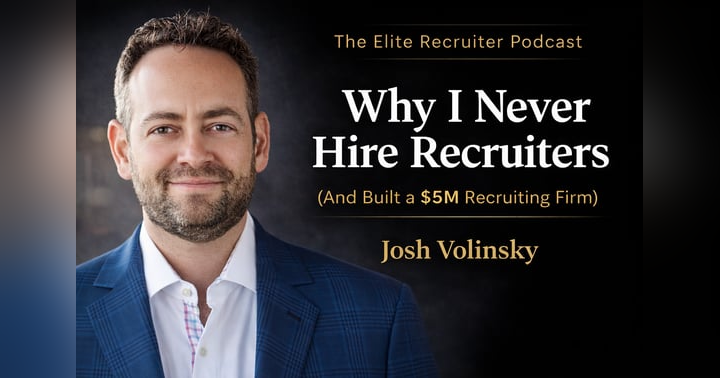
Why I Never Hire Recruiters (And Built a $5M Firm) | Josh Volinsky


Josh Volinsky never hired a single recruiter. No experience, no desk history, no cold call background — just accountants. And somehow he built a $5M firm where 7+ people billed over $400K in their first year.
That's not a fluke. That's a system.
Josh is the co-founder of Synergy Search and the former all-time single-month billing record holder at Robert Half — $259K in one month. He walked away from one of the cushiest books of business in the industry, started a firm above a liquor store and a Dunkin' Donuts, hit $2.7M in year one, and $5M in year two. Then the market shifted, their best performer passed away suddenly, and everything they'd built got stress-tested in the worst possible way.
This episode is the full story. The rocket ship. The crash. The rebuild. And the exact decisions — on hiring, culture, KPIs, and partnership structure — that separated Synergy Search from every other firm that tried the same thing and failed.
**What You'll Learn**
- Why hiring experienced recruiters actually slows your growth (and what to hire instead)
- The "day in the life" interview method that predicts top billers before they start
- How implementing KPI tracking turned a $700K quarter into a single $700K month
- The exact culture reset that took them from their worst quarter ever to their best Q4 in firm history
- Why splitting everything equally with partners — even when others called it crazy — was the secret to scaling fast
- The relationship-building system that took one recruiter from $400K to $850K per year
- What separates $500K+ billers from everyone else in today's market (it's one thing)
If you run a desk, lead a firm, or are thinking about going out on your own — this one's going to hit different.
**Timestamp Highlights**
00:40 – The moment Josh told his wife he was leaving Robert Half
05:19 – The $259K month that broke the all-time firm record
08:00 – Why they spent $25K before making a single call
16:21 – How following the non-compete forced their best BD strategy
18:49 – Doubling lifetime billings in one month after their first hires
22:13 – Full desk vs. split: putting people in positions to thrive
31:45 – The worst quarter in firm history and the breakfast that changed everything
36:57 – The 3 levers they pulled to reboot the culture
39:31 – How KPI scorecards produced three $100K billers in a single month
43:06 – The hiring blueprint: A-players only, and how to spot them
53:30 – What $700K+ billers do differently than everyone else
---
🚀 **Atlas** – AI-first ATS & CRM. Automates admin, syncs conversations, and surfaces insights instantly.
Try it free → https://recruitwithatlas.com
🎯 **This Is Your Year – Recruiter Summit**
https://this-is-your-year-recruiter-summit.heysummit.com/
💼 **Join the Elite Recruiter Community**
https://elite-recruiters.circle.so/checkout/elite-recruiter-community
🔧 **Tools & Links**
PeopleGPT Free Trial → https://juicebox.ai/?via=b6912d
Talin AI Free Trial → https://app.talin.ai/signup?via=recruiter
Pin Free Trial → https://www.pin.com/
Email Newsletter → https://eliterecruiterpodcast.beehiiv.com/subscribe
YouTube → https://youtu.be/raE6o8Ngtrw
Josh on LinkedIn → https://www.linkedin.com/in/joshvolinsky/
Benjamin Mena → http://www.selectsourcesolutions.com/
Benjamin LinkedIn → https://www.linkedin.com/in/benjaminmena/
Benjamin Instagram → https://www.instagram.com/benlmena/
Benjamin Mena [00:00:00]:
Are you still trying to grow your recruiting desk or business on your own? Join the Elite Recruiter Community and connect with recruiters who know your challenges. Members get unlimited access to replays from the AI Recruiting Summit, Finish the Year Strong, and all our past events, plus bi-weekly roundtables where we dive into sourcing, business development, and mindset. You'll also tap into our Billers Club for accountability and a split space to partner on roles. Join the number one growth environment for recruiters for just $49 per month.. You'll be part of a tight-knit group that pushes you to grow, and you can cancel anytime. Visit the link in the show notes and click Join Now to get started and start mastering your craft today. Coming up on this episode of the Elite Recruiter Podcast.
Josh Volinsky [00:00:40]:
But I do remember telling my wife, we were up in our bedroom in the hallway, and I just said, hey, this is happening. I just want to let you know I'm going to leave Robert Half next month. And she definitely cried and begged me not to, not to leave my you know, leave the cushy world of corporate America. When you build as successful as we had and do it as long as we have, there is a, there's no luck to it. It's, there's no, oh my God, this is why he got it. It's the little details that we were focused on from our references were better than anybody else. Our counteroffer conversations happened in the first meeting. All those little things that is very easy to make a placement without doing.
Josh Volinsky [00:01:20]:
We were obsessed with those details. Welcome to the Elite Recruiter Podcast with your host Benjamin Mena, where we focus on what it takes to win in the recruiting game. We cover it all from sales, marketing, mindset, money, leadership, and placements.
Benjamin Mena [00:01:42]:
You know, the resume never tells the full story. Candidates share what really matters during conversations, on calls and interviews, over email. Their motivations, salary expectations, plans to relocate. Most of that detail ends up buried in notes and forgotten. Atlas changes that. It's the AI-first recruitment platform built to eliminate admin. It captures every conversation automatically and turns it into something you can use. With Magic Search, you can ask Atlas questions like, who talked about wanting a 4-day week? Or who mentioned they're open to relocating next year? It searches across your entire database and pulls the answers instantly.
Benjamin Mena [00:02:16]:
No keyword guessing and no digging through old notes. You get insight from real conversations. Not limited resume fields. Atlas also makes BD easier. With opportunities, you can track and grow client relationships powered by generative AI and built into your existing workflow. If you want visibility, wait, smart dashboards give you a clear view of the pipeline across your business. And that's not theory. Atlas customers have reported over 40% EBITDA growth and over 80% increase in monthly billings after adopting the platform.
Benjamin Mena [00:02:45]:
It's built for agencies that want to grow without adding more manual work. Don't miss the future of recruitment. Get started with Atlas today and unlock your exclusive listener offer at recruitwithatlas.com. I am so excited about this episode because here's the thing. So many of us grow up in the recruiting chair. We started off with the big box, the huge global firms, but what's so special about this guest and his firm is every single one of their recruiters are industry professionals. And it's not just industry professionals. They've figured out how to get somebody with zero recruiting experience off the ground successfully.
Benjamin Mena [00:03:34]:
They've had 7— over 7 people on their team bill over $400K their first year in the business. How awesome is that? Something that is duplicatable and repeatable and able to help people win. And we're excited to talk about that. But here's also some of the crazy things. Their first year in business, they almost hit $3 million. But let's take a few steps back. This guest also, before COVID and things were crazy during COVID also held the record for billings, for one-month billings at a global firm. So anyways, let's take a few steps back real quick.
Benjamin Mena [00:04:12]:
Josh, welcome to the podcast.
Josh Volinsky [00:04:14]:
Thank you. I'm really excited to be here. I feel like I'm in recruiting royalty presence here.
Benjamin Mena [00:04:20]:
No, I'm with you. Like, you're pinnacle member too. Yeah. Well, anyways, quick 30-second self-introduction.
Josh Volinsky [00:04:28]:
Yeah. So hi, everybody. I'm Josh Walinsky. I'm president and co-founder of Synergy Search. We're a finance and accounting recruiting firm. We're primarily based in the Nashville, Maryland, and Texas markets, but our entire team, as Ben said, is made up of ex-accountants that we have taught how to be recruiters, and many of which are ex-CPAs or former Big Four folks that have decided to leverage their accounting background into a different way. Started the company during COVID in 2020, and majority of our work is permanent placement, but we do have a consulting group as well.
Benjamin Mena [00:05:01]:
That is awesome. I still like— that's so awesome that you guys have found a duplicatable way, and we'll talk about that, like your blueprint for success. But anyways, let's—
Josh Volinsky [00:05:10]:
okay.
Benjamin Mena [00:05:10]:
You were breaking— you broke the record for the best month ever at this large global firm. Was it a $259,000 month or something like that?
Josh Volinsky [00:05:19]:
Yeah. Yep. So at the time it was March 2019. I had never broken $100,000, but I came close multiple times. I was like $98,000 one year or one month, and I just went on a run. I had 14 deals close in March and it was amazing. I did $259,000 in that month and then went on to bill almost— I think it was $925,000 and the rest of the year.
Benjamin Mena [00:05:43]:
So, I mean, it's one of those things like you, you've hit your stride at this big firm. Like you've figured out how to just do it and you probably could keep on doing it. Like I gotta ask, like what made you finally, you're crushing it.
Josh Volinsky [00:05:55]:
Why'd you walk away? Yeah. Yeah. It was very difficult. And I'll tell you, there was a lot of stop starts with potentially leaving, but even from the early days, I knew I wanted to build something special. My partners would joke with me that even in 2018, and I would joke that I want to build a company and take everybody on a trip to the Caribbean. In each year. So, you know, every, every few years I would tease the idea of leaving and it just, it just for some reason it just never really got going. And thank God it didn't because it was, it, you know, it takes the right people and the right group, right timing to make it work.
Josh Volinsky [00:06:29]:
And, you know, in 2020 that ultimately came together.
Benjamin Mena [00:06:33]:
So, but yeah, I, I gotta ask, so you made the decision, was it July 31st, was it 2020? You went and talked to your wife.
Josh Volinsky [00:06:42]:
How did that go? Yeah, so I don't remember the exact moment where it became real, but I do remember telling my wife. We were up in our bedroom in the hallway and I just said, hey, this is happening. I just want to let you know I'm going to leave Robert Half next month. And she definitely cried and begged me not to leave my, you know, leave the cushy world of corporate America. But once she realized that this wasn't a, stop-start thing like it had been over the last X amount of years. She, she became fully on board and, knew that it would, it would succeed. And she even came up with a name, Synergy Search. We were sitting, sitting down and we're tossing names out for that first couple weeks when we were going back and forth with my business partners.
Josh Volinsky [00:07:27]:
And she's like, oh, how about Synergy Search? And that just took. And I've got two kids. I had an 8-year-old and a 4-year-old at the time. I had the mortgage, I had the daycare, you know, walking away from a job where I was making really good money and pretty, pretty turnkey book of business was pretty scary. But at the time, just nothing mattered. I was totally at peace walking away from that book of business, and I didn't really even care who would pick it up or, you know, what would happen after that. I just became obsessed with making that happen.
Benjamin Mena [00:07:56]:
And like before you guys even launched, you guys spent $25K. Like most people like launch and spend like $1,000.
Josh Volinsky [00:08:04]:
Yeah, we each put in, that amount actually. So it was a little bit more than that, but certainly a little overkill from what it was at the time. But we really knew that we wanted to build it the right way and we had to have an executive level presence to compete from the beginning. You know, we didn't, we didn't need a CRM, we didn't need the website to just go off and start it. But thank God we, you know, had that entrepreneurial mindset to think ahead and did it right from the beginning. And also when you do a startup, you know, you can certainly act upon desperation and, hey, we got a bill, we got to make this happen. I just walked away from a, you know, a really nice job, and here we are on September 1st. But because we were not desperate, because we slowed down and made sure we build the right foundation from the beginning, it ended up working out.
Josh Volinsky [00:08:50]:
So because I couldn't imagine having to build out CRM— of that, we use Bullhorn— I couldn't imagine programming that like we had to while at the same time needing to go find job orders in a new market due to a non-compete and all the other things that come with it.
Benjamin Mena [00:09:05]:
Yeah, amazing. So actually, let's, let's take a few steps back. Let's go back in time. Sure. How the hell did you even end up in this place? Because you were an accountant yourself.
Josh Volinsky [00:09:13]:
Yeah, no, absolutely. So I graduated in college with accounting, as you mentioned. I started working at a CPA firm. My dad is in sales. I grew up around him being on the phones at dinner and, you know, driving places, he'd be taking calls. And I did telemarketing and I sold Cutco knives at the end of high school and did telemarketing throughout college and just loved that part of it. And when I started looking for a new job, the recruiter ended up asking me, you ever think of doing recruiting? And the rest was history. I, you know, I was never the technical accountant, although I did pass the CPA exam, which was cool, but I just worked really hard at it.
Josh Volinsky [00:09:51]:
And then I think 3 weeks later I moved down from Rochester, New York, where I'm from, to a brand new city in Baltimore, Maryland. Didn't know anybody, had no idea what I was about to get myself into., and, uh, the rest is history.
Benjamin Mena [00:10:03]:
I, I gotta ask, as an accountant, like, you, you did have a background, a little bit of sales, so I'll give you that one. But like, you're sitting there in the accounting chair and then you're now in the recruiting chair, which is truly a sales job. Like, how hard was it to flip the gear into the sales world?
Josh Volinsky [00:10:22]:
So for me, I felt like I hit the ground running. I mean, I remember my now business partner jokes with me that the first day I was in work, this is 25-year-old, I couldn't imagine imagine having to manage me. But, you know, 25-year-old kid saying, hey Gary, I can help you close that deal, because he was trying to close the deal. So I mean, for me, I really got spoiled by, you know, I think I averaged around $33,000 a month from the first 8 months. So from April 20, 2008 to— it was 2007, 2008, sorry, to, you know, it was 2007. So April 2007 to December. That December I had my first $60K month. And then I'll never forget the clock turned or the calendar turned and I was skiing in Killington on a chairlift and my boss told me that a candidate had resigned on day 80 and didn't give notice.
Josh Volinsky [00:11:14]:
So we ended up having to have my first fall-off and then the market just completely changed. So I saw the good, I saw the bad early on, and I'm actually grateful that I did see both.
Benjamin Mena [00:11:25]:
And Okay, so fast forward, like, you, you were at this large global recruiting firm for years. Like, yeah, like, why'd you stay for so long?
Josh Volinsky [00:11:36]:
Yeah, I mean, the people, for the most part. I mean, all of it was the people. I really enjoyed my team. I was very successful. Naturally, you know, you build up a book of business and there's always future AR that you're owed, or from billings, or, you know, you don't want to lose the clients that you've, you've built up. And that non-compete is scary start over, but it got to the point where it was okay.
Benjamin Mena [00:11:59]:
Like, I just didn't care. So one of the hardest things when you are looking at starting a business, and especially if you're looking at starting with a partner, is choosing the right people. Yeah, because this is almost as legally binding as a marriage. Yeah. Like, how did you know that your two partners right now were the ones?
Josh Volinsky [00:12:25]:
I think that's a really good question and probably one of the most important decisions that I ever made and the reason that we're as successful as we are. I got a lot of flack for, you know, why would I go and leave a job where I'm getting, I think it was like 40%, to go to a place where I'm making less, you know, been splitting everything with my partners. And I just didn't care because I knew to build a business, to build a real business, you had to, one, treat it like a marriage where everything's equal, right? And two, you had to have different pieces. I couldn't have three of me starting the business. It would never even come close to the amount, to the success that we've had had it not been for the other two guys. And then you add on, we had a pretty early on employee that we hired and she was part of building, setting up a lot of the different things that we hadn't had, a lot of different ideas. So when you kind of put the four of us together, it bred for a lot of success. But yeah, you have to have the right people without question.
Benjamin Mena [00:13:29]:
Like, how did you know? Because I've seen a lot of partnerships like sink ships.
Josh Volinsky [00:13:34]:
Yeah, for sure. I, I guess part of it I got lucky. Part of it I was really good friends with the two people. I couldn't imagine doing it without them is part of kind of my mindset. It wasn't even, it wasn't even, oh my God, I gotta start a business with these two people because of these, this quality that they have. It was, I just want to go somewhere where I can build something special and love what I do with people that I love doing it with. And I had a vision of, okay, well, the one guy is, is he's the CEO type. He's the guy that's just that back office guru, the one that's going to keep us out of jail, all those little things.
Josh Volinsky [00:14:08]:
Like, and then the other guy was a really good developer and trainer. And obviously, you know, had worked together directly for the last, I think it was 5 years. So we did a lot of things in a similar mindset. And when you put the 3 of us together, it really balances everything out. It's very rare where both me and, say, Mark agree on something every time and Gary doesn't. Any number of the, the 3 of us working together, it definitely makes it work. And if it was just me and one other person, I don't think we would have it as smooth as possible as it has been, because it's— if it's me versus one other person in decision-making, I can imagine that that's a lot more difficult. But it's nice to have that, that intermediary third person kind of make, make, uh, their points.
Benjamin Mena [00:14:59]:
So these are people that you've got to see for years. Yeah. What they did, how they acted, how they— when the shit hit the fan, Times were good. So like you had that background with him.
Josh Volinsky [00:15:12]:
Mm-hmm. Yeah. I mean, Gary was the first person I ever met when I came down to interview. He met, he came to, uh, to meet me on that Saturday when I came down in the middle of busy season to, to Baltimore.
Benjamin Mena [00:15:21]:
All right, well, let's jump back into like the, the first month. You guys, you guys made the decision, you guys started building. What did that first month look like for the, or first month or two look like for the three of you?
Josh Volinsky [00:15:34]:
Yeah. So, uh, like I said, the first month we really didn't focus at all on going off and getting job orders. We were second-guessing everything. We're sorry, where do we go? What market do we work on? Once we just kind of figured out all the back office stuff, building the website, setting up Bullhorn, all that, we ended up just going gangbusters in the Nashville market and it really just took off. And we did about $250,000 in the first 4 months. So from our first month— so sorry, on October 15th, it was about 45 days in, we made our first placement and then it just felt like a rocket ship from there.
Benjamin Mena [00:16:12]:
So $250K billings for you guys in the first few months. Like, what were you guys doing? What did that initial BD look like for you guys? This is a brand new company, this brand new organization.
Josh Volinsky [00:16:21]:
Yeah. Yeah. One of the best things that happened to us was that we followed the non-compete because it forced us to get scrappy, forced us to go and just get back to the basics. And a lot of times we were coming in late on searches because we didn't have the relationships, we didn't have really anything. And we're sitting here above a liquor store and a Dunkin' Donuts. In the middle of Maryland calling into Nashville. And these people were just so impressed by our speed, our quality of candidates. When you build as successful as we had and do it as long as we have, there's no luck to it.
Josh Volinsky [00:16:55]:
There's no, oh my God, this is why he got it. It's the little details that we were focused on from our references were better than anybody else. Our counteroffer conversations happened in the first meeting, all those little things that is very easy to make a placement without doing. We were obsessed with those details, even to the point where one of our clients— I'll never forget, we had made a placement of a controller with a company down in Nashville, and the guy— we closed the deal and the guy's like, hey, listen, just want to let you know, you guys are very impressive. You're going to make major, major waves in this market. And, you know, I'll never forget that.
Benjamin Mena [00:17:33]:
So the early confidence, you guys outperformed everybody and it really just started taking off like a rocket ship. So your first year, you guys almost landed where number-wise?
Josh Volinsky [00:17:44]:
So I think we did 2.7 our first 12 months at 2021.
Benjamin Mena [00:17:49]:
And how many people did you guys have by the end of that year?
Josh Volinsky [00:17:52]:
End of the year we had, so we added 4 more that year. So it would've been 8. We had 8 people at the end of the year.
Benjamin Mena [00:18:00]:
So why did you guys like go hire like as many people as you did? That's like massive.
Josh Volinsky [00:18:06]:
Like you guys, that's a risk, especially like so new. Yeah. Our mentor, we were sitting down for a brunch with one of our mentors who had been a business owner and whatnot, and it was December of 2020 and we're like, hey, we're going to bring these 3 people on in January. We had built $250K and we're like, oh, we're amazing. And he's like, you guys are insane. You're going to go and bring 3 new people on when you just started. And thank God we did, and we hit early, because had we not hit early, I can see— because later on we can get to it, we had some bad hires. But we were very fortunate to have found the right people to start the business with, and, and the first few hires really took off.
Josh Volinsky [00:18:49]:
Our— so they started at the end of January, and that February We had billed $250K already just in that month and the one guy did $60K. So like we had already in one month of hiring, we doubled our lifetime billings and it just went off from there.
Benjamin Mena [00:19:07]:
Okay. So, and for the listeners, like these hires, these people weren't recruiters, right?
Josh Volinsky [00:19:12]:
No, no. So the one guy had done business development for a CPA firm, but everybody else was a true accountant.
Benjamin Mena [00:19:22]:
Never did recruiting. So often I get messages from people like, hey, like, I'm looking at like hiring somebody and I'm always just like, I'm probably not the best person for this. Like, I'm looking at hiring like industry professional professionals. Like, yeah, I don't know if it makes it work. Like, should I look for a recruiter? But like, you guys didn't want to even touch recruiters, right?
Josh Volinsky [00:19:41]:
Yeah, we, we think that it is difficult enough to learn how to be a recruiter that when you don't know how to sell what you're selling or the market you're in, it makes it even more difficult. If I don't know what an accountant does or what a consolidated financial statement is or any of those types of things that you come up against every day, then it makes it a lot more difficult. Plus it adds a lot of credibility to it. And you're not teaching somebody that, you know, reteaching bad habits that somebody might have picked up at a firm where it just— the details and the level of, of hustle was not, not the same as what we were trying to build.
Benjamin Mena [00:20:16]:
I gotta ask, like, I, like, you shared with me the blueprint of success that you guys now use. So amazing. But those early days, like, how did you train these people to be recruiters while at the same time having to do everything that you're doing with a new startup?
Josh Volinsky [00:20:30]:
Yeah. So it starts with, I think, how we were structured and, uh, we wanted to build a, a company, like a true company where it gave people a vehicle to go and love the, the game as I call it, the way we did. Make stupid money and have a lot of fun, right? And if we had built the business where me, Mark, and Gary were eating what we built, we build ourselves, we would've never had time or we would've never put as much emphasis on the development because I need to, I need to bill myself. It allowed us when we split everything equally, as we talked about earlier, to really allow me to go and help train or help have Mark go and do, do the website or go, you know, Gary set up the financials or whatnot. So that was a, a really big impact. We actually, there's a story, there's a friend of ours that had started their firm the exact same day we did, and they thought we were crazy by splitting everything the way we did down the middle, especially the difference in our success at the old place. And they never really grew. They never really hired anybody that made it.
Josh Volinsky [00:21:34]:
It was just kind of case study that we're pretty proud of.
Benjamin Mena [00:21:38]:
And let's fast forward, like you're looking at the second year, like second year of business, like What were you guys looking at?
Josh Volinsky [00:21:44]:
Yeah, so the second year we doubled another— we had added another 4 people that, you know, were pretty incredible, many of which are still here today. I think we did just over around $5 million in that second year, $5 million, and, uh, it just was going gangbusters.
Benjamin Mena [00:22:04]:
So were your recruiters like these accountants that have turned recruiters Were they doing 360? Were they like kind of split between account manager and recruiter?
Josh Volinsky [00:22:13]:
Like, how did you train them up? Great question. So we were 360 full desk, but one of the— another reason that it worked was because we wanted to put people in a position to thrive with what they love to do. That's very important to us. We— the first person that we brought on, Kara, she was an incredible recruiter. I would get off a call for a SaaS controller down in I think it was North Carolina. And within an hour, I had the person who ended up getting the job and was still one of my favorite placements to date. And we let her do that while we were still able to bring in business for her. And then at the same time, because she was so good at building relationships and keeping in touch with people as well as making the match and doing recruiting, the people ended up coming to her when they needed to hire.
Josh Volinsky [00:23:01]:
So by setting it up with 360, not forcing anybody to do anything they're not comfortable, but really pushing the impact of how important it is to get job orders, especially in this market, which we can talk about later. It really works. Another example, we have contact ownership. So as an example, if Kara placed a controller with one of my, my clients and that— who's the best person to end up helping that controller find a new senior accountant? It'd be the person who has had the relationship with her and was working with her. And it just allows people to start up a little quicker.
Benjamin Mena [00:23:34]:
From that perspective. And I know we're going to talk a little more about her a little later on, but sure, one of the things that you told me in the pregame when we sat down is the sales, like, wasn't her focus. Like, the recruiting was her passion. She brought in more job orders than pretty much anybody else. Yeah, for the company. Like, when you talk about strong relationships, what was her secret?
Josh Volinsky [00:23:54]:
What was she doing? Yeah, it was incredible. I mean, and not only was she the one that had the most job orders, It was cringeworthy to listen to it, but somehow she ended up billing and closing the deal and people loved her. Like, it was, it was, was wild. But, but yeah, I mean, her secret sauce was connecting with people. She did an amazing job connecting with people and she would constantly be in touch with them one way or the other, whether it's an email, whether it's LinkedIn posts, whether it's just calling us to say hello and talk about kids. She even, she even wanted us to add a section in Bullhorn where she could put people's birthdates into the system so that she can email them on their birthday. Like, it was that important to her to have real relationships. And she really just became— at first, like I said, she was not good at all on the job order side.
Josh Volinsky [00:24:44]:
And, and we just were like, okay, if you get a lead or do something, you know, we'll, we'll take it from, from there and we'll help you out. We'll, we'll give you something, you know, give you a flip credit or whatnot. And, you know, it, that worked for a while and she would start listening to us do job orders and then ultimately she just got the confidence and it just started humming for her. And that's really when she went from a $400,000 or $500,000 biller to, I think her last year she did $850,000. Wow.
Benjamin Mena [00:25:11]:
That's crazy. Yeah.
Josh Volinsky [00:25:12]:
So, so you, okay.
Benjamin Mena [00:25:12]:
And so you guys were just going gangbuster. Everything was working. Yeah. You guys were riding a high. Looking back in time, you had this incredible second year. Like what did you think was gonna happen year number 3?
Josh Volinsky [00:25:22]:
At the end of year 3. Yeah. I mean, we thought we were unstoppable. Yeah, we thought we were going to, you know, grow. We made a contest that, hey, if that next year we do $6 million, we'll take everybody to Cabo. You know, it was, it was nobody had expected things to kind of some of our flaws of how we set it up, which we can get into as well, to kind of shine through so bad when you take away the market that we had in 2021, 2022. The golden era of recruiting is what I— yeah, yeah, it was incredible.
Benjamin Mena [00:25:54]:
But that golden era crashed.
Josh Volinsky [00:25:56]:
Like, what happened at the firm? We had a lot of people that we hired that started in that golden era, so era. So it was, you know, the market was so easy that they almost had to just be playing whack-a-mole all the time with, okay, I gotta, I gotta fill these job orders, I got a job order here, I got a job order here. They're so easy to get that it became very transactional and they— we weren't having to really scrap like we did in the beginning, beginning for job orders through ad calls, lead chases, constant follow-up, all the things that we're doing back and got better back at again now. But we would literally just send off an email blast and we'd have multiple job orders. So you have— I'm sure you're aware, and I think it was early 2024, the email Spam rules changed and all of our emails just dried up and went to spam and became a major halt. Some people couldn't adjust to that at all. And you know, others that could really have continued to thrive and probably be better for it.
Benjamin Mena [00:27:00]:
And if, and I know that you, we chatted about this in the, in the pregame, but if you want to, listeners want a funny laugh, guys, like Josh was waiting for me about 20 minutes and we started late because I think all my emails went to spam. Yes, exactly.
Josh Volinsky [00:27:14]:
We're like, uh, I hope he's okay. I was assuming you were closing a deal or something. Unfortunately, I, it was, I don't know where, where he was sitting there waiting for me. Like, what is this guy doing?
Benjamin Mena [00:27:23]:
Yeah. I thought you were closing your deal. So there we go. Yeah. Well, okay. So like, but you, before you guys like this whole email thing changed, like you guys stepped back and like, hey, we need to start working on the relationships. Can you talk about the realization of that?
Josh Volinsky [00:27:37]:
Like how you had to start teaching that? Yeah, so we had a pretty weird 2024. So like I said, the email campaigns dried up, and then some of the people that were just thriving had a really hard time adjusting, mixed with, from a leadership perspective, we had made some, some hires that just didn't go as well as we had hoped. We were less involved in everybody's deals because we weren't doing it as much as you normally would have liked to see. We were so focused on developing the people that our stop-go of the flow of our leading by example was a big problem. So we really— all those factors really came to a head. And then we lost a really important player or part of our, of our company. And luckily, when we actually lost two that same day, and one of them came back like a week later.
Benjamin Mena [00:28:33]:
And, you know, when we're sitting there talking about a bit of a downturn, like, how bad was this downturn as a hit for you guys?
Josh Volinsky [00:28:39]:
Yeah, I mean, it wasn't awful. I mean, we were definitely down, you know, half a million dollars that year or something like that. It wasn't anything crazy. And the reality is we kept getting told, you know, we're down 30, 40% and you guys are even or you guys are down a little bit. So we felt like we were good, but it it, and we had just won, I think, Inc. 5000 based on our production from 2021 to 2024. So the first eligible year that we could, we were in like the top 3,000 of company growth. Thank you.
Josh Volinsky [00:29:10]:
But it just, it came at a time where it felt a little bit phony just by nature of the, the dip that we've been having. People weren't working together again, you know. We also, one of the big factors that was probably a part of the formula for, for a little bit of a setback was our non-compete was over. So we thriving. Everybody's working in Nashville, everybody's working together. And then we ended up hiring some folks back in, in the Maryland area to recoup and rebuild that business. And I ended up shifting gears yet again to come back to Maryland and work that client base. And between the stop-go and then I wasn't doing as many deals with some of the team down in Nashville, so I lost a little bit of touch there, which, you know, is never good from a culture perspective mixed with when it's harder.
Josh Volinsky [00:29:55]:
The job sucks. Like, let's be real, when there's nothing worse in this job when you're not billing or you don't have something to be excited about or a purpose.
Benjamin Mena [00:30:05]:
And it takes weeks to get out of that. Oh man, that momentum, like momentum works both ways.
Josh Volinsky [00:30:14]:
Yeah. Yeah. It's, uh, that flow is so important.
Benjamin Mena [00:30:17]:
Now, when you said like the non-compete ended and you started focusing on the Baltimore market, Baltimore, DC market. Did that really just split your focus and that, like, how much of an impact do you think that made?
Josh Volinsky [00:30:27]:
Yeah, it made an impact. I mean, at first it was great and it still is great. We're still, you know, doing a great job in the Maryland area. I mean, it is, it's tough in any time in anything you do in sales to, to have that, that stop-go and gear shift.
Benjamin Mena [00:30:42]:
You said like the culture was having some issues or was breaking down a little bit. Like looking back now, like what did you miss?
Josh Volinsky [00:30:51]:
So what's funny is I think that a lot of A-players, like what we were hiring, and they really want and thrive on accountability. And we had built the company where it was very entrepreneurial. We're not tracking activity, you know, just go bill and have fun and love life, but work hard. And when you work hard and play hard, it worked. But when you're taking, you know, when a recruiter gets past that first year and specifically into that second or third year, it gets a lot more things coming to you, which means that some of the things that you did to get there in that first year, you can still make placements without it. And, um, you know, it, it all kind of came to a head.
Benjamin Mena [00:31:33]:
So I know, like, if you're drawing a line in the sand, like, hey, we're going to be accountable now, like, how hard was that to, like, try to shift the ship and implement?
Josh Volinsky [00:31:45]:
Yeah, so in August of 2025, we had just come off of our worst quarter we've had in a long time. We were shrinking. We didn't have any new, no new fresh internal recruits that were bubbled up. And we knew we needed to change something. And we just sat down as owners. We were actually at a wedding for one of our colleagues in Milwaukee, and we went to breakfast that day and we were just got real with like, hey, this is what we need to do. This is why we need to do it. This is how we're going to do it.
Josh Volinsky [00:32:19]:
And quite frankly, if, if it— if people don't like it, we knew it would be for the best of them. But if they didn't like it, for example, we needed to get people— we had a situation where some people were coming in every day, some people were coming in a couple of days a week, some people would randomly come in, randomly not come in, some were fully remote. So we needed to really get some structure back into the business. And it just worked. I mean, we went from— I think it ended up being around 25 per person PDA, if you're familiar with that term. We went over 35 and had our best Q4. I think that next month we did it, we had more than we did in the entire Q3. So it was, it was, it was really wild to see.
Josh Volinsky [00:33:02]:
And people started having fun again. People started really enjoying what they were doing and working together. To build specifically to build something cool again.
Benjamin Mena [00:33:11]:
Sorry. So you guys literally had like one of your worst quarters ever.
Josh Volinsky [00:33:15]:
Yeah. Yeah. I think we did like $600,000 or $700,000 in the entire quarter, maybe $800,000. And then we build pretty much that, that next October.
Benjamin Mena [00:33:25]:
And was it like moving the ship, implementing all this before everybody started having fun again?
Josh Volinsky [00:33:31]:
Did you guys get a lot of pushback? Honestly, when we people were asking for it in some respect. Like, nobody was really upset about it. And I think everybody knew the reason why we were making those changes. And it just— the— when people started seeing the results of what was going on again, it was pretty clear the direction forward.
Benjamin Mena [00:33:55]:
I'm going to be honest with you. I really believe that 2026 is your year. I truly believe in you. I truly believe with everything in my heart that this is the year that you can own it. This is the year that you can hit your dreams. And to help you do that, we are kicking off a summit called This Is Your Year. You are elite. You were born to be elite.
Benjamin Mena [00:34:19]:
You were born to be the best. You were born to be the greatest. And I'm pulling together some of the industry's best speakers to help you get there. Going to be kicking off April 27th. You do not want to miss this. Make sure to run to the show notes, get registered. All the live sessions are free. I'm bringing in Mike Williams, Brianna Rooney, Mark Whitby.
Benjamin Mena [00:34:40]:
We have an entire week of stacked speakers that are going to help you achieve your dreams. This is going to be the industry event that you do not want to miss. I believe in you. I believe in you so much that I'm pulling the best to help you achieve your dreams. 2026. Is your year. And prior to all this, like you guys also had something tragic happen.
Josh Volinsky [00:35:06]:
Yeah. So that same, I mean, it's all part of the same thing. That same year, Kara, who I talked about earlier, she ended up passing away suddenly in January. I think it was literally a year ago today when we're filming this. So just came off of, you know, an $850K year, things were great. And then she woke up with a headache and told her husband, hey, I'm not feeling good. And then I think she was helicoptered out to the to the hospital and she passed away pretty quickly after that. And she was pregnant.
Josh Volinsky [00:35:36]:
She left behind some kids or a 3-year-old.
Benjamin Mena [00:35:39]:
So it was really tough. And you guys, like, from looking online and doing some reading, like, you guys raised money.
Josh Volinsky [00:35:48]:
Like, what kind of legacy did she leave for the farm and with you guys? I mean, she was an incredible connector. I mean, still to this day we talk about her. I, you know, we— one of the things that we did you know, throughout was really driving mentorship and team-led mentorship. So we would have different people on the team from Kara to the newest hire come in and speak on a random Friday about what they do, what they're struggling with, you know, any sort of mindset. And one of Kara's presentations, one of those days was about mindset. And, you know, we still really kind of embody the way she was so positive and all the affirmation stuff that she was, she was really big into. But she built an incredible book of business. And there's still to this day people are just to know who she is.
Benjamin Mena [00:36:36]:
So, man, I'm definitely like so sorry to hear that, especially for the family and everything. And yeah, well, and you know, looking at when you guys had to rebuild, you guys drew the line in the sand, you guys started having accountability. You know, what were the first like 3 levers that you really started pulling to make for the shift to actually magically happen?
Josh Volinsky [00:36:57]:
Not magical, but actually happened. Sure. Yeah. When we were growing together, we were adding about 4 people to the team a year. And then, like I said earlier, through September of that 2025, we hadn't added anybody. We were actually shrinking. And for this first time, we really saw the cost of not continuing to grow and how that impacted the team. After the reboot, as we call it, we've actually hired 2 more people in just one quarter, and it's already been a dramatic improvement.
Josh Volinsky [00:37:25]:
You know, we also had, you know, those two people, I mean, one of them did $65K in Q4, which started in September. So doing really good. And then the other guy started in December and has already brought in a couple of job orders. And it's really cool to see that it wasn't necessarily how we, how we teach it. We would— we just needed to find the right people.
Benjamin Mena [00:37:49]:
Yeah.
Josh Volinsky [00:37:49]:
And then—
Benjamin Mena [00:37:49]:
sorry, go ahead.
Josh Volinsky [00:37:50]:
No, go ahead. Go ahead. Yeah, it's just there's a clear line of— the other big part of this is in this market in 2025 and beyond, I think there's a clear line of if you can bring in job orders, you are dramatically ahead of people that cannot. While we allow full desk, while we still want to put people in position to do what they love to do, I think the conversation that we're constantly having and pushing, for example, the new people, it's like, hey, I know this is hard. It's not meant to be easy., but you just gotta keep trying and it'll come. And to see that all take, take shape 2 weeks ago as they started getting in job orders and seeing how happy they were and kind of how it all just kind of trusted the process, it's been incredible. And there was a clear line between the people who were billing $500K or more in 2025 and those that, that were under $300K.
Benjamin Mena [00:38:40]:
It was purely a job order game. When things were the wild, wild west compared to where they are now, You guys weren't tracking numbers, right?
Josh Volinsky [00:38:50]:
Correct. Yeah. Another major miss that we had. You know, we had no idea how many sendouts it took to make a placement. We hadn't— we had a guess somewhere 8 to 10, but to actually be able to force tracking those KPIs that are so important, whether it's job orders you've gotten, sendouts you've had, candidate interviews, they really— that September when we were actually able to use and trust the data. I sent out a monthly newsletter that shows, all right, this is the scorecard, these are the top billers, any highlights of, you know, all-time highs, stuff like that. And, um, you know, I also added on the ratios and how that impacted it. For example, hey, it took this person 10 sendouts to make a placement.
Josh Volinsky [00:39:31]:
Each job order that was brought in was, you know, $15,000 of GM in your pocket, stuff like that. And, you know, it really just was so visually appeasing to the team, even to the point where one called me up after that came out and he billed, I think, like $140,000 that month. And that same month we had 3 $100K billers after implementing these metrics and having accountability and all that. But he calls me up after having this monster month being number 1, and he saw the metrics and he's like, it took me way more sendouts than the next guy. Like, we need to fix that. I need to get better at that. And it's like just seeing that was just wild to me. And it's That's just part of what makes it so, uh, so interesting.
Benjamin Mena [00:40:14]:
I think that's amazing. Like, yeah, I just had my best month ever and I want to figure out how to get better.
Josh Volinsky [00:40:18]:
Yeah, I mean, that's the mindset. That's culture, right? Yes, correct. Yep. You have to constantly— and we can, we can speak about this later, but yeah, I mean, you, you have to be always— yeah, you have to have the mindset of always wanting to grow, always wanted to be mentored, always want to give back and be a mentee, if that's the right version of the mentorship word. But I mean, yeah, it's so important. I mean, I'm learning things. I'm almost 20 years into the business and I'm still having deals that I never experienced before.
Benjamin Mena [00:40:51]:
So two questions on that. First of all, first question is, I know you're a brand new Pinnacle member, Pinnacle Society member. Is there anything that you've learned from that group that you've taken away that have implemented in your business?
Josh Volinsky [00:41:03]:
Yeah. So talk about mentorship. I mean, to be around a group of people like I get the privilege to be around that have had the success that they've had and to be in that room is just incredible. I mean, that's where we met. They, the amount of people that were interested in what I was doing or what we were doing as a company, I was just expecting a ton of egos, a ton of, you know, you know, really egos. And it was the exact opposite. We learned a ton of different things when you start a business and you go off and break away from corporate America, you really are only in your little bubble and that's all you see. So to be able to have a place like Pinnacle where I can get an idea— like this morning, I was on a call with Pinnacle owners and, you know, I come to find out that you're supposed to spend about 7% of your, your top-line revenue on your tech stack.
Josh Volinsky [00:41:54]:
And I sent a message to my colleague, I was like, what are we spending? Are we around this? And it was, it was just that idea was, was was, was incredible to learn about. And then obviously the technology that we've implemented, I mean, it's crazy how fast our tech stack got outdated that we thought we would build this incredible tech stack when, you know, day one and, you know, 5 years later we're revamping our website, we're adding a bunch of new software, we're getting into AI, learning how to figure out how to make our people faster, better, more efficient and effective and take a lot of that thing, the admin stuff or the stuff that they're doing every day that they can repeat and automate.
Benjamin Mena [00:42:34]:
And building automation for them.
Josh Volinsky [00:42:35]:
If you guys like found a favorite AI tool? Yeah, I'd say Pin right now is one that I'm the most excited about.
Benjamin Mena [00:42:42]:
I just, it really speaks to me. Awesome. So I'm kind of curious and I wanna jump back to hiring people because, you know, there's a lot of times people look for recruiters. What has actually been your secret to unlocking this like full desk speed of these people learning the industry and just like incredible gangbuster out of the gate, like, oh, job orders and placements. Like, what's the secret?
Josh Volinsky [00:43:06]:
Like, you gotta share this. Yeah. I think it's the people that we hire first and foremost. I mean, one of the best things I talk about having the different viewpoints from the different partners. In the beginning, we just needed bodies. That's all we needed. I needed, I just needed some help, right? We just, that's, and we'd come from a place where you get these big box staffing firms where they just hire bodies as well. You get, you know, one that sticks and you hire 10 and and like I said, one of them stick.
Josh Volinsky [00:43:32]:
So we knew what my business partners were very, very adamant that we only hire A-players. We only hire people that have had immense success in whatever they were doing, had the personality, and, you know, that we could want to develop, and that A-players breed other A-players. I mean, people were hitting $50,000, $60,000 months very early on in their time here. Now, granted, it was a great market, But it's still— there's— you can't take anything like that away from anybody. I mean, that's, that's a great month for a brand new person who's never done recruiting and just came off of a desk doing journal entries. There was that. Our interview process has, from the beginning, involved the three of us together as a group. And then, you know, we expanded out in a lot of cases to the team, both from a culture fit and just an opinion.
Josh Volinsky [00:44:23]:
And then the biggest sign of if we want to hire somebody, we do a day in the life session where, you know, we walk them through our software, we walk them through how we do things, and it's very easy to tell how engaging that conversation is and how they're going to be to train. If, if I want to walk out of that meeting and I want to run through a brick wall with that person and they want to do the same, then we're hiring them. If they're asking great questions, if they're engaged, that is the best sign ever. It doesn't mean it's perfect, but certainly it's, it's for us to be able to bring somebody into the circle, we want to be able to give them everything and be able to develop them and really take a lot time with them. And, you know, that's, that's one of our kind of compasses to make sure that we do that with the right people.
Benjamin Mena [00:45:08]:
I love that.
Josh Volinsky [00:45:09]:
Accounting is definitely not a sales world. You'd be surprised.
Benjamin Mena [00:45:14]:
Accounts can party. Partying is different. They're banging out phone calls.
Josh Volinsky [00:45:17]:
Come on.
Benjamin Mena [00:45:18]:
I know you're right. Is there, is there like a question that you guys have used that maybe that you could share that has more just been like a separator between like, okay, maybe this is somebody that'd be a great recruiter versus somebody that isn't?
Josh Volinsky [00:45:31]:
I wouldn't say there's a question. We are more of the approach of this person has to sell us on why they're a fit. I actually listened to an event that Mike Williams, who has been on the podcast before, had led, and he's— he was dead on with how he said it. He said, you know, most recruiters are all about selling somebody and wanting to come work for you. And in the beginning, we did a lot of that. That. And all of a sudden it just shifted to, hey, make them do the follow-up, make them almost beg to come work for us. Because if they can't follow up with us, if they can't show that initiative and hustle, then they're not going to be making 8 phone calls to somebody they've left voicemails for the last 10 weeks.
Josh Volinsky [00:46:16]:
It's really probably more along that, and then just making them really dive into the mindset, like tell them all about the uphill battle that they're about to experience. And on the other end of that is, is just an incredible opportunity, an incredible organization, we hope, incredible job that's really given us a lot. And we really are trying to build something, like I said earlier, that, that can be that vehicle for people to just thrive.
Benjamin Mena [00:46:43]:
You said earlier also that you didn't build this to extract— you built this because you love it.
Josh Volinsky [00:46:50]:
Like, what mean to you? Yeah, it's the same thing of how we make our comp plans. I mentioned earlier that the first year we took everybody to Cancun as a whole company. You know, it's, it's not about, yeah, can I make an extra X amount of money? It's about, hey, do I love what I do? Can I be myself? Can I goof around at times and get serious at other times and do this with people that I genuinely like? That are equally as much of a badass as we want to build and, and are worthy of, of talking to clients and building a book of business with. And we wanted to build our comp plans that way. We wanted to build our benefits. We got benefits 8 months into the company. Nobody does that as a startup.
Benjamin Mena [00:47:35]:
Stuff like that. You know, recruiting is super easy to fall out of love with. It's great when you're billing. It just feels so good when you're billing good good when you're not? Like, but how do you— you know, you're— you got a great background, you can build, you can work hard, so can your team members or your, your partners. But how do you keep your team in love with a game?
Josh Volinsky [00:47:57]:
Yeah, yeah. I mean, that's part of what we had a challenge with in that, that down spell here. You know, when there's not a purpose and you don't have a job that you're super excited about, or you're not, you're having a bad couple of weeks, it just snowballs the wrong way. So, I mean, we talk about mindset at any given month because we have, you know, the amount of people that we've built the company to. Somebody's down any given week and somebody's up any given week. And the ability to not be alone and have had and work around people that have all been there, done that that, whether you're brand new and you're like, where do I even start, to, hey, I'm not satisfied with my $800K month or year, and, you know, I'm disappointed and frustrated and whatever. You know, it just— it's speaking openly about the mindset of that and then how to get out of it is, uh, is really what we try to do.
Benjamin Mena [00:48:54]:
Now, with what you guys have done in the rocket ship that you guys have had, and then the having to like a little bit of a crash and then rebuild and rebuild back up. What's the number one piece of advice that you would give to somebody that everything's riding high? We all know that not all rocket ships last forever. Yeah.
Josh Volinsky [00:49:13]:
Like when, when, go ahead. And I'll, I'll answer your question, but real quick, the, the, the word rocket ship made me think of something. On my first birthday in business, one of my colleagues, Tori, ended up getting my desk all fancied up with balloons and the balloon was a rocket ship 'cause we were talking about just being a rocket ship at the time. And that rocket ship that she blew up with her own breath is still sitting on my window, blown up fully. It's just wild. But to answer your question, you know, the biggest advice I'd give people is you have to become obsessed with this. Like, you have to work harder than— work harder than your colleagues who have been in it for a while. You have to be thirsty for mentorship and growth.
Josh Volinsky [00:49:52]:
You know, this is a career. This is not a job. And it can be an incredible career. People make stupid money here. We make more than a lot of people we place, but you have to just learn it all and become an expert in it. You have to listen to the podcast, you have to understand your niche, and you— and even before you are the expert, you have to believe you're the expert.
Benjamin Mena [00:50:17]:
Amazing. Fast forward in the future, 5 years out, 10 years out, like, how big do you think you guys are looking at?
Josh Volinsky [00:50:24]:
I don't know. We get asked that from the beginning. You know, I don't know. We always used to say that even if we stayed at the 7, 10 people that we were at at the time, we'd be totally happy. And it's been beyond our wildest dreams. But we definitely want to just keep growing. We want to keep owning the market share. We want to keep developing this with people that, that are worthy of, as we call, the locker room, you know, and, and continue to add better tools, continue to operate more efficiently and effectively.
Josh Volinsky [00:50:51]:
Absolutely. I don't know, I don't think we'll ever become a 100-person firm in 10 different cities, but I would hope that within 4 or 5 years we're well over 20 people. So 4 or 5 years of well over 20 people, what do you think that you are going to have to or be forced to deliberately say no to get there? Wow, great question. It's almost, you gotta, I gotta be a little more selfish with my time as an owner. And we've got to lead by example. When we don't lead by example, like I said earlier, it does not work out as well. So I think those two things would probably be what I would say.
Benjamin Mena [00:51:29]:
You know, we've had a lot to chat about, and this is purely on me for the listeners for having Josh sit around for 20 minutes. So I know, is there anything that I should have asked you or should have gone deeper on that I it?
Josh Volinsky [00:51:47]:
Yeah, that's a great question. So, yeah, you could certainly make a lot of money being a solo owner, you know, single desk operator, uh, and recruiter. But if you want to build something special and build a true business, you know, you have to build it for other people and not yourself. And I think that that mindset early on allowed us to attract the people that we were lucky enough to attract early on and allowed us to grow and thrive the way that we did. And in the end, building something special for others, you yourself will thrive as well. But it has to be about others first. And, and then, you know, everybody wins.
Benjamin Mena [00:52:33]:
And I do get one more question before we jump over to the quickfire questions right now. And these people weren't recruiters before, before, and these are accountants. You have multiple people now billing over $500K a year, two over $700K a year. Like now, because you're able to see what they're doing, you're looking at the data. What are those big billers doing different than you see potentially other people doing?
Josh Volinsky [00:52:55]:
So great question. And it's the beauty of recruiting is you can do— you can win a lot of different ways. I've got a guy who is the most steady, hardworking, even-keeled, doesn't care about what other people are doing on a team, doesn't care about the scorecard. Just focuses on himself and bills. And what he does is his secret sauce is similar to Kara, where he just wants to build relationships. One of the common themes among those top people that have separated themselves is that they can bring in job orders. But in— as an example with him, you know, that's what he does, and he just stays even. He doesn't get too high, doesn't get too low.
Josh Volinsky [00:53:30]:
I've got another guy that did $780,000, $790,000 last year, our top guy, and he is all about being obsessed with delivering for his clients. Like, it is insane. He says to them, hey, listen, within 48 hours you're going to get candidates from me, or you're going to be ready to interview people. And he delivers every time. It is wild to me. I've got a, a young woman who, who we actually hired in a, hey, can you— we'll teach you how to recruit, but can you help us with some of the administrative side as well? And And, you know, she is just coming on like gangbusters in the last year or so to where she's going to be billing over $400,000 this year. And she's bringing in a ton of job orders in the last 30 days or so.
Benjamin Mena [00:54:18]:
It's crazy. That's awesome. So jumping over the quickfire questions, and as you know, they don't need to be quick answers.
Josh Volinsky [00:54:24]:
Okay.
Benjamin Mena [00:54:24]:
Sure. Yep. You're, you know, you get a call from, because you're Pinnacle, like you get a chance to, you know, talk to a lot of recruiters now, but you get a call with someone like, hey, I'm good, or I'm average, how do I go elite? How do I become an elite recruiter?
Josh Volinsky [00:54:37]:
What kind of advice would you give that person? Yeah, so kind of like my answer from earlier, but just become obsessed with it and really outwork everybody else. You know, you should, you should definitely come out of your bubble and seek the mentorship, but you should also really figure out what your niche is. I think that's one of the things that, that has made us successful is that we're really big on, you know, the finance and accounting focus. One of our mentors told us when we had left Robert Half, we had a mentor that we had showed our website to, and this was a CEO who had built multiple businesses. It was, you know, a great client of mine. And we were like, hey, our website, can you check it out? We do IT recruiting, we do finance and accounting, we do marketing, we do legal, all that stuff. And he's like, guys, what are you doing? Just focus on what you're good at and what you know. Why even you know, think about expanding that to other things.
Josh Volinsky [00:55:31]:
So from advice to a person that is both either starting a business or, you know, trying to get better at recruiting, figure out where your mix of— where do you dominate in the game? Where are most of your placements coming from? Where is the industries? What are the types of client sizes?
Benjamin Mena [00:55:48]:
And really lean into that. So, and for the listeners, many times the quickfire questions are I, Josh knows most of them ahead of time. I'm passing one in because, you know, he is a brand new Pinnacle member. And I know one of the things about Pinnacle is like, you guys are all great at so many things. It's such a wild how everybody wins different ways, but everybody's winning in the room. But one of the things I do know about Purple is they like to have Pinnacle, like members teach what their zone of genius is to other members. If you had to do a talk to give a talk at a future, like, session or future conference, what would that talk be about?
Josh Volinsky [00:56:26]:
Yeah, great question. I've thought about this a lot. Probably similar to what we're talking about here, that the evolution of our company and how we grew it to what we did and some of the mistakes that we made. You know, I, I could talk about mindset, I could talk about, you know, starting a business, I could— there's so many different things, but those probably be where I'd be most passionate to talk about.
Benjamin Mena [00:56:47]:
Awesome. Has there been a book that has had a huge impact on your career?
Josh Volinsky [00:56:51]:
Sure. Yeah, if you're going to go off and, and not have a salary for almost a year, you better get your finances right. And Dave Ramsey, Total Money Makeover, was a, was a big one for me. His same book, EntreLeadership, has been, uh, been great. I really just— I mean, I know he's a little controversial and a little out there, but I love 10X by Grant Cardone, just from a mindset that he has. And then, uh, Rich Dad Poor Dad was, was another great book that, that stands out to me.
Benjamin Mena [00:57:18]:
Talking about finances, like, you guys are all about making sure your bills are paid.
Josh Volinsky [00:57:22]:
Yeah, talk about that real quick. Sure. I mean, from the beginning, I mean, even down to the way we pay our commissions. When I was at my last company, I think we had to wait like 45 days to get paid when something was collected. We don't want to hold on to money that is not ours, so we pay immediately. And beyond that, we also pay our contracts pretty much right away. We have a massive LinkedIn contract that— don't get me started on that. We renewed it at 19 people and then now 13.
Josh Volinsky [00:57:53]:
So we're overpaying for that. But I mean, the whole thing's been paid, I think, the last year or two. So we got a couple more years left on that to be able to use it. But yeah, I mean, everything we, everything we do, we try to pay ahead of time. The only thing that's really fluctuates is, is when, we pay out commissions.
Benjamin Mena [00:58:11]:
And I just like, so often that also like takes the headache from you guys and, you know, we're looking XYZ per month. Like, no, that, that you guys paid LinkedIn, was it 4 years in advance?
Josh Volinsky [00:58:21]:
Yeah. Uh, I think it's a 4-year contract and I think it was pretty much paid within the first year, if not year and a half.
Benjamin Mena [00:58:28]:
Yeah. Well, less, less stress for you to think about.
Josh Volinsky [00:58:30]:
You can focus on growing. Yep. And it helps when, you know, the unforeseen happens.
Benjamin Mena [00:58:37]:
So, which we certainly learned about. Now, you've said multiple times, uh, you've had mentors. How did you find these effective mentors that were willing to actually spend time with you and help you grow?
Josh Volinsky [00:58:48]:
Yeah, I am not one to shy away from asking people's opinions or asking for help or reaching out to random people. Our first month, the minute we gave notice, I got a call from a competitor locally and said, hey, listen, there were 3 guys that did their own thing many years before us, and they took us out to dinner, and it's just been incredible. Over the same time, I had another person reach out to us from Texas that former, you know, we worked at the same employer together, and she had left on her own, and, you know, now she's in Pinnacle with us. So it's just one of those things where, I mean, we were, I have a funny story actually about mentorship. We were at, in the Caribbean, we went for one of our anniversaries to Baha Mar in the Bahamas, which if you've ever been there, I strongly recommend going. It's awesome. But we were sitting down at dinner and it was me, my wife, my business partner's wife, and my other colleague, my other business partner. And who was there? There was a big pop star, I forget his name now, but there was a group of young women that were sitting next to us that were like, oh my God, did you get to go see him? And we were joking around like, oh, did you get him? You get to see him and all that.
Josh Volinsky [00:59:58]:
And they're like, come to find out we were talking to them and they were 3 wives that were married to 3 guys that had started a staffing firm. And just the conversation that we had that night where from a woman's and the wives' perspective was incredible. I mean, the things that they told us, a couple of them came true in a bad way, you know, but it was, it was really, really interesting. And I noticed that— and I'm sorry to ramble on here, but I noticed that recruiters as a community are very open to helping others, and I find that amazing.
Benjamin Mena [01:00:36]:
I remember when— God, I'm aging myself now— I got my offer letter for a big box staffing firm. It starts with an A, it ends in a tech. Uh, 20 years ago to like yesterday, and nobody would share their stuff, and now it's just Josh, you're, you are now sharing with the world on how to help other people get better.
Josh Volinsky [01:00:59]:
So absolutely love that. Yeah.
Benjamin Mena [01:01:00]:
That's, it's an amazing game as I call it. So if you had to go back with everything that you've gone through, the ups and downs now, and have a conversation with yourself at the very beginning of you getting started, what would you go, what would you tell yourself?
Josh Volinsky [01:01:15]:
Yeah. I would without question tell me, make sure that you document everything in the journey. Because we didn't do a very good job of, of, hey, how were we feeling back then? What were we thinking? What did we expect us to build in our first year? We had no— I just, I wish we could go back to those conversations and see them every time. We randomly will search for an email and I'll see something. But I, I would say I wish I documented more and really stopped and smelled the roses along the way up and then implement metrics from day one.
Benjamin Mena [01:01:47]:
Yeah. Yeah, love that. Well, I mean, so you've, you've been in this game for a while. You've probably helped train hundreds and hundreds of recruiters between, you know, the two places you've been.
Josh Volinsky [01:02:02]:
Yeah, maybe a little more because of the first place you're at for a long time. Sure, it was, it was less. I didn't have a huge office, but yeah, I mean, it's, it's definitely, we've seen a lot of people come and go in the, in both companies for sure.
Benjamin Mena [01:02:15]:
And you're part of Pinnacle, like you're online, you're active in the recruiting community. I'm sure you get questions all the time, like what's the secret to the BD script that you guys have? You know, what about, what are you guys using for business development? Actually, real quick, before I ask my question, what has been the best BD way that you guys are winning in 2026 or 2025?
Josh Volinsky [01:02:37]:
Oh, recapture focus. I mean, that's, that's not necessarily be D, but we, we really try to, to work. If people have paid us and written us a check in the past, we want to, we want to make sure that we're still talking to them and, and building relationships with them. So that, I mean, we're old school, to be honest. I mean, it's, it is ad calls. Touch base calls are the best thing that we could do, in my opinion, from a business development perspective, when you're reconnecting with your candidates, even if you don't have anything for them. But touch base calls are without question. If I'm ever in a rut or don't have something that's, that's exciting to work on, I just go back through my Rolodex of people and I just say hi and see what's going on.
Josh Volinsky [01:03:20]:
And it turns into referrals. It turns into, you know, what they're doing. Their company's hiring. My biggest client came from me doing a touch base call. I actually wait on an offer to be accepted from them today. So It's, uh, I didn't need to call. The person was moved out of the area. I'd placed her years before and I knew she left.
Josh Volinsky [01:03:41]:
And at that point at Robert Half, you're not calling people that are not in your area, you know. I, but I did and was about to get off the call with her and she's like, I was like, hey, by the way, is your company hiring? And she's like, yeah, and connected me and the rest is history. So, you know, we have the automation tools with, with various sequencing, which we're trying to, that's where we really need to get better at. What I've learned about our tech stack is our tech stack needs to talk to each other, it doesn't work and it doesn't get adopted. You know, we're, we're really trying to get better from that perspective. I actually have a consulting call in a little bit with a guy who's, who's gonna help us with that.
Benjamin Mena [01:04:14]:
But yeah, so hopefully that answers your question. It did. But, and then I'll jump now back to my original question. Most of the time you're getting questions like BD, like why you guys are doing so well.
Josh Volinsky [01:04:23]:
Do you ever wish there's a question that like recruiters would ask you, but they never do? Yeah. Yeah, I'm so— I think people underestimate how important it is to have the right mindset, the right people around you. You know, my wife has been a massive help to my career. I think I— to be able to have the focus that I do has been huge. I think, you know, we started really taking care of myself a lot better when it comes to working out every day and, and, you know, that part of just living and work. Whenever I stop working out, my job suffers. So I think people really need to get a better handle and really more focus on what it takes to win outside of making phone calls.
Benjamin Mena [01:05:11]:
So I love that. Well, Josh, I just want to say thank you so much for getting on. This has been amazing. Congrats on being a brand new Pinnacle member too. It was great to meet you in person. Yeah. But here's, here's the thing that I think is just super important is so many people think about or look at how to scale their business, and so often it's a debate of like, where do I hire, how do I hire, how do I grow, how do we do these things? You've figured out a blueprint how to take an industry professional, find the right ones, and grow them to be successful from so early on.
Josh Volinsky [01:05:43]:
Yeah, I love that. Yeah, it's— I mean, as many people have said to us who have seen it along the way, they're like, you guys made it look easy, and It's not, it's the decisions that we made early on to do it the right way. Didn't violate the non-compete, did it with the right group of people, having that giving mentality and love of the game. And if you can get that and you genuinely have that, then you'll be in a great spot. Awesome.
Benjamin Mena [01:06:08]:
Well, Josh, if anybody wants to follow you, how do they do that?
Josh Volinsky [01:06:12]:
Yeah, so I'm on LinkedIn, of course, Josh Filinski, uh, Synergy Search. Certainly follow the journey that way as well., you know, we were fortunate enough early on, one of the things that we did was bought synergysearch.com before we had any revenue for a couple thousand dollars, you know, so it's, uh, you can find us all that or find my entire team and kind of get a better sense of our profiles that we've been hiring.
Benjamin Mena [01:06:34]:
Before I let you go, is there anything else that you want to share with the listeners?
Josh Volinsky [01:06:39]:
Um, no, I mean, I think we've covered a lot of it, so thank you very much.
Benjamin Mena [01:06:43]:
This has been great. Great. Well, Josh, once again, thank you so much for, for sharing. Like, you've probably answered a lot of people's questions that I know I've got, and I've seen you probably answer too. It's just like, how do you grow properly? How do you grow with the right people? How do you train these people to win?
Josh Volinsky [01:07:01]:
Yeah. And my God, if they're, if they're getting started winning early, this game is so much more fun. Yes, for sure. Yeah, I mean, there's a stat that we have where there's not a single person that's still here that didn't make a placement in the first 45 days of joining the company. So it is, it's quite telling. Now, we've had people that were successful that maybe passed that line a little bit, but they're not here anymore for whatever reason.
Benjamin Mena [01:07:28]:
So I love that. Well, for the listeners, 2026 is your year. Make it happen. Yeah. Thank you. Whatever it takes. Be accountable with yourself. Track your own numbers and make it, have some fun.
Benjamin Mena [01:07:42]:
Keep crushing it, guys. You know, the resume never tells the full story. Candidates share what really matters during conversations, on calls and interviews, over email, their motivations, salary expectations, plans to relocate. Most of that detail ends up buried in notes and forgotten. Atlas changes that. It's the AI-first recruitment platform built to eliminate admin. It captures every conversation automatically and turns it into something you can use. With Magic Search, you can ask Atlas questions like, "Who talked about wanting a 4-day week?" or "Who mentioned they're open to relocating next year?" It searches across your entire database and pulls the answers instantly.
Benjamin Mena [01:08:17]:
No keyword guessing and no digging through old notes. You get insight from real conversations, not limited resume fields. Atlas also makes BD easier. With Opportunities, you can track and grow client relationships powered by generative AI and built into your existing workflow. If you want visibility, wait, smart dashboards give you a clear view of the pipeline across your business. And that's not theory. Atlas customers have reported over 40% EBITDA growth and over 80% increase in monthly billings after adopting the platform. It's built for agencies that want to grow without adding more manual work.
Benjamin Mena [01:08:51]:
Don't miss the future of recruitment. Get started with Atlas today and unlock your exclusive listener offer at recruitwithatlas.com. Um.

President & Co-Founder
Josh Volinsky is a former CPA turned nationally recognized recruiting leader with nearly two decades of experience placing top finance and accounting talent, from Staff Accountants through CFOs. His mix of technical depth and sharp recruiting instincts has made him one of the industry's most trusted advisors and top producers. Josh is also a member of The Pinnacle Society, a select group of elite recruiters.
Before launching Synergy Search in 2020, Josh earned Chairman’s Club honors at a global staffing firm for both individual production and team leadership, a recognition reserved for the top performers worldwide. He also set the record for the highest revenue-producing month in the company’s history.
Josh’s edge comes from his background. After earning his CPA and starting his career in public accounting, he moved into recruiting in 2007. That hands-on experience gives him a rare ability to truly understand the roles he fills and the people behind them. Clients and candidates often say, “Josh just gets it.”
At Synergy Search, he leads a team made up entirely of former accountants and finance professionals, delivering high-impact placements across industries with a focus on trust, transparency, and long-term results.
A Western New York native and University at Buffalo graduate, Josh now lives outside Baltimore with his wife and two sons. He’s a die-hard Buffalo Bills fan who still believes every season might finally be the one.