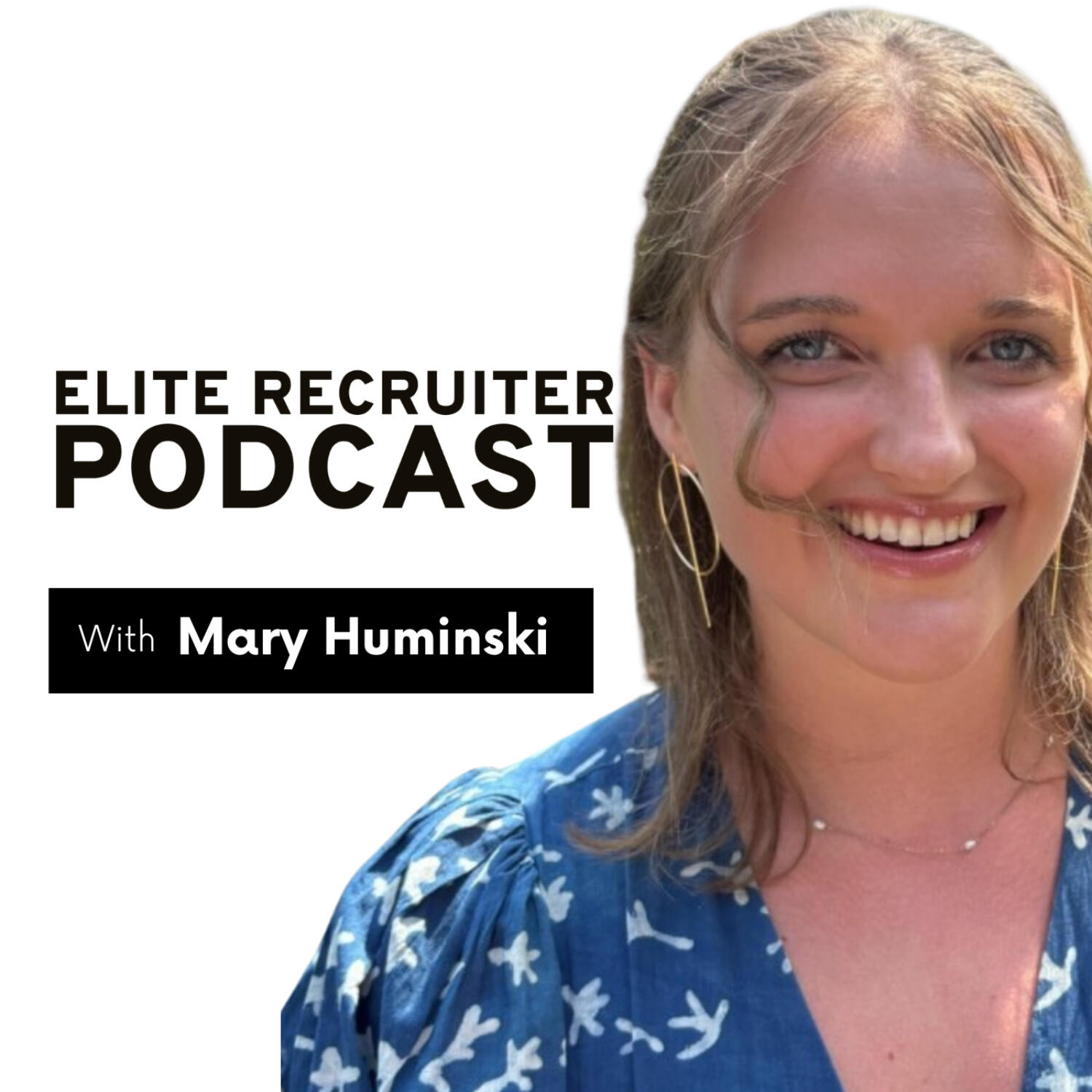
$1M At 25. What's Possible In Your First Two Years

 Spotify

 Apple Podcasts

 YouTube

 Castro

 RSS Feed

 Amazon Music

 TuneIn

 Audible
Key Takeaways
- Mary Huminski achieved a massive milestone by billing $713K in her first year and crossing $1 million by year two at just 25 years old.
- Rejecting conventional wisdom to join a big firm, Mary chose the boutique path and quickly inherited two desks from veteran recruiters with decades of experience.
- The '9 Before 9' rule ensures that no coffee or routine tasks happen until nine strategic business development calls are completed.
- Mary's million-dollar year was driven by approximately 70 percent referrals and inherited relationships, 20 percent cold reactivation, and one client from an MPC.
- A customized training method involving an all-day open Zoom window allowed real-time coaching and rapid skill development.
Before the episode, two dates. Finish the Year Strong runs September 28 through October 5, and the brand new Firm Leaders Summit runs November 16 through 18. Live sessions for both are free. Register at https://recruiters-finish-the-year-strong.heysummit.com/ and https://firm-leaders-and-owners-recruiting-summit-2026.heysummit.com/. Replays, VIP access, and the Elite Recruiter Community are there if you want to go all in on the rest of 2026.
This episode is brought to you by Atlas, the CRMx that captures every call, email, and message automatically and tells you the next action to take: https://recruitwithatlas.com/
Mary Huminski was 22, fresh out of Bentley, and everyone told her the same thing: go to a big firm first, learn the trade, then think about boutique. Her uncle, a career headhunter, said it. Her future boss said it. She had a Michael Page offer in hand. Twenty minutes after congratulating her on that offer, Annie Colabella called back with a better one, and Mary took the boutique path everyone warned her against. Year one, as Mary tells it, she billed $713K. Year two she crossed $1 million. She's 25.
This episode deconstructs how. Not the highlight reel, the operating system. Mary walks through inheriting two desks from recruiters with 10 and 20 years on her within months of starting, and the mindset shift that turned a terrifying phone list into a once-in-a-lifetime opportunity. She breaks down the training method she and Annie built around her learning style: a Zoom window open all day for months, mute and unmute, Annie typing the next question in the chat while Mary drove the call. She explains 9 Before 9, the rule that no coffee happens until nine business development calls are made, and why she plans every single call the night before.
The numbers get honest treatment. Mary breaks down where the million-dollar year actually came from: roughly 70 percent referrals and inherited relationships, about 20 percent cold reactivation of dormant clients, and one client from an MPC. She shares her original MPC voicemail script word for word, then the evolved version that leads with market intel instead of the candidate. She walks through a counteroffer she saw coming from the first call, and the client who lit her up for 15 minutes over a follow-up email, the calendar reminder Annie made her set, and what happened when she called back three months later.
There's a Gen Z conversation in here that goes somewhere unexpected. Mary doesn't think she's an exception. She thinks there are a lot of Marys out there who never had someone say I'm invested in you.
What You'll Learn:
- The 9 Before 9 rule and the night-before prep that makes it fit
- How to build a rookie's training plan around how they actually learn
- Mary's original MPC voicemail script and the advisor version it became
- Where a million-dollar year actually comes from, by percentage
- The difference between busy and productive on a full desk
- Why the client who yelled at you won't remember it in three months
🔗 Connect with Mary: https://www.linkedin.com/in/mary-huminski-b030901a2/
📅 Finish the Year Strong Summit, Sept 28 to Oct 5: https://recruiters-finish-the-year-strong.heysummit.com/
🏢 Firm Leaders Summit, Nov 16 to 18: https://firm-leaders-and-owners-recruiting-summit-2026.heysummit.com/
⚡ Atlas: https://recruitwithatlas.com/ 🤝 Elite
Recruiter Community: https://elite-recruiters.circle.so/checkout/elite-recruiter-community
📬 Newsletter: https://eliterecruiterpodcast.beehiiv.com/subscribe
Frequently Asked Questions
Who is Mary Huminski on The Elite Recruiter Podcast?
Mary Huminski is a high-performing recruiter who billed $713K in her first year and over $1 million by her second year at age 25, choosing a boutique firm path right out of college.
What is the '9 Before 9' rule in recruiting?
The '9 Before 9' rule is a disciplined daily habit where a recruiter must complete nine business development calls before having any coffee or starting other administrative tasks.
Where did Mary Huminski's million-dollar year revenue come from?
Roughly 70 percent of her revenue came from referrals and inherited relationships, about 20 percent from cold reactivation of dormant clients, and the remainder from MPC placements.
Benjamin Mena [00:00:00]:
Do you realize that 2026 is almost over? Do you realize that COVID was almost 7 years ago? Crazy, right? But here's the thing. I truly believe that a short window of time and a short sprint can absolutely change your life. And who cares what has happened so far this year? That is the reason why Finish the Year Strong, the summit kicking off September 28th through October 5th, is going to help you get there. Is going to inspire you. It is going to motivate you. It is going to teach you. Remember, all the live sessions are free. If you want to get the replays, VIP, or join the Elite Recruiter Community, this is your opportunity to draw on the line in the sand.
Benjamin Mena [00:00:40]:
Make sure that you get registered. And we're going to be doing one more thing this year. Something brand new that we have not done before. We're going to do a Firm Leaders Summit on November 16th to 18th. Same thing. Live sessions are free. Make sure you get registered for both of those. And if you guys want a good laugh, I almost thought about doing the Firm Owners Summit.
Benjamin Mena [00:01:01]:
And then I realized so many of us are leaders, no matter where we are in the organization, we are a leader in the firm. So what I switched it up to Firm Leaders Summit. These are the 2 opportunities for you to get educated, get on board, grow, and absolutely crush the rest of the year and set yourself up as a foundation For 2027. I truly believe in you. I'm excited for you. I'm excited that the impact that you're going to have on your desk and other people's lives because of what you're capable of doing. I'll see you there. Coming up on this episode of the Elite Recruiter Podcast.
Mary Huminski [00:01:43]:
Annie's goal when I started and still to this day is to make me a millionaire by the age of 27. So When I first heard that, I was like, whoa.
Benjamin Mena [00:01:54]:
Do you think you would've made this jump and been where you are if you didn't have or weren't seeking mentorship even before starting in this position?
Mary Huminski [00:02:03]:
Ooh, good question. Would I have made this jump?
Benjamin Mena [00:02:09]:
Welcome to the Elite Recruiter Podcast with your host, Benjamin Mena, where we focus on what it takes to win in the recruiting game. We cover it all from sales, marketing, mindset, money, leadership, Atlas is a CRMx, a CRM that actually understands context. It captures everything you say, hear, read, and write. Every interview, client call, LinkedIn message, email, and WhatsApp automatically. Not because you spent the time entering it. It's because Atlas is always listening. Then it goes one step further and tells you the next action to take. So when you need to fill a role, People Search ranks the best candidates and tells you why.
Benjamin Mena [00:02:50]:
No digging required. The same memory turns BD into a shortlist of who to chase and why. And then it's just a matter of sending the email. So you win more clients. Need to see your pipeline? Speak to your dashboards and Atlas builds a view automatically tracking whatever matters to you. Whether you place permanent or contract, Atlas covers both with a new contract suite. That means you never have to chase a timesheet again and live margin visibility on every single placement. And with its new MCP and API, Atlas plugs into your, your LLMs, Claude, ChatGPT, and the rest of your stack.
Benjamin Mena [00:03:19]:
The low-value work that keeps you from billing, Atlas does it for you. Atlas customers right now are saying that they're seeing a 50% higher candidate response rates. A 35% increase in new clients won, 15 hours saved every week, monthly billings jumping 85%, and agencies hitting 150% of their annual revenue target by building their business with Atlas. If you want more information, check out Recruit with Atlas. I am so excited about this episode because I have a Gen Z recruiter, and not just a Gen Z recruiter. I had a Gen Z recruiter that the first year she built $713K, and the second year she was a million Dollar biller. Here's the crazy thing. Like, she had the opportunity to go to one of the large firms.
Benjamin Mena [00:04:00]:
I mean, that's exactly what I did. I mean, of course I knew nothing about recruiting prior to going to a large firm, but I remember crushing it, being at the top of like the rankings every single week in the office across the country. And I think that, that year I rocked it out. I think I made $59,000. Being a top biller, man, knowing what I know now, if I had the opportunity, would I have gone to a boutique firm? Comp structure's different. The growth structure's different. You handle a lot more things. Or would I have continued the journey that I took at that large firm? Like at this point in time, like with everything that I know, I don't know what I would've done.
Benjamin Mena [00:04:45]:
But I'm excited that I get the chance to sit across from somebody who took the journey that I might have been able to do. Because if you want a good laugh, I actually had 2 offers going into recruiting. One was a giant firm that started with an A and ends in a tech. And the second one was a boutique firm where I got to work from home. But at the same time, I also knew I didn't have any self-discipline. So let's, let's rewind this tape. Let's just jump right in. So Mary, everybody you talked to told you that you need to do exactly what I did.
Benjamin Mena [00:05:21]:
Go to that gigantic firm. Actually, even your now boss, your now CEO, your mentor even said like, yeah, no, you need to go to a big firm to figure this stuff out. You ignore them all. And year number 2, you build $1 million at the age of 25. Like, walk me through that decision.
Mary Huminski [00:05:39]:
Part of it is I think I'm a little bit of a hardheaded person and like to do things my way at the end of the day. So I got originally introduced to recruiting through my uncle who was a career headhunter. He worked at Robert Half and also encouraged me to go to the big firm, get the formal training. And I think the really big reason why I ended up at Cardea Group was because they were the people that I wanted to work with. When I first met Annie, she was really acting as a recruiter for me in my job search and mentoring me through the process with Robert Half and Hobson Associates. And I actually failed a personality assessment for Hobson Associates.
Benjamin Mena [00:06:21]:
Um, wait, what? And this, this is Danny Cahill's office, right?
Mary Huminski [00:06:25]:
Yeah, exactly. Wait, it sounded competitive enough actually to be a recruiter. So I think through that, I told Annie that and she was like, I see something in you. I think that personality assessment is dead wrong, and I think you could be awesome at this regardless of where you do it. So at that moment, I didn't have any offers in hand yet from any big firms. She still was encouraging me to go to a big firm. A week later, I got an offer from Michael Page, and she turned around and was so excited, congratulated me. And 20 minutes later called me back with an offer to come join her.
Mary Huminski [00:07:09]:
And it was a better offer. And she told me all the reasons why she wanted me. And a huge— the, the reason that I went was because I was like, oh my gosh, this person believes in me. This person's gonna have my back. And I think we can do really awesome things together. So it was a little bit of a, a gut decision, but also a lot geared towards where I thought I'd have. the best mentorship at the end of the day.
Benjamin Mena [00:07:36]:
It's, it's one of those things that I, looking back on the careers of many recruiters, and I don't want to call this luck, okay? Because like, I truly believe that you designed your own luck, but the, it's amazing the impact of your recruiting career with your first manager in the space. And for those that don't know, uh, Annie, done a podcast with her. She's a Pinnacle Society member. I don't, she actually didn't want to talk about numbers on the podcast. She only wanted to talk about you. Um, but when I was at the Pinnacle Society meeting in Miami, I think that day she closed a deal that was like bigger than most people's years.
Mary Huminski [00:08:18]:
She's a baller. She's the— Yeah, she is.
Benjamin Mena [00:08:22]:
She is. All right. So somebody listening is hearing this, these numbers like $713K first year, million-dollar biller second year, but you do 9 business development calls before 9:00 AM, and you don't even let yourself drink coffee until you're done. I'm, I, I have coffee like 7 o'clock in the morning. Like, where does a 25-year-old Gen Zer get that?
Mary Huminski [00:08:46]:
I know that nothing is more motivating to me than withholding something that I love. I need my coffee every single day, so I have to make the calls in order to get it. And I think the original concept came from Jen Meyer, who makes time for 10 business development calls every single day. And I was like, dang, if she can make time for it, then I can surely make time for it. So the 9 Before 9 kind of came from that original idea, and then I just made it my own because knowing that I'm a very like goal-oriented person and I love either withholding something from myself and then of rewarding myself, I was like, okay, this is a recipe in order to make myself be accountable.
Benjamin Mena [00:09:31]:
And for those that don't know Jen Meyer, she's probably one of the people when I ask Pinnacle members who they look up to, she's one of them. I think her numbers are in the millions. She's a—
Mary Huminski [00:09:39]:
We call her queen.
Benjamin Mena [00:09:44]:
Okay. So let me take a step back. So I believe that you picked up some habits probably in college, but you Were a college athlete and you were a competitive diver. But the thing is, I, I would, I, I've heard that you didn't start as a diver, you started as a gymnast and then you had to completely rebuild to a brand new sport. What did that pivot teach you that is showing up at your desk?
Mary Huminski [00:10:08]:
Yeah, great question. So I did gymnastics for the majority of my athletic career and my sophomore year of high school, I destroyed my ankle. So This pivot, to be fair, was forced upon me, not one that I chose to make. And the way I got into diving was from one of my like best friends and teammates' father being a coach at Yale. And she, one day when I, after I, I busted my ankle, was like, just come to practice with me and see what this is about. So she and I were, had this really awesome natural competitive spirit with one another that was still really encouraging. And I quickly realized like, dang, I'm gonna be a lot better at this than I would be ever at gymnastics. And saw that opportunity and built upon it to eventually get the opportunity to do it in college.
Mary Huminski [00:11:03]:
And then I ended up being undefeated at our championship meets and the female athlete of the year for our university at large when I graduated. So What that taught me, something that feels so horrible at the start can turn into something absolutely incredible if you're surrounded by the right people who are going to be there for you and pick you up in the moment where you're like, what am I doing? So how that shows up in my desk, you get rejected a lot in recruiting, right? And you find yourself in situations, at least in my story, Where there was changes all around me and having the right people in Annie and the team that we have here to make sure that I stay positive and focused on what I can control and therefore able to achieve has kind of led, led me as my goal, my north star throughout the journey. And what I mean by that is when I joined Cardea, there was 2 quite seasoned and senior recruiters who departed very soon after I left, and it changed a lot, right? Like, these are people who had 10, 15, 20 years of experience that left, and now I came in and had a couple months of experience and was inheriting their desks. So, some people might see that as like, oh, whoa, what am I gonna do? But to me, I was like, Oh my gosh, I'm so excited by this. And I have a person who's in my corner, in Annie, that's saying, let's get after it and let's make the most of it. And that's, I think, some, a mindset that, that will take anyone far, uh, in recruiting.
Benjamin Mena [00:12:54]:
Let, let's rewind this tape. 25-year-old Gen Zer, million-dollar biller. Quick 30-second self-introduction so people know exactly who Mary is.
Mary Huminski [00:13:02]:
Sure. Um, my name's Mary Kuminski. I am, as you said, 25 years old. I started after school recruiting at the Cardea Group, which is a boutique retained search firm that focuses exclusively on legal and compliance recruitment within the fund space, and started as a fully remote recruiter and then transitioned into living in New York City and have been here ever since and Hoping and planning to be here for quite a number of years.
Benjamin Mena [00:13:34]:
Wait, so you started off remote and then you moved to, like, how many months until you moved to New York City for the, the position?
Mary Huminski [00:13:40]:
9, 9-ish, 9, 8 months before.
Benjamin Mena [00:13:43]:
So you were, you were, you were figuring this out all remote?
Mary Huminski [00:13:46]:
Yeah. Yeah. I was figuring this all out remote, which in hindsight I definitely wouldn't honestly recommend for people.
Benjamin Mena [00:13:55]:
Okay. Like we're, we're, we're gonna touch base on that a little later on. Yeah. Like I didn't know that. Because I know Annie likes being in the office and I thought building those kinds of numbers, like you were really just sitting there absorbing everything that she was doing, like next to her. All right. We're going to, we'll talk about that later, but let's take a step back. When you joined the firm, you took over 2 desks from recruiters, like a 10-year recruiter and a 20-year recruiter.
Benjamin Mena [00:14:17]:
Most recruiters probably would have been like a little, or walking in a little terrified of that phone list, especially in the niche that you guys are in. Like, What was call 1 like?
Mary Huminski [00:14:28]:
I mean, I won't lie, I definitely was nervous on call 1. I'm going off of no knowledge versus people who have like obviously an abundance of knowledge, but I quickly pivoted my mindset into, oh my gosh, like this is a once in a lifetime type of opportunity. Like I'm not gonna waste it. So call 1, in the way that me and Annie Work together when I first started, cuz I was virtual, was to be on Zoom calls for the entire day and mute and unmute ourselves so that we could listen in on each other's calls. She could provide me feedback in the chat as I did my first calls and just help guide me. So call 1, I had just listened to her leave a voicemail for a legal associate position and wrote down every single word that she said. And then she turned around and said, okay, your turn. And I said every single word that Annie said the way that she said it, because one, that was the type of learner that I was.
Mary Huminski [00:15:33]:
And two, I was not about to change the script until I felt a little bit more confident. So call one was very much so, how can I do this exactly like I'm hearing it? And that, that was a, a big north star in not just my first call, but in my first new candidate intake, my first business development call. My first client meeting, everything. Like I was gonna try and do it as close to how she did it as humanly possible.
Benjamin Mena [00:16:00]:
One of the things that you said in your pregame is you had this thesis that you couldn't control how much experience that you had, but you can control how you spent every single hour. Feed that back to me, unpack it. What did a Tuesday in those early days, or maybe in, maybe even now actually look like? When you're trying to control every single hour of the day.
Mary Huminski [00:16:23]:
Yeah, absolutely. So where that originally came from, before I actually even started at Cardea, I went through the According to Danny training sessions that are online, and he has an episode that talks about this concept that when you're a rookie, you are not gonna work as smart as somebody who has more experience than you. So you need to work As hard as you possibly can. So that was in the back of my mind and still lives in the back of my mind as somebody who's got a whole lot less experience than some of the people that are, are also calling the folks that I reach out to. So what that manifests on a random Tuesday or even today, it means that I want to be always working closest to the money. In every single thing that I'm doing. So when I'm in a cold call block, it means turning my email off and not getting distracted from what I'm doing. Because at the end of the day, something that I've grown to really appreciate is you can be responsive and at the same time not respond within the first 10 minutes that the email is sent to you.
Mary Huminski [00:17:36]:
So minimizing the time that you're jumping between tasks while still being adaptive shows up every single day, not just Tuesdays, in terms of how I make sure that I'm, I'm staying closest to the money. And another key piece of that is working on cultivating the relationships, right? The way that I position myself as a recruiter is an advisor and somebody who is an expert within a very specific niche. So, in order to become that, one, you need to understand the landscape that you're working within. So, anytime that I get an opportunity to speak to an expert like a CCO, A general counsel, a CFO, CCO, anyone, a legal analyst, a compliance associate, I'm present on those calls. I am listening actively. I'm taking note of what they're saying and I'm absorbing it instead of trying to do 15 different things at once. So I think the people that I work with would tell you, wow, like Mary cares about what she's working on, and I know that and I trust that about her. So to me, it's a multitude of things, but part of it is just being able to learn how to focus on what you can control and what you're doing in that moment.
Benjamin Mena [00:19:00]:
So before you started working at Kadero Group, you worked at Predictive Index. And one of the things that you learned there is your learning style. From my understanding, Annie actually hand-built a training plan for you and not just like a generic onboarding. Like, walk me through like what you guys put together for yourself based on how you learn.
Mary Huminski [00:19:23]:
Yeah, so I think I, I told Annie this either when we were first talking about me as a becoming a recruiter more broadly, or like in my first week, I walked her through The personality test, Predictive Index is a personality assessment company. So I walked her through what my assessment's results were day one and said, I need you to know this about me because it's gonna show up in how I work and it's gonna buy us back a lot of time if we incorporate it into the training program. I'm an extremely auditory, auditory-focused learner, so if I hear something, I can pretty much say it back or If I write it down and hear something, game over. So the training program that we came up with was listen to Annie do it and then trial by fire. And that minimizes a lot of the, I think, fear that, that some rookies can have around, oh my gosh, like what if I mess up? I didn't have that because Annie and I were on calls and She would give me the chance to do it and before I was perfect at it. And it therefore kind of like made me realize very quickly, oh, I'm talking to people. I'm not talking to anybody who, who should be viewed as anything other than that. And that allowed me to build from the start my own style and get involved on a 360 desk without feeling like intimidated from the get-go.
Benjamin Mena [00:20:58]:
Real quick, like you, so you had a Zoom window up the entire day and you guys just like back and forth. Like how long did that last?
Mary Huminski [00:21:05]:
Ooh. I mean, I was working fully remote, so I remember the intensive training sessions were probably like a month, but for probably 3, 4 months, A lot of the time I would, we would just keep that open in the background throughout every day because I didn't wanna feel like I was on an island. And we would just mute and unmute when we needed to talk to one another and ignore it some of the rest of the time. And sometimes one of us would totally forget we were on the Zoom call and then we'd say something and scare the heck out of one another, like, oh my God, forgot you were there. So that was a nice, I honestly, I think we did it for most of the time that I was working. remote, just as a way to feel connected to one another.
Benjamin Mena [00:21:55]:
And I just wanted to clarify that timeline and for the, the leaders listening and hiring recruiters, like this isn't a one and done, a one-week training. This is like months of actively getting a chance to listen to all these conversations back and forth. Absolutely. Not just cool, good luck. Good job.
Mary Huminski [00:22:14]:
Yeah, exactly. And we still do that honestly. Like me and Annie will role-play handling objections with one another. And trying to field those questions and giving feedback to one another. Or if a new job comes in, we'll sit down and we'll pitch it to one another and give each other notes around how we should be positioning it and what's the sizzle items that we should be highlighting. So even though we're not necessarily doing it every single day, the whole day, I'm still doing this with her on a daily basis and refining. Everything that I do.
Benjamin Mena [00:22:53]:
One of the things that Annie talked about is she likes to be an excavator of information. Give me like a live call moment where you dug and found out what everybody else missed.
Mary Huminski [00:23:04]:
Yeah, it's a great question. So the origin of Excavator Mary came around digging in around compensation instead of just accepting what is What is the comp package that is most exciting to you? So that's the the reason behind why we started this on NCIs. But actually, a different moment that's coming to my brain right now was working on a search that was for a standalone position in a satellite office where they needed somebody who had the gravitas to work with. Everyone from the founders down to the lowest levels of employees being the face of compliance. And it was a tough search because it was in a very niche location. So, I was doing a lot of recruitment around folks who weren't actively in the talent market. And that's what we do normally. We're cold call recruiters.
Mary Huminski [00:24:02]:
We are not just looking for the talent that's actively out there. So, In this situation, I cold call recruited a woman who was extremely impressive. I had met her in person before and I had had her on my radar for a year and I finally got her. But in the back of my mind, from the first call, I was like, ooh, she might be a counteroffer. She is going to be a counteroffer risk because she's not even looking. I'm calling her with something to convince her to look. So throughout the entire process, I made sure that in my debriefs that stayed a topic of conversation and an open door, asking her consistently, what are you going to do when you get a counteroffer? How is it going to feel when you tell your manager that you're leaving? Because I bet you it's going to suck. And what do your parents think? Who do you talk to within your search? I dug in every single step of the process, and of course the hiring manager, as I knew they would, fell in love with this person.
Mary Huminski [00:25:13]:
And I remember sitting with Annie and being like, ah, I don't know if this is going to work, and we need to make sure that the client is aware of the risks with this. They should move forward if they think this is their person, but I just don't want them to be blindsided. And in my mind I was like, this is a 50/50, right? But we should try it cuz you'll never know unless you try. The offer comes out, she's so excited. And in my mind I'm, I'm giving myself a glimmer of hope, but the, the realist in me is like, we haven't crossed the bridge yet. And, and sure enough, the thing that kept her there was not the money in the counteroffer. It was the kind words that her boss gave her. And I just think like, if I hadn't had the honest conversations with Annie and the client and managed their expectations, then they probably would've felt a lot more blindsided by when she did take the counteroffer than if I hadn't have dug in.
Benjamin Mena [00:26:21]:
So when you got started, Annie had goals for you. What were they, what were her goals and were they bigger than what yours actually were?
Mary Huminski [00:26:32]:
Yeah, they were. Annie's goal when I started and still to this day is to make me a millionaire before, by the age of 27. So when I first heard that, I was like, whoa, like what are we talking about? That's crazy. And all of my goals, were around how do I learn? Like, I need to be a sponge and focus on the output that I'm generating. So her goal for me in order to reach that has always been to give me the knowledge base to be an expert in our space. And we, we align there because she allows me the chance to ask her questions. Constantly. Like there's no question that I, I don't feel comfortable asking Annie.
Mary Huminski [00:27:23]:
And I think that's something too that, that goes a long, long way when you're learning how to be a recruiter, especially if you're in a niche. And 2, she gives me the opportunity to do it the way that I wanna do it. And for somebody who's hard set and dead set on doing it their own way, that was extremely motivating. So I guess taking a step back and giving you my goals, my goal is still a lot focused, or is very much so focused around learning at the end of the day. Like I'm still new to this and yes, I've been able to have incredible opportunities in the short time that I've been a part of it, but at the end of the day, I'm thinking about 10 years from now and what I want to achieve. And that means that my goal today is cultivating relationships that 10 years from now are going to be hiring managers and folks that will help me bring in more business because that's really how our model operates. So, they're aligned, but they're different. I think the focal point for me is still learning and how many calls I'm doing in like the, the ins and outs of my day-to-day, if you will.
Benjamin Mena [00:28:44]:
I guarantee you after this goes live, watch someone be like, hey, uh, Mary, is there any way I can come work for you?
Mary Huminski [00:28:51]:
Yeah, we're not big on, to be totally transparent with you, Ben, we aren't like actively tracking our numbers day in and day out. And I honestly like that a lot about the way that we work.
Benjamin Mena [00:29:06]:
Before we go that direction, I wanna take another step towards like, were you getting started before we start doing like a deep dive on like your day-to-day and everything? So Annie told you to go to a big firm. Why was skipping that right for you and who is that wrong for?
Mary Huminski [00:29:19]:
Great question. It was right for me because I have been an individual athlete my entire life. I think of myself as being quite disciplined. And having a higher level of accountability than a lot of folks that are my age. So the reason that it was right for me was because the bar that I set for myself is higher than any bar that anyone else can set. So I am extremely goals-oriented and was elated. To work at a firm where I didn't have to fit into a box. I could build the desk that I wanted to build the way that I wanted to build it.
Mary Huminski [00:30:08]:
And it would be very, very wrong for a person who needs structure and a formalized plan of how their day-to-day looks. Because it, when you're working at a boutique firm and a place where There's 2 full-time recruiters. Annie does not have the time to micromanage me or, or like keep a fine-tooth comb over what I'm doing day in and day out. So if you're a person who doesn't gravitate towards that type of freedom and feel energized by it and excited by it, then I could totally see this not being the right work environment or the right fit.
Benjamin Mena [00:30:59]:
Awesome. So first year, $713K. Awesome. Deconstruct that for me, honestly. Like how many placements? Like what kind of roles were they? Like what kind of fees?
Mary Huminski [00:31:11]:
Yeah, absolutely. So my first year I made 21 placements. They ranged from legal analyst, paralegal type of roles that were looking for folks Right out of school to CCO roles, looking for heads of the department, chief compliance officer seats. My average fee was roughly $61K for my first year. And in terms of the breakdown there, and something important to note, about a third to a half of those were contingent searches and the rest were retained searches. There was a little bit more variety and difference between the way we were working across deals in my first year.
Benjamin Mena [00:32:01]:
And this is something that I know behind the scenes, cuz I, I know you guys, but you guys, while you were getting started, you guys were also transitioning from a contingent firm to a retained firm. So it was like almost learning another recruiting language.
Mary Huminski [00:32:16]:
Yeah, but honestly, it was kind of like a blank canvas. I actually thought that I had an advantage over Annie in that way because We went through the Retrained Surge program with Lou and Jordan, and I didn't know any other language, so I didn't have to like re— retrain my brain. I was just learning it all from scratch. So I actually think that was like a huge advantage for me.
Benjamin Mena [00:32:40]:
That's awesome. Well, I, I also wanna ask you about your first solo client, like the first one that you picked up on yourself. That wasn't a cold call, that wasn't an email, that wasn't a Like an email multi-channel sequence. No, this was a networking event. Like, walk me through that room.
Mary Huminski [00:33:00]:
Yeah. So I, as I said, I was working fully remote based out of Chicago, and Annie and I were talking about how I wanted to go to more networking events. So she got me connected with a group that supports women in finance, and the event was very broad. It, it really wasn't focused in on legal and compliance professionals. It was women across all different departments. And the goal of the event was for me to just make connections and get to know people in Chicago who work in this space. It was not geared towards, you need to find a client here. So I walked into that room with pretty much no agenda other than let me make a friend and let me find somebody who can be a point of contact that I can get coffee be with.
Mary Huminski [00:33:51]:
So I found a woman who works in finance and accounting, and we hit it off talking about like the cheese and the, the snacks that they had available. And we did not talk about work for probably the first 15, 20 minutes. We were just, again, like going back and forth very naturally. And she ended up inquiring about who I was, what I did. And I told her that I specialize in legal and compliance recruitment, and she was like, I think our CFO is looking to bifurcate his titles, and I'm wondering, like, is that something that you could help with? And my face, Ben, must have lit up in that moment of like, yes, that's absolutely something I could help with. And she ended up connecting me with him, and, and that led to my first solo client visit, solo search that I got in. It was a big moment for me and, and one that really came from I suppose a very unique, uh, origin. Yeah.
Benjamin Mena [00:34:56]:
Cheese. It came from cheese.
Mary Huminski [00:34:57]:
It came from cheese.
Benjamin Mena [00:34:58]:
All right. Your early days. How do I even say early days? Like you're what, 2 years in? That just sounds weird. Um, you, you were doing a lot of NPCs, right?
Mary Huminski [00:35:11]:
Yeah, absolutely.
Benjamin Mena [00:35:13]:
Real quick before I go into my question, like what did your NPCs look like?
Mary Huminski [00:35:18]:
So MPCs for me, are you familiar with Hinterview at all?
Benjamin Mena [00:35:22]:
Yes.
Mary Huminski [00:35:23]:
Yeah. Okay. So I would do an MPC pitch. My voicemail would sound something like, hey Ben, this is Mary Kaminski with the Cardea Group. I'm not sure if my name sounds familiar. I specialize in legal and compliance recruitment, and I thought it was worth highlighting a 2017 JD candidate that I am actively bringing to market. They are a Ivy League undergrad. They have worked as a generalist across all aspects of compliance, including code of ethics, marketing materials review, regulatory filings, and more.
Mary Huminski [00:35:57]:
And, and they just struck me as somebody who's a real no-ego player. So I'm not sure if my timing's right, but I'd be remiss not to highlight them. If you have any interest here or active needs upcoming, would love to connect at 475-202-9413. And that would be my, my NPC voicemail or pitch that I would send along a follow note to that had a Hinterview attached where I would do a video recording pitching the candidate as well to hopefully bring their inbox to life a little bit more. And after I left that voicemail and did a Hintro pitch of an NPC, I'd follow up 2 days later, 3 days later with another voicemail that was very generic, to be so honest with you. Hi Ben, it's Mary Huminski with the Cardea Group. I'm following up on my note from a few days ago. I'm not sure if my timing's right here, but wanted to reflag that 2017 undergrad.
Mary Huminski [00:36:56]:
Would welcome the chance to connect and discuss further at blah, blah, blah. So my MPC. when I first started, didn't have anything other than the MPC included into it and pretty much my name. And it's, it definitely has evolved since then.
Benjamin Mena [00:37:18]:
So, what has it evolved to with how you evolved as a recruiter too?
Mary Huminski [00:37:22]:
Yeah, so we've done additional hires at the Cardea Group, and one of our team members is amazing at creating different pieces around market insights. So my MPC pitches have evolved in order to include information about what I'm hearing from their peers and competitors, compensation benchmarking, team structuring, how folks are using AI, just tidbits and pieces of information that Could help them regardless of if they're hiring, because the thought process here, Ben, is, okay, the likelihood of getting the timing right with an NPC is not the ultimate goal of NPC pitches, but if I can add something in that is like super relevant regardless of where they are and just give them a hook.
Benjamin Mena [00:38:22]:
Yeah.
Mary Huminski [00:38:23]:
into getting on the phone with me to get at information that they need at all times, then that's my golden ticket to be viewed as an advisor in the space and an expert, and also just increase my hit ratio. So the way that it's evolved is to still do an MPC pitch on the voicemail, but follow it up with something along the lines of, or let me just give you an example. Hey Ben, this is Mary Huminski with the Cardea Group. I specialize in legal and compliance recruitment and wanted to check in on Recruiter Firm X and see how the year has been going. I have a 2017 undergrad who I think is exceptional, but I'm not sure my timing's right. And also wanted to highlight that it's a really interesting time in the market, and I've been seeing a lot around AI trends. So if you're interested in hearing about what your peers and competitors are doing, I'd love to compare notes at 475-202, blah, blah, blah. So it still includes the NPC, but it's not the focal point.
Benjamin Mena [00:39:27]:
I just thought that was like interesting because so often we talk about the NPC and we all, we all know that most of the time the NPC isn't going to be the person that gets hired. It's the walkway into the door. So love it. All right. Year number 2, 25. Sorry. Gen Zer. So the, the million, where did each client come from? Give me like the percentages.
Benjamin Mena [00:39:51]:
Was it like, what was inherited? What was networking events? What was NPCs? What was referrals? What was cold outreach?
Mary Huminski [00:39:58]:
Yeah, absolutely. And we're very fortunate at Cardea to have a lot of our business come in through referrals and from Are the network effect that Annie and the team has built over the past 15+ years. In terms of the million-dollar year, the vast majority of these searches came in through referrals and inheriting them from her. I'd say that's probably 70% of the, the business that I worked on. And then In terms of NPCs, I had, I believe, one client through an NPC come through in the million-dollar year. And then in terms of cold calls, which I bucket into cold calls just to be aware, like reaching out to previous clients that we haven't been in touch with for a period, like a long period of time, and kind of recultivating those relationships. That's probably making up another 20% of the business that I brought in. So a lot of it was from referrals and the network effect.
Benjamin Mena [00:41:14]:
And is that why, I know there's something that you told me, I think like maybe about 7 times during the pregame, like you're so focused on the long game and the relationships because you, you're watching the seeds that was planted years ago now coming up to fruit, but, and you are Like really focused on planting your own seeds that will come up down the road.
Mary Huminski [00:41:34]:
Absolutely. It's amazing to watch the way that people in the legal and compliance world light up when I say I work with Andrea Colabella is so awesome because she's not only known as somebody who's an expert, she's known as somebody who's fun and lively and brings a lot of comfort to the search process, which let's be honest, like it can be so stressful and terrible. So to have somebody in your corner like her, people appreciate that and remember her for that. So I'm trying to replicate— I want to be known as somebody who any person that works with me can trust and also genuinely be seen as making their lives easier. Love that.
Benjamin Mena [00:42:23]:
So you're, you're 9 before 9. So 9 BD calls before 9:00 AM. And no coffee until it's done. I want you to walk me through 7:30 to 9. And are there days where like you've gotten to like 9:30, 10 o'clock and you're like, it's not done yet. I still can't have my coffee. Yeah. But also like who answers a BD call at 7:45 in the morning?
Mary Huminski [00:42:46]:
Well, I'm not making a call until at least there's an 8. Nobody answers a call at 7:45 in the morning. I did have one guy though, uh, a CCO who I cold called He was pretty early on my list. I will never forget this. And he picked up the first time that I called him and he was like, why are you calling me right now? I'm in the middle of breakfast. And I just went about my day. I was— because it, you catch people at a time where they're not expecting you. And I think there's something to be said about the art of disruption and catching people at a time where they can chat freely.
Mary Huminski [00:43:24]:
So that guy, I called him back, I don't know, 4 months later and, and I told him it's Mary Kaminski with the Cardea Group. And he is like, oh, I know you're the only person who calls me at 8 in the morning. So like, it actually, I think, really helps with cultivating relationships. But what my day looks like from 7:30 to 9, I'm getting into the office somewhere around 8, 8:15, and I'm not turning my email on until I get these calls done. That is very key. There's so many things in your inbox that, at least in my inbox on any given day, that I feel like are urgent. So I cannot let myself have the opportunity to look. I do not have the self-control to not answer if I do that.
Mary Huminski [00:44:13]:
So I don't give myself that chance. I get right into a call and I have My email template already set and ready to go. That's the first thing that I pull up and I have 9 of them in a browser ready to just put the email in and then send it off, put the email in and send it off. So the whole point of this 9 before 9 and protecting this time is have all of the prep work done so that you truly can fit in all of the calls and get them done within the quick quickest period possible because naturally I do get a lot of voicemails before 9:00 AM. So it's pretty quick.
Benjamin Mena [00:44:53]:
So this 9 before 9, like, are you there that morning making your list? Or the day before, are you not allowed to leave, personally allowed to leave, not Annie forcing you to leave the office until your, your 9 before 9 list is already built for the next morning?
Mary Huminski [00:45:08]:
Let myself leave the office. I won't let myself go to bed Without doing it, I think that the planning piece of recruiting is the most tedious, but the most important part. I plan the, for the day, I plan my day the day before it happens. That's how I finish my day, either at the office or I log back on at night and do it before I go to bed or whenever. But I actually think and would argue that's More important than anything else.
Benjamin Mena [00:45:45]:
So before you joined Annie, you were listening to According to Danny, and like, I'm still blown away that even during the interview process, you're like, yeah, I'm listening to According to Danny, doing the According to Danny training. He's like, why are you, how do I still fail this? Uh, but there was a principle that you absolutely loved. What principle was that and why?
Mary Huminski [00:46:03]:
Um, so the principle that I love there, I mean, According to Danny, everyone should listen to that, that has the opportunity to be a recruiter. In terms of what I love a lot from According to Danny, it's this concept that you have to hold yourself accountable. And what he says is you have to work harder than anyone when you're starting as a recruiter because you cannot work as smart as the people who have 10 years from you. So, To me, that principle follows me and I, I resonated with it a lot because I've been doing that since I was a kid and in sports where if you, if you put in the reps and do more than everyone else, nobody's ever gonna be able to catch you in the long-term game of it. This concept that he had was go the extra mile, do the additional 3, 4 calls that nobody else wants to do. Because if you do that, the compound effect is going to give you the opportunity to elevate at a quicker rate than anyone else.
Benjamin Mena [00:47:21]:
I just, if you want a good laugh, I looked up and we're at 45 minutes in. I'm like, oh crap, I have so many more things I want to like dig into. Uh, so we're gonna jump around in the original plan.
Mary Huminski [00:47:31]:
Yeah.
Benjamin Mena [00:47:31]:
So Being new, and I don't want to say this is like Gen Z, because I think this is something that like everybody deals with, especially whether you're new or whether you're old, especially the way the algorithms work, if we have any of those things on our phone. But you said you had to learn the difference between being busy and productive. What did that look like for you? And when did you notice and how did you change? And did that impact your billings?
Mary Huminski [00:48:00]:
Yeah, absolutely. It impacted my billings. So to me, the difference between being busy and being productive is how I focus in on the given task at hand. And what I mean by that is when I was busy and what that looked like on my desk was I was responding to every email that I thought was urgent that hit my desk. I was answering every text as soon as I got it that I thought was going to move a process forward and bouncing between tasks every second of every single day. So there was a lot of time that was being wasted in that process versus being productive. I think the focal point is, all right, I am going to I do take a task and finish it when I have it across my desk. So what that's translated into is candidates getting my full attention on a prep and a debrief and not rushing those things.
Mary Huminski [00:49:06]:
A lot of people say your time is your money and spend it wisely. Spending the time to give the highest quality prep that you can and the time to fully understand a candidate's viewpoint on any given search is something that will pay dividends in terms of making sure that you're closing deals, because you'll be able to listen for what is actually happening, not for what you're hearing. And then also match them with jobs that make more sense, cuz the more that you get to know somebody, the more you can understand what's gonna resonate with them from a hiring manager perspective. So. Then it just makes the entirety of my desk more efficient because I'm better at making the matches. And if I get in a role that I think is great on paper, but personality-wise it'll never work, guess what? I'm not gonna pitch it to them because I know that. And that's where I just think like, if you can play the long game and focus on productivity in that context, 5 years from now, you'll thank yourself.
Benjamin Mena [00:50:17]:
So you have your 9 before 9. Awesome. That's helped you tremendously. What does the rest of your day actually look like as a typical day as a million-dollar biller at 25?
Mary Huminski [00:50:30]:
Cold call forward throughout the entirety of the day. So I—
Benjamin Mena [00:50:35]:
So this isn't, you aren't done with being with the phone at 9:00 AM then? Yeah.
Mary Huminski [00:50:39]:
As if. Um, I spend probably 90%, I don't know, 80% of my day on the phone. Like the vast majority of my day is speaking to people, and I'm always trying to look for ways to leverage AI and the team around me in order to make sure that I can spend the most amount of minutes possible on the phone. So what my day looks like, I Then drink my coffee, uh, and I catch up on my email. So, the 2 other principles that I actually keep on a, a board right next to my desk and have kept it there since the first day that I ever worked as a recruiter, it says, work closest to the money, who, what, when, where, why, and shut up and listen. And though those 3 principles are how I construct my day and how I think about being a recruiter day in and day out. But what that really translates into, I, I get my coffee, I look at my emails and make sure that I haven't missed anything urgent. I'll usually touch base with Annie, see what her priorities are, make sure that we're aligned, and then I get on the phone and start calling.
Mary Huminski [00:51:49]:
I'm a person who's better in the morning and more snappy, so I try and get through candidate outreach in as much as I, as many Candidate calls as I can for, I don't know, an hour, hour and a half, 2 hours, whatever I have before I have my first NCI scheduled or a debrief scheduled or a prep call scheduled, which I will play around with depending on the availability of the individual. But just for ease's sake, I'm gonna say like, that's the first chunk of my day followed by a chunk of scheduled calls, followed by checking my email again, followed by another call block where I'm doing candidate outreach, followed by more debriefs. Usually I, I save a good amount of those for like the last chunk of the day, and then I end my day prepping for the next and making sure that I have a list of folks to call. Tomorrow.
Benjamin Mena [00:52:52]:
So NCI, for those that don't know what NCI is, what is that?
Mary Huminski [00:52:56]:
That's a new candidate intake call. So what that means, I ideally look to spend 20 minutes on an NCI. I do 30 minutes a lot of the time, to be candid with you. And what I'm doing there is getting to know the person's background, their interests, and their compensation information, the notice period that they're looking for without ever mentioning a job, because the goal of the NCI is to make sure that the candidate is not telling you what you wanna hear against a job description, but you're really getting at what growth means to them, what their intrinsic motivators are, and, and what's most important to them in this next step. I do a lot of digging in and excavating. In those calls so that I can keep them in mind and set the ground rules with them on how I work so that they know what they're getting from the get-go.
Benjamin Mena [00:53:54]:
And when you say plan the next day, like what are you actually planning?
Mary Huminski [00:53:58]:
My calls.
Benjamin Mena [00:53:59]:
Um, like how, like how many calls are you planning?
Mary Huminski [00:54:02]:
Sure. So the 9 business development calls, and then I will make a list of at least 20 names for candidate outreach. Depending on how many live connects that I get, like I might get to all 20, I might not. A lot of the time I don't because I'm very fortunate to catch a lot of people live. But I'll just roll over the, the names that I don't get to. And another thing that I do when I'm planning is the names that I call, say on Monday, I then call back 2 to 3 days later because it takes consistency in order to get somebody's attention. And if you're pleasantly persistent versus trying to call the double the amount of names, but you only touch them once, I'm a firm believer in making sure that you get to touch people as many times as possible.
Benjamin Mena [00:54:57]:
So has there been days where you left the office and didn't have those 30 calls planned out?
Mary Huminski [00:55:02]:
Yeah, absolutely. I mean, I think—
Benjamin Mena [00:55:05]:
What do I got? Like, what did those days, the next day or two look like if you didn't spend that planning time?
Mary Huminski [00:55:13]:
Yeah, when I first started, we didn't have people on dedi— dedicated research teams. So if I didn't plan my day out in full, then I had a huge problem the next day because I had to then spend my morning running searches in order to find the people or run the search and call the people at the same time. So I was probably half as productive as I was previously. We have an awesome research team now, so they are hugely helpful with my planning efforts because now I can go into any given job screen and there's 200 people populated who they've identified against the job description and have a little bit of a cheat sheet. If I don't plan now, the The drawback is not nearly as dramatic, but when I first started, I think it was detrimental to the next day.
Benjamin Mena [00:56:14]:
So I want to switch gears a little bit. Everybody knows Gen Z is the group that doesn't want to do anything. They're lazy, they're time blind, they're what else? ADHD and this and that. I mean, I think we're all ADHD in this space, but Yeah, certainly. You're almost like a walking counter-type to your entire generation. Are you an exception or have we just not found the proper ways to tap that direction?
Mary Huminski [00:56:47]:
Yeah, it's a great question. I don't think I'm an exception. I certainly do believe that there are plenty of Gen Zers who don't want to work hard. I'd argue that that's true of every generation though. But what motivates a Gen Zer, from my humble opinion, is to be surrounded by people who have their back. And I'm not sure that that is integrated into how people mentor their junior talent day in and day out. And if you're able to show somebody like me listen, I'm here for you and I'm invested into you. I think that there could be a lot of Marys out there who just haven't necessarily had that type of support that inspires confidence in them.
Benjamin Mena [00:57:43]:
Do you think you would've made this jump and been at where you are if you didn't have or weren't seeking mentorship even before starting in this position?
Mary Huminski [00:57:53]:
Ooh, good question. Would I have made this jump? Probably not. I mean, I have made so many big decisions in my life based upon the people. Like, for example, when I was figuring out what school I wanted to dive at, it was all about the coach. Could I see myself working well with that individual? Yes or no, that was pretty much how I decided where I went to school, and it's exactly how I decided where I ended up recruiting as well. So to me, it's so foreign to even think about doing it any other way because that is just who I am. But I, I don't know it if I would've, if I wasn't focused on that, given that I went to a business school. Benly University, and the vast majority of folks that I was surrounded by were going into the Big 4 accounting firms or like a very, very large company.
Mary Huminski [00:58:58]:
And again, being the individualistic type of person that I was, I had no problem going in a completely different direction. But I think if I had prioritized doing what was considered right were the norm, I don't know if mentorship would have been the thing that was driving me. Does that make sense?
Benjamin Mena [00:59:20]:
Makes sense. Well, in talking about mentorship, I want to talk about Annie. You said that you would never leave Annie. I gotta ask, is that— is that loyalty a strategy, or is it a feeling?
Mary Huminski [00:59:32]:
It's a strategy that is rooted in the feeling that I have towards her. I trust Annie and that she is doing what is best for me full-heartedly and without any questions. So to me, it is a strategy because I've found somebody who sees something in me and then invests into that. The way that I'm able to actually go about operationalizing around my 5 to 10 year goals of being viewed as an advisor and deeply integrated into the legal and compliance world is extremely unique to working at Cardea because she allows me to do things like host my own networking events and get together specific groups of people that I have very, very much so confidence if I was at like a very large firm, I wouldn't be given those same opportunities. So that coupled with working with somebody who just honestly is very similar in terms of how we think is one of one. And I don't see any opportunity where I would be able to replicate that.
Benjamin Mena [01:00:50]:
So there, like, for the listeners, there's probably about 20 other questions that I was going to have that we might have to do an encore conversation a year, a year and a half from now. But I want to, before we go over to the quickfire questions, I want to end with this question. I know that there's a Mary right now, 18 months into a mega firm. I can guarantee it, especially with somebody with a sports background listening to this episode with you. She's you in an alternative timeline. What do you say to her?
Mary Huminski [01:01:23]:
Ooh, I would say to her a few things. One is be honest with yourself. There is No one right way to go about building your career path. And the one that I've had has worked for me, but wouldn't work for every single listener on this call. And the big career, the big firm might be the best place for that person to be. So don't be a— trust yourself at the end of the day in order to pick what makes sense for you and How you're learning, and if it's not working, you're never gonna have the perfect time to make a change. So go ahead and see what else is out there. I say this to candidates all the time, and I would say it to this person too.
Mary Huminski [01:02:15]:
Interviewing's like dating. You're not committing to anything. And if you're curious, give yourself the opportunity to get more information and make a more informed decision. And that decision could absolutely be staying where you are. Or it could be finding something different. And so why, why rob yourself? Why not?
Benjamin Mena [01:02:36]:
Awesome. So jumping over the quick— before, actually, before we jump over, eh, I'll ask that later. You can, we can come back to that. To the quickfire questions, they don't need to be quick answers. Okay. Is there a book that has had a huge impact on your career?
Mary Huminski [01:02:52]:
Is there a book? There's a book called Untamed by Doyle is the last name. It's, it's a really good read. I, I think everyone should read it. It has impacted my life, not only my career.
Benjamin Mena [01:03:10]:
Your favorite tech tool right now? Claude Code or Claude?
Mary Huminski [01:03:15]:
Claude, regular Claude. That is an organization tool that is 10 outta 10, and that's what I need most.
Benjamin Mena [01:03:25]:
All right. So the rest of the quickfire questions actually came from Annie.
Mary Huminski [01:03:29]:
Ooh, okay.
Benjamin Mena [01:03:31]:
Uh, the fun parts about knowing people.
Mary Huminski [01:03:34]:
Okay.
Benjamin Mena [01:03:35]:
So for what are some unhealthy habits that you wish you kicked sooner in your career to expedite your success?
Mary Huminski [01:03:41]:
Ooh, good question. I think that listening for what I wanted to hear instead of what I am actually being told was something that took me a long time to build and I'm still working on. So I think being a little bit more real with myself is a habit that I definitely wish that I was more aware of at the beginning.
Benjamin Mena [01:04:08]:
What habits do you wish you had adopted sooner to help your desk?
Mary Huminski [01:04:12]:
Time blocking, especially around cold calls. And turning my email off. I did a terrible job at that at the beginning, and I think the more that you do that, the better.
Benjamin Mena [01:04:30]:
What are the mottos that you live by in work or elsewhere, and do you think they helped shape you into a successful recruiter?
Mary Huminski [01:04:39]:
A motto that I live by is, um, it sounds kind of corny, but give first without expectation and you'll receive more than you could ever imagine. And how I live by that, I love to see the glass half full perspective on the people that I work with, the situations that I find myself in. And I think it just enables me to always be thinking about the future and being maybe delusionally optimistic, but I think it allows me to view the world in a way that's very positive and cultivate like this mindset of plentifulness. Rather than getting stuck in the weeds of, man, like I put up a goose egg this month. What am I gonna do now? Like, and spiraling in that way. Cuz at the end of the day, that is, I think, the worst thing that you can do for yourself as a recruiter and will just eat away at your mental space and your time.
Benjamin Mena [01:05:40]:
If a rookie recruiter wanted to do one thing today that would be considered a simple change or adaptation to their day-to-day work to help them be more successful, what would you advise?
Mary Huminski [01:05:50]:
Slow down to speed up. What I mean by that, you might think that the most important thing is hitting the number of calls that you've been told that you need to hit or getting as much done as possible. But if you can make those calls quality, calls rather than just running through them and sound a little bit more educated and listen a little bit harder, do 2 less calls. And I know that contradicts some of the things that I've said, but that effort is very, very important. Yes. But the way that you're going about putting in that effort supersedes everything.
Benjamin Mena [01:06:33]:
So one of the interesting things about your space is The fees that you see, I mean, these are like big numbers. Like you're sitting there, like something's about ready to come in and you're counting like a $60,000 placement fee, a $75,000 placement fee, a $100,000+ placement fee. How do you overcome bad situations, whether it's a turndown or an accepted counteroffer, or you find out somebody's lying to you? Like, what do you do to turn your day around?
Mary Huminski [01:06:59]:
I first go for a walk, to be so honest with you. I am a person who needs to move. So the first thing that I do immediately is go for a walk. And take a breath and not act based on the emotion that I'm feeling. And then what I actually do after that is call people who I have placed previously and catch up with them and hear how they're doing because, oh my gosh, the feel— I just did this with a woman that I placed earlier this year, a couple weeks ago after getting an individual on the phone and telling me that he wanted to pull out before late stages of interview processes. And she went on to tell me. This is the big girl job that I thought I'd get 10 years from now, and I have it today. And you were the person who was the sounding board that helped me get here.
Mary Huminski [01:07:44]:
You called me outta the blue and I thought you were my doctor, and that's the only reason that I picked up the phone. And now look at how my life has changed. Like, I never could have imagined that this would be my 2026, and this is all because you called me that day. Thank you. And that's what keeps me working really hard in this business. I, God, like those conversations, you realize, wow, like what I'm doing is impacting these people on such a personal level. And I just think there's nothing more motivating than that feeling that you get in your heart of like, wow, oh my gosh, look, this person's thriving. And you get a lot of nos, but you also get these yeses and it's worth Revisiting.
Benjamin Mena [01:08:33]:
And this one you might have to pull from your memory because this is something that Annie and you talked about, but with kicking this interview out a week, we'll see if you still remember it. Tell me about a time when someone got upset with you during a call or after a cold call. What happened and what did it teach you?
Mary Huminski [01:08:51]:
I think I know what she's talking about and it happened years ago. Um, so when I was first starting with business development, I cold-called somebody, got them live. We had an awesome conversation. At the end of it, she mentioned, oh, I wanna keep my ears open. If you see anything at the senior level, just keep me in mind. And to her work email, I said something to the tune of, thanks so much for your time. Looking forward to keeping in touch about the market. And I read that as being Vague enough where it could mean anything.
Mary Huminski [01:09:27]:
It could mean the candidates that we have coming across our desk, but she called me back and lit me up for 15 minutes about how unprofessional that was and that I put her in a compromising position and that her firm could see that as her looking, and how could I ever imagine doing that? And it made me So sad. Nobody had ever talked to me that way in a professional setting. So I started in that moment to just be like shaking with anxiety. And I called Annie on the phone, a puddle of a human, and was like, I messed up. And she was like, no, you didn't. That is crazy. That not— is not your fault at all. And you have nothing that you did wrong here.
Mary Huminski [01:10:22]:
And the important lesson for you, Mary, is although this is making you upset and you will remember this, she's not gonna remember it 3 months from now. And you need to put a calendar reminder on your calendar to call her 3 months from now so that you can see this lesson in real time. So 3 months later, the calendar reminder pops up and I'm like, shit, I gotta, I really don't wanna call this woman. But I had to. I get on the phone with her, I catch her live again, and I pitch her a job that we had at the time. The most pleasant conversation ever. She was like, thank you so much for thinking of me. I appreciate you keeping in touch.
Mary Huminski [01:11:08]:
Um, like, how are things with you? Did a full NCI with her on the fly. And I was like, damn, like you never know when you're catching somebody on a bad day where their boss just yelled at them, or maybe they have something going on at home, or they're getting a divorce, or their dog died, whatever it is. That might impact how they show up on the phone. So just like be a goldfish, like don't let that bother you and keep in touch because she had no idea that had happened 3 months ago, even though I was thinking about it the whole time.
Benjamin Mena [01:11:49]:
This has been an awesome conversation, Mary, and a huge congrats to your first 2 years. And I wanted this episode to be an inspiration for other newer recruiters of what is capable of, how this business can absolutely change your life while you're changing other people's lives. But before I let you go, 2, 2 more questions. If somebody wants to follow you or connect with you, how do they go about doing that?
Mary Huminski [01:12:11]:
Yeah, on LinkedIn, my username is Mary Huminski. I'm more than happy to connect and just talk with anyone. I really do think this business can change lives, and if I can play a part in doing that for anyone listening, I'm always happy to be a resource in that way.
Benjamin Mena [01:12:31]:
And before I let you go, is there anything else that you want to share with the listeners?
Mary Huminski [01:12:36]:
Anyone listening to this, I have been doing this for not so long, and I think one of the things that I really truly believe in my heart of hearts is doing it the way that I wanna do it and cultivating my own style. So I've had the luxury of being able to connect with some of the best and brightest minds in recruiting, and that certainly has played a huge influence on my day-to-day, and I'm beyond grateful for those opportunities. And at the same time, I'm not doing it exactly the way that everyone else is doing it. So don't be afraid to, to add your own little flair into, into how you're recruiting.
Benjamin Mena [01:13:19]:
Absolutely love this. I know when me and Annie were originally chatting about like you, she wanted this to be an inspiration podcast. So what is capable? And not just, and I don't want you to be, if you're at a big firm, like looking back and like, hey, I missed out. No, like you can redraw your story. Or I've seen, we've had plenty of interviews where people have worked at the firm and are now owning the firm or now leadership at the firm. This is the opportunity for you to figure out your path because recruiting is one of the most rewarding, impactful careers out there. So 2026 is almost over. Go all in for the rest of the year.
Benjamin Mena [01:13:56]:
Go Delusional in 2027. Make it happen. Thank you guys for listening. Thank you, Mary.
Mary Huminski [01:14:02]:
Thank you.
Benjamin Mena [01:14:03]:
Atlas is a CRMx, a CRM that actually understands context. It captures everything you say, hear, read, and write. Every interview, client call, LinkedIn message, email, and WhatsApp automatically. Not because you spent the time entering it. It's because Atlas is always listening. Then it goes one step further and tells you the next action to take. So when you need to fill a role, People Search ranks the best candidates and tells you why. No digging required.
Benjamin Mena [01:14:27]:
The same memory turns BD into a shortlist of who to chase and why. So you win more clients. Need to see your pipeline? Speak to your dashboards and Atlas builds a view automatically tracking whatever matters to you. Whether you place permanent or contract, Atlas covers both with a new contract suite. That means you never have to chase a timesheet again and live margin visibility on every single placement. And with its new MCP and API, Atlas plugs into your, your LLMs, Claude, ChatGPT, and the rest of your stack. The low-value work that keeps you from billing, Atlas does it for you. Atlas customers right now are saying that they're seeing a 50% higher candidate response rates, a 35% increase in new clients won, 15 hours saved every week.
Benjamin Mena [01:15:07]:
Monthly billing is jumping 85%, and agencies hitting 150% of their annual revenue target by building their business with Atlas. If you want more information, check out Recruit with Atlas. Thanks for listening to this episode of the Elite Recruiter Podcast with Benjamin If you enjoyed, hit subscribe and leave a rating.

Executive Recruiter
Mary is an executive recruiter at Cardea Group, specializing in Legal and Compliance search across the asset management industry. She partners with private equity firms, hedge funds, credit platforms, investment managers, and other financial institutions to identify and attract talent at all levels.
Since joining Cardea, Mary has developed deep expertise in the Legal and Compliance market and built strong relationships with both clients and candidates across the industry. She takes a highly relationship-driven approach to recruiting, serving as a trusted advisor to the people that she works with.
Mary graduated magna cum laude from Bentley University with a Bachelor of Science in Management, concentrating in Human Resources with a minor in Finance. A former college athlete, she was named Bentley University’s Female Athlete of the Year in 2022–23.