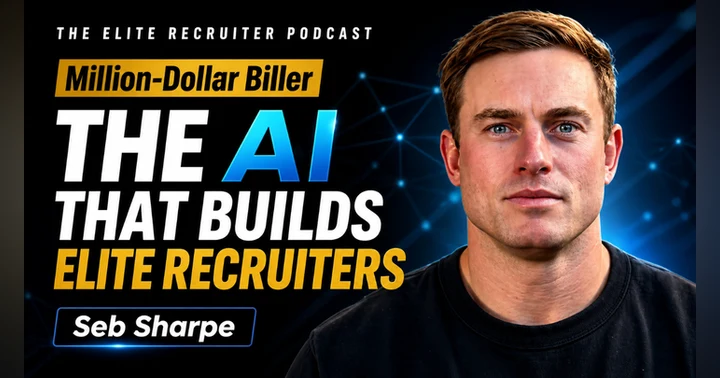
Million-Dollar Biller: The AI That Builds Elite Recruiters
Welcome to The Elite Recruiter Podcast! In this episode, host Benjamin Mena sits down with Seb Sharpe, a former million-dollar biller turned entrepreneur, to dive deep into the realities behind top-performing recruiters and the evolving role of AI in the industry. Seb Sharpe shares his candid insights on why relying solely on AI may actually accelerate a recruiter's irrelevance, the crucial difference between speed and quality in recruitment, and what it really takes—behind the scenes—to build a multi-million dollar book of business. Together, they explore practical strategies, hard-earned lessons, and the mindset shifts necessary to compete and thrive as the future of recruiting rapidly changes. Whether you're a seasoned recruiter or just getting started, this episode is packed with actionable advice and a peek into the relentless work ethic that sets elite performers apart.

 Spotify
 Apple Podcasts
 YouTube
 Castro
 RSS Feed
 Amazon Music
 TuneIn
 Audible
 Two million-dollar billers. A $4 million book. They walked away from all of it — at the peak of their performance — because they believed most recruiters were about to learn the hard way that AI doesn't save careers. It exposes the ones built on shaky ground.
🎁 Try Millee free for 30 days: https://www.millee.ai/
Seb Sharpe is the co-founder of Millee, an AI recruitment intelligence platform powered by 15 million tokens of what he believes to be the highest-quality data in recruiting. He's also co-founder of Generate, the "business in a box" infrastructure play built for the next generation of agency recruiters. Before any of that, he and his business partner Charlie Rawlings — friends since age 12 — built Inventure into a $4M renewable energy search firm out of Los Angeles. Then they walked away from the desk to build the thing they thought the industry was missing.
In this conversation, Seb makes the case most recruiters don't want to hear: the ones betting on AI to save their careers are actually accelerating their own irrelevance. He explains why the contingency hit ratio sits stubbornly at 25%, why "more emails faster" is the wrong problem to solve, and why reputations across the industry are about to be won and lost at speeds nobody's prepared for.
He breaks down the math behind a million-dollar desk that almost nobody talks about — the first $400K happens between 8:30 and 5:30, and the remaining $600K happens between 5:30 and 10pm, for months on end. He shares why "only the paranoid survive" is the operating principle of every elite biller he knows, even in their best quarters. And he reveals the mentor advice from Joel Slanning that took Inventure from $1M to $4M with healthy margins.
You'll also get an inside look at Millee itself — how it sits inside your inbox like a $3M biller looking over your shoulder, how its health-score dashboard exposes the deals you think are alive but aren't, and why it's just as powerful for entry-level recruiters as it is for top performers. Plus Seb's read on the bifurcation coming for the industry: the recruiters who'll use AI to triple their output, and the ones who'll quietly fall behind.
The AI Recruiting Summit returns in July, and Seb is one of the featured speakers. If 2026 is going to be your year, this is the room. Details and registration: https://ai-recruiting-summit-2026.heysummit.com/
🎁 Try Millee free for 30 days: https://www.millee.ai/
🔗 Connect with Seb on LinkedIn: https://www.linkedin.com/in/seb-sharpe-01b89840/
🚀 Learn about Generate: https://wearegenerate.com/🎯
🎤 AI Recruiting Summit, July 2026: https://ai-recruiting-summit-2026.heysummit.com/
📺 Watch on YouTube:
👥 Join the Elite Recruiter Community: https://elite-recruiters.circle.so/checkout/elite-recruiter-community
Benjamin Mena [00:00:00]:
Coming up on this episode of the Elite Recruiter Podcast, what's like one thing that most people don't see behind a
Seb Sharpe [00:00:08]:
million dollar biller, that only the paranoid survive.
Benjamin Mena [00:00:10]:
You believe that a significant chunk of recruiters who are betting on AI to save their career are actually accelerating their own irrelevance.
Seb Sharpe [00:00:18]:
I understand it's a hot take, but welcome to the Elite Recruiter Podcast with your host Benjamin Mena, where we focus on what it takes to win in the recruiting game. We cover it all from Sal marketing mindset, money, leadership and placements.
Benjamin Mena [00:00:38]:
I'm excited about this episode. This is a conversation that I've actually been looking at having for a while because I've been watching from the sidelines what these two individuals have been doing. These are both million dollar billers and I have only one of them here with me today. Million dollar billers that walked away from their desk. They walked away from their business because they knew all the information, everything that they've done, they figured they could package it up and help other recruiters help other recruiters do exactly what they were doing. And this is why I am excited about AI and the future of AI. But at the same time, like you and me can't hop on LinkedIn without seeing like AI this and AI this and hype this and hype that. And yes, it has been overhyped for a while.
Benjamin Mena [00:01:25]:
We are now walking to the time period where AI can really move the needle for the recruiter. That's why I'm excited to have this conversation. So we're just going to dive right in. The industry is celebrating AI like it solves recruitment. We hear it all the time. But we talked about this in the pregame and you said the contingency search is still only about a 25% hit ratio. It's probably even lower than that. So we're not even closing three out of the four jobs that we saw.
Benjamin Mena [00:01:53]:
So that's stuff that we're just not filling. Why are we spending billions of dollars on the top of the funnel to make everything faster when we should be working and spending time on what actually gets deals closed then.
Seb Sharpe [00:02:06]:
Thanks for having me on. And yeah, great question. And one, I get asked all the time because naturally it's a big part of our hypothesis with Millie, but I think first and foremost recruiters are known for finding great candidates or if you're somebody that's in a candidate driven market, you're known for being in touch with fantastic clients. So with these top of funnel sourcing tools like naturally, just from an endorphin standpoint, you're able to just to click very, very, very quickly and all of a sudden pile up like 100 different candidates that you've just contacted. I cut my teeth in the day where you would add someone on LinkedIn as a connection, wait for them to connect, wait for the email to come through, send them an email, send, give them. That process was so arduous and all of a sudden now you can just click and 100 people have popped up. So I think there's probably like that change of pace that has got people quite addicted to these top of funnel tools. And while I think they're really fantastic, I mean, if you look at some of the technology out there, like it's changed my business, it's changing every recruiter out there.
Seb Sharpe [00:03:02]:
However, I think it still doesn't address one of the most critical issues that our reputation is facing right now, especially as internal recruiters become armed to the teeth with AI, which is that at a baseline, we're filling one out of four positions. And with AI, with this increased pray and spray, I think reputation is going to be so, so important. It's not necessarily the email that you're sending, but the person behind the email. And so I think that while the access to increased emails and finding the right people quickly is very good, I think that there's a serious danger in play right now of it costing us our reputation. And so as a business, our entire mission is to focus on how effective are you beyond that point of introduction, which we think is probably the most critical part of the role and will only become more critical as AI evolves.
Benjamin Mena [00:03:48]:
Okay, so you were a million dollar biller. Your partner was a million dollar biller. You guys are running about a $4 million book of business. You guys, a book, a team, a business, a desk that was working and you guys kind of like both stepped away from it. Like, you guys are now spending what, 14 hours a day building this product, seven days a week, the last nine months. Like, my God, that's like. Or hardcore recruiting time. A lot of people would have just hired a consultant to come and build it.
Benjamin Mena [00:04:15]:
Like, why was that not enough for you guys?
Seb Sharpe [00:04:17]:
Yeah, it's a great question. And naturally, as you can imagine, there are many, many late nights or early mornings or middle of the nights where I'll wake up and go, what the hell are you doing? So, so of course, like, these are questions I'm asking myself very often. But you know, I think that we're just, we're experiencing this moment in Time where there are people building incredible products. And for me and Charlie, like, the reason we got into the entrepreneurial game was not to just, like, make buckets of money for ourself, but to have a real impact on an industry, like, to create something that really pushes the industry forward. And we had a fantastic team. We still have a good team, and it was going very, very well. But I think we looked down the barrel of where the next 10 years were going. And the notion of running a boutique and earning a great bit of money and kind of living in our little corner of the world, over in la, where we're based, just wasn't really doing it for us.
Seb Sharpe [00:05:05]:
And so as people who have just always been obsessed, like students of recruiting, endlessly researching the best that are out there, we've worked with, like, three or four mentors that we've paid for four years, just gleaning as much information as we can. We saw this very unique opportunity to create a product that wasn't just, you know, making Charlie and myself a little bit better, but to genuinely push the industry forward. And I think that, you know, every conversation I have with someone, what's the latest and greatest AI tool? What should I be using? What's everybody else using to make me better? And we just thought this was a very unique opportunity for us to create something that just gives everybody the confidence to feel like they're in the driver's seat on the agency side of recruiting. So I think it was this kind of like this higher calling to create something that had a larger impact on the wider industry. And I can rabbit hole down that, but perhaps that's a good place to start.
Benjamin Mena [00:05:53]:
So this is something that we said in the pregame and we covered again before we hit the record button. And I want to make sure that the audience hears this. You believe that a significant chunk of recruiters who are betting on AI to save their career are actually accelerating their own irrelevance. Explain that.
Seb Sharpe [00:06:11]:
Yeah, so I. I understand it's a hot take, but if you think about what AI actually is doing at the moment, it is helping you do the core functionalities of recruiting, I. E. Finding good candidates, negotiating, et cetera, et cetera, it's helping you do that much, much, much more quickly, but it's not necessarily helping you do it more effectively. The person behind the email, the copy that you're writing, the way that you're actually showing up in the market, AI can help you a little bit. Right? But it's not primarily where it's focused. I think at the moment it's focused on what I mentioned before, like the endorphins. How many candidates can you add? How much automation can you do? And, and so I think for folks that are already perhaps in need of a little bit of help in terms of like building their reputation or writing the right email, positioning the client in the best possible light, instead of focusing on that piece, which I think drives in a million dollar book, they're focusing on like how much automation and how much speed can I optimize for? And so naturally, if you're an average recruiter or you're an okay recruiter, or worse, you're a bad recruiter and now all of a sudden you're spamming the market at 25 times the speed that you were before.
Seb Sharpe [00:07:17]:
Now you're just that recruiter that doesn't really have a reputation and a brand for themselves that's just blowing up every single person on the market. And I think that if you're not careful, you can very, very quickly eviscerate your reputation within a space because you're optimizing for automation and speed instead of quality and depth of the work that you're doing.
Benjamin Mena [00:07:35]:
I'm excited because like, I have some questions wrapped around like you guys being a million dollar billers and what the future of that high performance recruiter actually looks like. But before we even start diving in, let's take a few steps back like Seb, welcome to the podcast. I've been looking forward to this conversation for a while. Give Everybody a quick 30 second self introduction.
Seb Sharpe [00:07:53]:
Yeah, no, me too. I'm excited to get into it. So, all right, quick rundown. Born and raised in Surrey, moved to Los Angeles when I was 18 to go to UCLA. Finished college. That was fantastic. I've only worked in recruiting since college. I started my career at the famous GQR in our LA office, which was a fantastic training ground.
Seb Sharpe [00:08:11]:
Did that for three years, moved to Chicago to open an office for those guys, kind of worked remotely there and then started my first agency back in 2018 with my good friend and business partner Charlie Rawlings, who I've known since I was about 12. We started in New York, moved to LA around the kind of COVID time. We've been running the business for about eight years now. And now I'm the co founder of Milli, which is a AI application and Generate, which is more of a sort of a recruiting infrastructure play. So yeah, that's the quick rundown on
Benjamin Mena [00:08:40]:
me and real quick for everybody that's listening, they can get a Free Millie account. How do they do that?
Seb Sharpe [00:08:45]:
Yeah, so real quick, I think that with Millie, we're so bullish on the value that it's adding, we're just giving it away for free for a month. If you're interested, try it out. If it's working for you and adding a bunch of value, great, you can keep it on. It will start at about 30amonth and if you hate it, you can get rid of it. So, yeah, free 30 day month. And you can find that link just on the website.
Benjamin Mena [00:09:05]:
Awesome. And I'll have the link in the show notes or hit up Seb on LinkedIn. All right, so I gotta ask this. You and Charlie, like, you guys knew each other from the age 12. Like, you guys didn't start at the. Or you guys didn't meet at the recruiting company. You guys put the school together. So you've known this guy literally your entire life.
Benjamin Mena [00:09:26]:
What does it actually look like to go into business with somebody that, you know, knows you so well and knows where all the bodies are hidden?
Seb Sharpe [00:09:32]:
Yeah, knows where the body's heading is exactly right. You know, when, like, when you go to school together for, like five years, I think you are obviously going to work out quite quickly. You know, all, like, little rough patches where you disagree on things and you, like, you come to terms with all that stuff at a very young age. And I mean, like, we went to school together in the English countryside. We were playing rugby together, we were in classes together. We've been through thick and thin. So for Charlie, he moved out to America to start inventure back in 2018. That was like a huge.
Seb Sharpe [00:09:59]:
He was working at PwC, he was working in finance, and he just took this huge leap of faith. So I think, like, all of the little small things, like all of the, you know, the rough, as I say, wrap the rough around the edge of stuff. We'd, like, been through that for years and years. But when we both kind of took this leap of faith and started the business, I think that that context for how much, you know, we're putting on the line and how well we know each other just amplifies the importance of every decision and allows us to just be ridiculously transparent with one another. And, you know, whether it hurts your feelings or not, which I think has been a real strength for us.
Benjamin Mena [00:10:31]:
Okay, so you and Charlie, your first Office was in WeWork with a subway rattling, probably like interrupting your phone calls. Walk me through what that first year actually looked like and not the highlight reel.
Seb Sharpe [00:10:44]:
That's a good question. So I guess the first year we moved to New York, December 2018, and I had just come from Chicago, which is pretty bloody cold, but in Chicago it's so cold you don't really go outside. For any listener that's in Chicago. We're in April, you're almost there, the summer's around the corner. But anyway, New York, you're walking around everywhere, right? So we would wake up every day at 6am we'd walk to the gym, we'd then walk to our office and then walk back. And you know, in the middle of that there was 12 to 14 hour days where both of us were just like, well, first of all, I was still a very young recruiter with plenty to learn. Charlie was brand new to recruiting. So as you can imagine, it was just 12 to 14 hours a day of madly trying to get any deal possibly done while absolutely littered with imposter syndrome every single minute.
Seb Sharpe [00:11:31]:
And I think that that was really good for us, right, because you know, there's that famous expression in sales, only the paranoid survive. And I think that that certainly was the case for us. We started out in accounting and finance, recruiting, a very gritty market, reaching out to audit associates in Chicago, all the rest of it. And it was a fantastic first year. You can imagine that we certainly celebrated the wins as a couple of young 23, 24 year olds living in New York. But it was, it was a grind, it was a lot of fun and it certainly shaped our character for the
Benjamin Mena [00:11:58]:
rest of the journey, I got to say. Like, we work, like, how did you even stay focused in? We were. Because I remember working out of a wework and I don't drink beer, I hate beer with a passion. And this is like back in the VC money days, they would drop off a bottle of wine at my desk at 6pm every single day. A brand new bottle. How the hell did you guys stay focused to bill $1 million your first year working in a place like that?
Seb Sharpe [00:12:22]:
Yeah, yeah, I know all too well. The 3pm we work, cocktail car on a Tuesday, saying, would you like a margarita? It's like, what do you what? But no, I think that like being in New York City, like in a we work, you're surrounded by other startups and, and New York is a bloody expensive place to live. So it's not somewhere where you can just kind of figure it out for six months and see where you go. It's like rent is due on the first of every month for your apartment, for your office, for all of your contracts. And so there were Distractions. And the building itself was relatively ancient, as you mentioned. It was the first ever wework. Adam Newman wired it by hand himself.
Seb Sharpe [00:12:59]:
I think the week after we left, there was a huge storm that blew the ceiling out and flooded our old office. All this crazy stuff. But there's certainly that New York state of mind, that New York energy. So it was great to be around. And funnily enough, the guys who actually ran a vegan yogurt company were behind us. And we're still in touch with those guys to this day. Shout out, Coco June. You guys won't be listening to this, but because you're in a different space altogether.
Seb Sharpe [00:13:24]:
But it was fantastic.
Benjamin Mena [00:13:26]:
I got to ask, did Adam really just walk around with our shoes?
Seb Sharpe [00:13:30]:
I didn't see him. I would have loved to see that, but I heard that he did, even on the freezing cold days of New York.
Benjamin Mena [00:13:37]:
So how like you guys hit that million dollars like your first few months in business? Like, when did things really start rolling out? What did it actually look like underneath the hood that nobody saw?
Seb Sharpe [00:13:46]:
Yeah, so I'll just, I'll just start by saying we, we got some enormous momentum in the first month or two. Like as soon as we started, I essentially had a hot list of clients to call up right away. And the first couple of days were just essentially blitzing through that list with a combination of, of things. Like, first of all, an enormous amount of confidence. Like, it's not just, hey, we're going out on our own to see what's going on. It's, hey, we started our own business. We have a really specific strategy for how we're attacking the market and the value that we're going to add. With that said, we are new and we are vulnerable and we're looking to partner with some early kind of design partners, so to speak, on our search practice.
Seb Sharpe [00:14:23]:
And off the back of that, we landed a retainer on our first day of business, which was a significant retainer. And we were introduced to the sister company of a very large private equity fund. Those two bits of business ultimately gave us kind of the rabbit chase very early. It's one of those, you know, it's one of those things that is material that can drive your work ethic on a day to day basis. We closed out those two or three searches and then as you can imagine in the background, we're still knocking out two hours of business development every single morning. So we were very fortunate, we were very hardworking. But we created that, that economic flywheel very early so that get on our Two feet as a business.
Benjamin Mena [00:14:59]:
All right, so talk about this. Like the two hours of bd, you guys literally stuck to that every single day. What did that two hours look like?
Seb Sharpe [00:15:06]:
Yeah, every single day. To be honest, the engine was NPC specking. We're big on NPC specking. I think that we are in a market where really good candidates were hard to come by. So if you'd find somebody with private equity accounting experience in a specific location that was active, you know, people will talk to you. So we would drive with a combination of email, NPC specking in mail, on the LinkedIn side of things, specking. And then naturally, like every single one of those, we would do our very best to follow it up with a cold call. Probably not enough cold calling.
Seb Sharpe [00:15:36]:
Early on, we could have done much, much more, but that was the cycle. And then I think above all, like a book that imprinted on me early was Eric Rees, Lean Startup. And ultimately everything that we were doing was just build, measure, learn, build an email, build a strategy, measure it, learn if it worked, repeat, compound on what strategies were working, quickly move on from emails and approaches that weren't working. And I think that that approach put us in very, very simple, but was very effective for us early on.
Benjamin Mena [00:16:05]:
And when or how did you guys make the decision to switch into the energy market?
Seb Sharpe [00:16:11]:
Yeah, so fast forward. Like, we had finished a couple of years. No, we'd finished a year in New York, about a year and a half. And we had hired a lot of people from my old business and they were all based in Los Angeles and that office was continuing to grow. I think we were up to like seven people in LA within the first year. Charlie came to our bedroom one morning and he was just like, hey, man, our businesses, this is really fun, but our business isn't is in la, it's not in New York. We gotta go for the voice of reason, as always. So we made that decision, we went back to Los Angeles and then boom, about a week and a half into our move, Covid hit right away.
Seb Sharpe [00:16:45]:
And that was an interesting time for everybody. But within our space, and at this point, the business was split in three. We were renewable energy. We were quantum slash kind of startup engineers and accounting and finance. We kind of mirrored my old business, GQR in a way. We were broad. However, during COVID the private equity and kind of tech spaces, our specific verticals really dried up. There was not much business, to be honest, but renewable energy was just pumping.
Seb Sharpe [00:17:11]:
There were these government scale contracts. Like the industry was. People were going on site. It was one of those markets that just accelerated during COVID and we saw that happening. And I think just naturally for everyone in Covid, it was a time of introspection and outside of just the fact that it was economically very, very viable for what we were trying to do, just on a mission driven perspective, we did like the idea that we were putting clean megawatts in the ground and pushing the world forward. So I think that those two things, it was like the intersection of economic opportunity and doing the right thing that drew us to renewables and sprinkled in with a few mentors being like, you guys have got to focus in one area. So that was how we landed on renewables and we didn't look back.
Benjamin Mena [00:17:52]:
I'm going to dig into these mentors later for listeners. Just watches, you watch. But I want to switch gears. I like, I want to switch gears a little bit. You said a phrase during our pre game that I just literally can't stop thinking about because it is just so true. You said AI in recruiting has just created more noise at scale. Unpack that.
Seb Sharpe [00:18:11]:
So I think I allured to colors of this a little bit earlier. But if you think about what AI has allowed everyone to do, as I said, it's speed and automation, but it's not optimizing for quality. So if you think about it now, let's walk through the average day of like any stakeholder within the world of recruiting, whether you're a hiring manager, an internal recruiter, recruiter, candidate, you are now receiving from a recruiter, probably 10 times the volume of emails that you were before. And then if you look on your LinkedIn feed, you're probably seeing 10 times the amount of LinkedIn posts that you did before. Most, not most of which, but much of which is AI assisted. There's a lot of AI slop that's out there. So now if you look at like every medium where someone is putting their attention, emails, LinkedIn, phone calls or whatever, like a lot of it is just packed with more volume and not necessarily more quality. Now, of course there's an enormous amount of quality that's popping up.
Seb Sharpe [00:19:04]:
The deep research reports, the access to more candidates, et cetera, these are all very, very good things. But I think that people are slowly but surely getting immune immediately when they see something that was clearly orchestrated by an agent or an AI or something like that. And so as I say, more noise at scale. Some of it's really good, but it's certainly harder to differentiate yourself. I reckon in an AI world today, just because of that volume.
Benjamin Mena [00:19:29]:
And another thing that you said, it really stuck out was we live in a world where it's a combination of AI TikTok algorithms, like four or five quick second to hits and then a seven page deep research report, which is freaking amazing. I love these. But you said the secret is in the middle. Can you explain that?
Seb Sharpe [00:19:48]:
It's my opinion at the moment that like if you look at an average social media feed or just like any medium where you get your content, on the one side you have six second videos or less, right? And most people are scrolling through those before they're over, let's be honest, right? So there's one part of your brain that's like, I, if I'm not getting value within one or two seconds, we're moving on. And then on the other side, AI is ridiculously popular. And what is AI doing? We've got note takers that are giving us seven page transcripts after every single call. It's giving us huge deep research reports. It's just providing an enormous amount of volume because all of these models are by the way engineered to be verbose to some degree. And I think that when someone like, if you think of somebody at the moment, maybe they have 15, 20 calls a day, they're not going to take the time to read four or five pages of a transcript right after a call. They might process that through like an AI or whatever to get like the bullet points. But there's this kind of like this balance where like they really want the depth of an AI and they want that deep research report and yet they don't have the attention to watch a six second video.
Seb Sharpe [00:20:49]:
So I think that the winners in the space and the people that are really kind of shaking the trees are the folks who are able to like find that really nice balance of simplicity for the user. A lot of complexity on the back end in terms of engineering and the process that goes in, but it just presents to the user in a way that's remarkably simple. Here's the three or four things you should know, here's what you might want to do about the situation, or here's the three or four best candidates on the market, here's who to email. So it's people who are finding that balance. And I know that's like an abstract thing to say, but yeah, it's where I'm at on the balance of attention today.
Benjamin Mena [00:21:22]:
And I want to kind of switch gears because I think this, the application of AI is going to be the important thing. Let's make this real for somebody that's listening. Let's jump into Millie. Like, walk me through a Monday morning with a recruiter using Millie. Like, not just the marketing version, but like, how their day actually starts.
Seb Sharpe [00:21:43]:
Yeah. So I suppose I should preface by just giving a rundown on. On Millie, like, high level. So you have some. Some context place to start. Yeah. Okay. So Millie is a recruitment intelligence application that's powered by 15 million tokens of what I believe to be the highest quality data in recruiting.
Seb Sharpe [00:22:03]:
You know, perhaps in the world. It's. You mentioned, like, we left our desk nine months ago. Essentially, Charlie and I just became recruitment historians and built a data set which we think has the highest quality in terms of what to do about every single possible recruiting scenario that happens in a workflow. So that's the engine. And then Millie essentially, like Claude appears in many different mediums. It has a Chrome extension, it has a dashboard for your analytics, and then there's like a Claude skill connector as well. So your question, like, what, what does an average day look like? How would somebody work on Milli on like a Monday? So the first thing is like, they'll open their inbox, and even if you are really working hard, I'll imagine that you have 20, 30, 50 emails in your inbox that need actioning.
Seb Sharpe [00:22:44]:
The problem is, right, as a top recruiter, like, I think everyone's looking for that edge to be working incredibly effectively, but also quite quickly. So Milli is a Chrome extension that basically just like, lives within your email or your LinkedIn inbox or whatever sourcing tool that you're using that has an inbox. It is going to analyze every single bit of data and context that's happening within your process. So, Ben, let's say you are a candidate. It's going to look at the email that you've just sent me, but it's also going to be incredibly aware of the hiring managers and the stakeholders in that process who are talking to you. And it then takes all of that context. It looks at how you traditionally like to speak historically based on your interaction with the app. It looks at our corpus of knowledge, and then it just drafts for you a really, really strong response to that email.
Seb Sharpe [00:23:25]:
And it shows you exactly why it chose it. Or perhaps it shows you, like, a transcript. There's a few different options. So if you're a top biller, you're going through your inbox and instead of spending like two hours clearing that out, you can basically just quickly, like an engineer reviewing AI code, you can just look at the response and go, yep, that sounds like me. That's how I would think. We're also uncovering some hard truths about this process. Insert reply and you rip through your inbox with high quality, high judgment, controlling responses in the space of maybe 15 minutes instead of a couple of hours. So that would be the first thing.
Seb Sharpe [00:23:55]:
That's the chrome extension. Maybe you then have a team, or perhaps you don't have a team, but you're then getting into your Monday morning where you're like, all right, let's have a look at, like, how we're actually progressing, you know, as a recruiter. Let's look at the analytics and you open up your dashboard and there's so many fantastic CRMs out there that I really, really respect. But at the end of the day, at the moment, CRMs are basically just providing you with, of course, your candidates and all that good stuff. But numbers, like, how many first time interviews, how many vacancies, whatever, how many leads do you have? It's just giving you the numbers. But for the first time in history with AI, we're actually able to reason about really large, messy data sets. Not just like, what are the numbers, but what was actually said in those conversations and what are the implications of that. So with Millie's dashboard, it's giving you basically, if you're a Garmin or a whip wearer, it's giving you a percentage health score on every single candidate and deal.
Seb Sharpe [00:24:45]:
Looking at the numbers, yes, of course, but also looking at like, what was actually said in all of those emails, what was actually said on those calls, and as a result of that, how healthy are those deals? So just to give you an example, maybe I have a deal where I've got five candidates in play, but Millie saying, hey, Seb, you know, nice job on the candidates, but I'm going to give you like a 39% health score. And I go, hang on, what the hell? And I go in there and it's like, hey, look, you've got four candidates in place. But all of them have just raised really material hesitations about the job. On the last call, none of them are going to look like closing. So that's really good data for me because then I can reprioritize and focus my efforts. But then of course, that scales to the billing manager who's looking at all the health scores of their consultants. And the conversation is now not like, all right, guys, what's happening in your process? Who have you got in play? It's okay. So we can see all of the problems here.
Seb Sharpe [00:25:34]:
What are we going to do about it? Which strategy are we going to implement? So I guess like as a Monday, you've cleaned your inbox, you've then had this data analytics kind of approach to your pipeline and then you move on and essentially like that kind of motion will scale. If you want to start creating market reports, doing other fun stuff, jump on the CLAUDE code connector and do things. But maybe that's like a good place to start in terms of the value that it's adding on a day to day basis.
Benjamin Mena [00:25:55]:
I got a chance to see the dashboard and literally the first thing I thought was like, man, that's like, whoop score. I was like, or at least on I have the Apple Watch, I was using bevel for a while and I'm like, just always digging the data. I'm like, how do I get like a 100 for my night's rest? Oh my God.
Seb Sharpe [00:26:10]:
Yeah, yeah, yeah, yeah, yeah. It's funny that you say that. Like, you know, we've obviously got people on the product now and like the, like, one of my favorite bits of feedback is like, we'll have consultants that will go in and see their health score on deals. And they're like, ah, I saw that health, you know, health score and it really pissed me off. Like, and I immediately went into my CRM and it penalizes you for things like, oh, you only have one champion at that account. Okay, so your entire deal relies on that one stakeholder. And they're like, no, I have two stakeholders. And so they get into their database immediately, start filling things in to give themselves a better health score.
Seb Sharpe [00:26:43]:
And as you can imagine, it's like a business owner or recruiter having increased database hygiene. I think it's the one area that everyone hates doing. But creating like some competitiveness around it, at least in our business, has really driven a lot of productivity for people
Benjamin Mena [00:26:56]:
that don't understand tokens and don't understand the, the back end of AI. Like, you guys said that. You guys, was it 10 million tokens, 15 million tokens of information that you and Charlie spent months building? Like what? Like, for someone that doesn't understand AI, like what actually went into that? How do you take 10 years of knowledge and put it into the magical machine, the LLM?
Seb Sharpe [00:27:21]:
Yeah, yeah. Well, first of all, in order to like bring this product to life, as you can see from our LinkedIn, like Charlie and I did not study computer science at Stanford, so we hired a couple of people that did and they helped us actually bring that product to life. They've got Ton of AI pans, they're engineers and all this kind of stuff. So to bring that to life in a way that's scalable, you know, fiscally responsible, these are things that take. That take a degree and experience. But anyway, on the token side of things, I mean, in short, what that looks like is, first of all, you need 800 to a thousand documents that you've written out. Breadth of data is obviously very, very important, and that can be anything. Like, let's just take, for example, a recruiting situation.
Seb Sharpe [00:28:00]:
Okay. A candidate, all of a sudden, late stage, decides that their compensation number has drifted, Right? So what are we doing? We're putting pen to paper and writing out 5, 6, 7 potential responses for how to deal with that based on lived experience, but also based on researching in depth as many deals as humanly possible around what happened in those situations to win that deal, to bring it back to life. So writing out situations like that, and then, most importantly, it's written in a way that is very friendly for an agent to look at the metadata, analyze if that file is relevant for this specific scenario, and then either move on or select it. So it's a combination of just an enormous amount of late nights on a Saturday and a Sunday, writing these huge, huge data sets, but then building it in a way that's friendly for an AI to then actually analyze it and choose from it when it needs that data.
Benjamin Mena [00:28:48]:
So many late nights with your significant other on the couch, or you're typing all this up or talking all this through.
Seb Sharpe [00:28:54]:
Yeah, yeah. By the end of it, my significant other was teasing me a lot about my usage. What are you doing? I'm working on the corpus of knowledge. And she's like, if I hear the word corpus one more time, I'm going to lose my mind. But luckily, she has a good sense of humor and has put up with it.
Benjamin Mena [00:29:10]:
Hey, Coachella helped, right?
Seb Sharpe [00:29:12]:
Yeah.
Benjamin Mena [00:29:14]:
With everything that you guys are putting into it and watching as it evolves, like, what do you see as the impact that it's going to have on a recruiter or recruiting team?
Seb Sharpe [00:29:24]:
So I think that from my experience, anyway, one of the big differentiators between quite good recruiters and excellent recruiters is their ability to analyze enormous amounts of context around a deal and then essentially use their judgment to ask the hard questions and make decisions, right? So when somebody seems quite engaged in a job. Right. Or they're quite sold on a job, or perhaps vice versa, the client is quite engaged with that recruiter on the search. The excellent recruiters have this ability to See what's actually being said in those conversations, draw an analysis from it and then decide, okay, what are we actually going to do about that, about that situation? Right, so how are we actually going to push that deal forward? And maybe sometimes that means eliminating a candidate or breaking up with a client and focusing your attention elsewhere. But at the end of the day, right, you only have 12 or 14 hours of work a day on average. Millie is ultimately helping you draw analysis from every deal that you're working on with increased depth and effectiveness and then push those things forward. So I think in short, like if you just look at recruiting holistically, like why do people work with recruiters? They find the very, very best clients or the very best candidates for their clients. They are able to provide market intelligence, like how do we build org charts, what's going on in the market, all this kind of stuff.
Seb Sharpe [00:30:43]:
And then the third bucket is like, how good is their judgment and salesmanship and process control, like how effectively do they sell those candidates, push that timeline forward so that we can kind of stay on budget and just generally add a sense of gravitas to the process. And then I think across all three of those things, your reputation as a recruiter, like who you are, how well you're known, that reputation allows you to push all those three things forward. Like if you've got a rep, candidates will respond to you and clients will respond to you. They'll listen to you and defer to you on deals and then of course, they'll listen to your market intelligence. So merely like the, the value that it's adding is it's massively amplifying your ability to process huge amounts of context, add a sense of judgment, and then control and push deals forwards through the form of like as I say, emails written transcripts written out for you, et cetera, et cetera. And then through doing that incredibly effectively, it will bolster up that kind of like that overarching pillar which is your reputation, you'll begin to become known as somebody that's very, very effective at identifying weaknesses in a process and pushing them forward. So I can go deep on like how that materially like pops up and how it looks. But hopefully that's a good overview.
Benjamin Mena [00:31:50]:
And I want to talk about Generate also. So you guys have Generate, you guys have Milli and how is it the AI layers interacting with those two and for those that don't know what is Generate.
Seb Sharpe [00:32:03]:
Yeah, so Generate basically is our other venture. We started it in January. We've already attracted some world class billers. We're up to about 25 people already. Our goal was to be 100 within the first year. But in short, I think that it's my prediction that because of AI and brand reputation becoming so important and folks just across America generally having this enormous desire to work with more autonomy and entrepreneurialism, I think that folks are generally trying to become an entrepreneur, right? Or at the very least they're trying to work their own hours with their own control, et cetera, et cetera. So again, like we were running an agency that was going very well, but we thought to ourselves we can either build this agency and try and get to 30, 40, 50 headcount or we can build this infrastructure for the next wave of recruiters, which I think is more like, you know, solopreneurs or perhaps groups of five operating with just an enormous amount of efficiency and effectiveness within that space. So generate insured as a business in a box.
Seb Sharpe [00:32:59]:
We give people the technology, they retain their own brand, we give them all of the L and D that they might need from some of the best heavy hitting advisors and mentors in the space. And then as a community there's obviously the commercial collaboration and things like that push things forward. We also have this like quasi equity piece which is our referral fund which allows them to make a lot of money if they help us grow. It's the infrastructure for the next generation of recruiters and that launched January 2026.
Benjamin Mena [00:33:24]:
So I want to talk about what you have done as a million dollar biller. I want to talk about what walking in with that work ethic or we'll say early mid AI because I think we're still early in the process. And I want to talk about how that high producing producer is going to be a few years from now. So three stages. What did it take and what did you do to become that million dollar consistent biller?
Seb Sharpe [00:33:51]:
I think million dollar billers are very meticulous with their time. Every single hour of the day is planned for and is held accountable for. Like not just like what did you do? But what did you get out of it? I think one of the biggest differences I noticed is like what are you doing in this hour? Like well I'm headhunting for such and such role. It's going from that to what are you doing in this hour? I am going to find two candidates for this position. So it's making that that shift from like I'm going to occupy my time doing this versus I'm going to achieve this in the hour. So first of all, like Every hour is planned for an accounted for. Right. I then think that they're very balanced in their day.
Seb Sharpe [00:34:29]:
So they are very intentional about splitting up business development, candidate acquisition, admin. And they don't do the classic merry go round where it's like InMail, email, cool, like LinkedIn and they just kind of like go around. It's like everything's off. I've got one tab open. I'm just laser focused on this one thing. Right. So they're varied, they're meticulous. There's a sense of focus.
Seb Sharpe [00:34:50]:
Specialization within your niche is obviously very, very important. The things I mentioned about before, like your ability to control deals, your ability to apply judgment, think really great access to the best candidates, those things are really important. And then on top of all of that, I would just say they work much harder. I think that to bill $400,000, that's happening between 830 and 530. The remaining 600,000, that happens between 5:30pm and 10:00pm And I'm not just talking about like one late night where you order in a pizza and watch Thursday Night Football. I'm talking about doing this for months and months and months and months. It's not something that just happens. I think it's a pipe dream where there's people who are working the three hour work week and billing a million dollars.
Seb Sharpe [00:35:29]:
It takes an enormous amount of effort and lift and weekend work and things of that nature. So those are just a few things off the top of my mind.
Benjamin Mena [00:35:38]:
Okay, let's shift now into this early AI phase where AI is. We're getting past some of the hype. We've been hearing this bullshit for years that AI is going to save you time. And in reality for most recruiters it's been wasting them their time. But for those high performance recruiters, like I'm starting to see them, like for those listening, I have an interview coming out soon. 740k or 720k in less than three months. There's recruiters out there that are doing it. So this early AI recruiter, high performance recruiter, what's going on underneath the hood? Like what are they doing? Talk me through them.
Seb Sharpe [00:36:12]:
Yeah, great question. I think a lot of people have this perception that like there are certain things that recruiters are doing with AI that are different from like the current day to day. It's like, oh, these unbelievable. Recruiters are using AI and there's like this new secret methodology that they're using with AI that's allowing them to find clients and candidates and Close them all. In it, AI is amplifying strengths that recruiters already had. Like, it's not creating new methods of work, it is just increasing like the effectiveness and the efficiency of methodologies that they may have been using for years and years and years. So I think like really the difference between a pre AI million dollar biller and a post AI maybe 3,4 million dollars biller is that they're still working 12 to 14 hours a day, but they're just achieving three times as much in that time window because they're able to contact the market much more quickly. They're able to add value in the form of research reports and guidance much more effectively and with more depth.
Seb Sharpe [00:37:08]:
And then the way that they're using judgment and salesmanship and all that kind of stuff, they're just able to be very, very nimble and effective. So I think when folks are like looking for the secret sauce, the magic answer, like this magical catalyst that's like hidden somewhere in Pandora's box, like that doesn't exist. It is the basics done very, very well, very, very effectively and just at more speed. So yeah, and I can get into like all of the various different tools that I think are helping them achieve that.
Benjamin Mena [00:37:33]:
What do you think that post AI recruiter, that high performance recruiter is going to be capable of?
Seb Sharpe [00:37:39]:
That's a good question. Again, like, I'll go back to the notion that they'll be able to achieve perhaps three to four times more in the same amount of hours. Right. So their productivity per hours is going to be much, much higher. However, I do feel like this will come full circle where there's going to be so much noise that eventually people will be overwhelmed and then there's going to be somewhat of a calm after the storm. And I think at that point it's the people who have really like dug their heels into a market and built out a strong reputation and they're known within their space as having access to all of the best companies within that area or all of the best candidates. I think that the folks that like, you know, you talk about king making and stuff with companies, I think there'll be people that ultimately define themselves as like the category owner within their space. And because of the tools that they have, maybe a search that would traditionally take them like four months to close might take them four weeks.
Seb Sharpe [00:38:30]:
As I say, I think there's going to be so many things that happen. I think people will burn their reputations. I think that people will make their reputations, but it's just going to Allow people to do their job much more effectively and at much more speed.
Benjamin Mena [00:38:40]:
Do you want to talk about tools or do they have to hit you up personally for about that?
Seb Sharpe [00:38:45]:
God, I don't know how much I could talk about tools. Yeah, I don't know. LinkedIn. Just use LinkedIn. Buy as much of their stuff. No, no, no. I mean, I'll say this, like, I think one of the most like talked about spaces at the moment is probably like the CRMs. All of the CRMs right now are in a battle to like, have we talked about that balance of like providing really great context without being too noisy.
Seb Sharpe [00:39:09]:
And I think above all, like, I just think the battle that's happening in the water CRMs right now is so good for recruiting. The final result of all this stuff is going to be every recruiter in the world armed with unbelievable amounts of context and efficiency to do that job better. So I'm really excited about the direction the CRMs are going because, you know, let's be honest, Bullhorn was built, what, in the late 90s or something like that, I'm not sure. And there really wasn't any competitors to them for a very, very long time. And now we're just seeing a lot of competition. So I would say the CRM battle is the thing that excites me the most at the moment.
Benjamin Mena [00:39:41]:
And going to go a little negative a little bit. You talked about this, I've talked about this. Other places there's going to be people that don't make it out of the other side of this AI change. Is it going to be the AI's fault, the industry's fault, or maybe their fault?
Seb Sharpe [00:39:57]:
I think a blend, right? I think there are people right now who are looking at AI and going, AI is going to be amazing because I will only have to work for two hours a day now. I can just get openclaw running, have it talk to all of the various stakeholders in my space and I can just basically sit back and do nothing. And I think many folks kind of think that like they're the only one that's in on the secret. But the reality is like, every corporation that they work for, in terms of clients, every candidate, every other recruiter, everyone is armed with the same technology to some degree. And so I think that folks who are like, I'm only going to have to work for two or three hours a day, they're competing against internal recruiters whose jobs are on the line because a lot of things are being automated hot billers who, as I say, are working 12 to 14 hours a day, achieving three times as much with the same amount of effort. And I think that folks who kind of take a step back, this kind of AI war or AI battle that's going to occur, reputations are going to be won and lost in that space, right? And folks will become enormously selective with which recruiters that they work with because 25 to 30% of a base salary is an expensive fee when you're battling against tools that do the job for $100 a month when it comes to sourcing and whatever. So I think that ultimately there'll be a bifurcation. There'll be people that see AI as this tool to help them achieve way more in the same amount of time.
Seb Sharpe [00:41:16]:
And folks that see this as an excuse to ultimately maybe be a bit lazy and, you know, go to the golf course or walk their dog three or four times a day and not have to do as much work. And I think that that latter party will really, really suffer unless they're doing things, you know, with, with a lot of intention.
Benjamin Mena [00:41:32]:
And what about the people that are in the middle? I don't want to say like the two hour workday, we see them out there looking for the magic bullet, but what about the ones that are just consistently putting in those eight hour days? Are they going to be able to survive?
Seb Sharpe [00:41:46]:
Yeah, absolutely. Absolutely. And then also I know that there's a lot of, like you mentioned this a lot. There's a lot of chatter like AI this, AI that. 90% of Americans today haven't even opened OpenAI or Claude. Like they haven't even opened it. And I think that like so many recruiters in America make a lot of money by partnering with middle market businesses. The folks that aren't really interested in AI, you've got like, you know, family owned construction businesses.
Seb Sharpe [00:42:09]:
Maybe it's like mom and pop shops or whatever, right? And these are folks that just simply don't have the time to do recruiting themselves. And then they work with local partners to ultimately find the right candidates. And I think that so much of the market will stay right in that place and folks will still have plenty of recruiting to get on with. I think what we're talking about here is like the upper echelons of performance and then the folks who are maybe like abusing AI that will suffer. The folks in the middle, as long as you have a niche, as long as you're really big on your relationships, I think you'll be totally fine.
Benjamin Mena [00:42:36]:
So you guys pretty much walked away from your desk to chase A dream. Walk me through this. Two years from now, you guys, Milli's scaled, Generate's going great. I don't want to talk about numbers. I don't want to look at the numbers. But two years from now, things are going good. What actually matters to you and what makes you feel like all that work has mattered?
Seb Sharpe [00:42:57]:
I think if you look at Generate and if you look at Millie, like, in many ways, the mission is actually quite aligned. Like, we're in this to elevate the practice of recruiting. I think that the profession of recruiting is such an important one in the economy. Like, every single big leader that you listen to, they always talk about how critical recruiting is, right? Who you're bringing onto your company is like, it's the most important thing. And I think that the recruiter, the agency recruiter, or maybe even like the internal recruiter, I'm biased, obviously, as an agent recruiter, I think that that role is so critical, it's like uncovering rare people that companies just simply don't have access to. So with Generate, by like aligning incentives and allowing people just to operate with a bit more freedom, I'm hoping that that's going to elevate their practice and allow them to work with more autonomy and just do a better job for their clients and embed in their industry. And then with Millie, it's going to mean that hopefully, I mean, if we achieve 30% market saturation in the next couple of years, it will mean that every single recruiter is just armed to the teeth with the heaviest hitting, context and ability to sell and judge and control processes, which in turn is going to make them indispensable to their clients. Like, hey, I can't use another recruiter except for Seb, because not only does he find me all the best candidates, but he's incredibly good at telling me which candidates to focus on, which ones aren't interested.
Seb Sharpe [00:44:11]:
He raises all of the pain points and threats to our processes, and he's basically just this quarterback that just controls the process and delivers exactly what we need. And so our vision, aside from market saturation, all that kind of stuff, it's really just to elevate the practice of recruiting and secure our level of relevance in an AI future. I know that's really high level, but that's kind of the mission across these two businesses.
Benjamin Mena [00:44:32]:
I got one curiosity point. Maybe a future rendition of Millie. I know it's built for the high performers, built for teams already up and running. You guys have maybe a start button for new recruiters that can Ramp them up into it.
Seb Sharpe [00:44:48]:
Yeah, I mean, I would actually say to the contrary. So for Millie, yeah, of course it's caching the memory of these top billers for them and allowing them to operate. But just as equally as important is the entry level recruiter or the beginner. Right. It's a chrome extension that lives in your email. I mean, how many times a day in a recruitment company does an entry level recruiter or a first year grad or whatever have a one minute meeting with their manager? Hey, this candidate emailed me, like, what do I say about this? Hey, the client just emailed me back like, what do you think I should do here? And they'll maybe use that a couple of times and then they'll be like, oh, I can't go and ask Seb again because I've asked him a lot.
Benjamin Mena [00:45:23]:
Right.
Seb Sharpe [00:45:24]:
So with Millie, ultimately what's happening for every single recruiter, especially the ones without confidence, it's especially good at these people. They have this thing in their dashboard that's like, hey, Ben, I just saw this email that you just got. Here's everything that you need to know about what's happening. Here's three or four things that you might not be seeing, and here's what you might want to say to push this thing forward. And so as a team, as a manager, overlooking all of your consultants, instead of having like these folks that are kind of lost and like sheepishly looking up at the desk wondering like, it's now the right time to go and bother them for a one minute meeting, it's like they have all of this context and all of these action plans ready to go and then when they do have that maybe round up at the end of the day, it's like, hey, Ben, so these four or five things happened today. Here's how I dealt with them. Do you think that that was the right thing to do or is there areas of improvement that I should focus on for next time? So I would say it's absolutely geared at all levels of recruitment and especially the middle market.
Benjamin Mena [00:46:14]:
Just had somebody in the elite recruiter community ask about new recruiter training and getting somebody off the ground. I was like, you know what, let me just, why not ask you right now about it?
Seb Sharpe [00:46:23]:
I was just going to say as well, like, of course, with the L and D departments, right, you're doing your presentations, here's all the definitions and things like this. But if you think about Milli, and one of the big reasons that we thought it would be such a valuable product is that in Short, it's basically like a three or four million dollars producer just looking over your shoulder at every minute of the day saying, here's what's happening, here's what you should say. Here's a transcript. Please let me know if you want to change anything. So the power of that, it's like, it's literally having like a $3 million bill of chaperone just guiding every move that you make during the day, which I think can add a tremendous amount of value to that, to that younger recruiter for sure.
Benjamin Mena [00:46:59]:
You talked about mentors and the impact mentors have had on you. I think people really underestimate what a mentor could do. So take a step back. Like you guys have searched out and looked for these mentors. How has mentorship actually made that impact? And the roi?
Seb Sharpe [00:47:18]:
Yeah, to be honest, it's been everything to us. Like I think of our recruitment journey as entrepreneurs before and after we started hiring mentors to help us out. I think, like, there's just so many different layers to the way they add value. But I think first and foremost, as an entrepreneur, like, it can be so isolating and so lonely and you can be so, like riddled with imposter syndrome. And yeah, you have your friends and family and things like that to give you encouragement and all the rest of it. But like, there are so many moments, whether you're doing really, really well and you have a $250,000 monthly overhead, or you're doing poorly and you're just trying to find your first deal, having someone on a weekly basis that just basically says, hey, what you're doing, you're on the right track. Like, keep going. We need a few more tweaks here and there.
Seb Sharpe [00:48:00]:
But like, continue to believe in yourself. I know you've got it. Like, you know, let's go like that. That is, that has just been so enormously powerful for us. So from like a, just an encouragement standpoint and kind of like a North Star, that just pulls you along like that, that has been huge. But then I suppose on a more pragmatic and numbers driven basis, for us, it's helped us analyze the numbers and use those numbers to drive scalable, sustainable growth, not just kind of spasmodic growth. So I think beforehand it's like, let's get some deals done. Who's hiring? Which candidates can we get? How many deals do we do this month? Great, let's go to the bars and celebrate whatever.
Seb Sharpe [00:48:37]:
After the mentors, it's like, okay, here's the value of your first time interview. Here's the value of your vacancy. Here's how many you had last month, here's how many you're forecasted to do next month. Let's figure out what you're financially forecasted to do. Let's look at inefficiencies within that bottleneck and then let's build a hiring plan around those metrics. And then all of a sudden it was like a complete light bulb moment and we went from doing, you know, a million dollars a year to, to $4 million a year with really, really healthy margins. So it's that like pre kind of factory machine like setting to just a well oiled machine that's almost running itself to some degree.
Benjamin Mena [00:49:09]:
I know we've covered a lot of different things, a lot of different angles. Before we jump over to the quick fire questions, is there anything that you want to go deeper on or is there a question I probably should have asked you, but I didn't?
Seb Sharpe [00:49:18]:
No, I, I, I think we've gone through a lot. I can't think of anything off the top of my head.
Benjamin Mena [00:49:23]:
All right, so these don't need to be quick answers. What's one thing that you think a recruiter should be doing differently starting tomorrow in their practice?
Seb Sharpe [00:49:34]:
Okay, well I, I mean I won't have a blanket answer for every recruiter. Like I, I have all the knowledge and everyone's doing this one thing wrong. But I suppose maybe common mistakes that I see very often. I think when I first started in recruiting I thought that like I could conquer the world between nine and five. And I think that whenever you're trying to achieve something exceptional, which I think everyone should be doing right now, considering the things that are happening in the market, it takes an extraordinary amount of effort. And I think that just putting in an extra couple of hours to send out that extra 10 specs or fire out those extra 10 cold calls between maybe Monday and Wednesday, it just goes such a long way. And for me the balance is very simple. It's short term versus long term pain.
Seb Sharpe [00:50:20]:
Right. You've got the short term pain of not wanting to do those extra 10 cold calls or that the next couple of extra hours of work in the evening or you've got the long term pain of falling well short of your potential and like knowing what you could achieve if you just applied yourself a little bit more. So I think for me, like when you just look at your average office, I think that perhaps just like pushing yourself and really planning like your effort on a quarterly basis is really, really critical and goes a Long way. It's usually the light that I see begin to open between the medium performers and the elite performers.
Benjamin Mena [00:50:50]:
What's like one thing that most people don't see behind a million dollar biller?
Seb Sharpe [00:50:57]:
Good question. You know, I as, I'll go back to a phrase that I said earlier, which is that only the paranoid survive. And I think that for every million dollar producer, they don't start every quarter saying, I've got the whole thing figured out. I know a million dollars is coming. Like, I know a million dollars is coming to me this year. I've got the whole thing. Like it's going to be easy. I think at the start of every quarter there's probably this moment of like supreme internal panic to some degree where they go, wow, $250,000.
Seb Sharpe [00:51:25]:
That is a lot to pull out of thin air for this quarter. Let's get down to business. Let's figure out exactly what I'm going to need to do this quarter to make that happen. Let's figure out how I won last quarter and made all these things happen. Let's try to create some repeatable processes over that. And then there's like this sense of like this Elon says it a lot, but this maniacal sense of urgency to get things done. So I think that like for the highest level of performance out there, yeah, of course there's repeatable systems and yes, there's clients that will come back to them. But I think that there's always going to be the imposter syndrome.
Seb Sharpe [00:51:55]:
There's always going to be that sense of like on day one. Okay, I'm back to zero. What the hell am I going to do this quarter to make this happen again? Because it's such an enormous feat to achieve. Yeah.
Benjamin Mena [00:52:06]:
You played rugby in college, right?
Seb Sharpe [00:52:09]:
I did. I tried my best.
Benjamin Mena [00:52:11]:
You're coming in as a college athlete. Did you have to deal with an identity shift in recruiting to become that top performer, that high performance? Did you struggle? Was there like a shift that happened with you personally or you just like it started to click and like I have this self confidence in myself. Or is it like you just ground so hard that you forced it and then you were able to repeat it?
Seb Sharpe [00:52:35]:
No. When I first started in recruiting, like my first quarter, like I was not good, like I was bad, you know, I was not a good natural cold cooler. I didn't like doing it. You know, it was, it was definitely tough. And I think what was worse is like coming out of a college setting where, you know, as you mentioned, like you're a college athlete and you're surrounded by your friends, like, you know, you kind of think you're hot shit. And the notion of like a billing manager coming in and saying, like, hey, Seb, get on the phone. It's like, of course that doesn't go down well. Right.
Seb Sharpe [00:53:03]:
Obviously, I think that initially, like, the ego got in the way for sure. But then, you know, I had all of my friends leave Los Angeles to take various other jobs. Like, my girlfriend at the time got into a medical school in Chicago, so she was leaving. And all of a sudden I was like saying to my boss, hey, I want to go to Chicago. Give me some targets to get there where I can open an office and work remotely. And they said, like, and you can imagine after one quarter in recruiting, they, yeah, if you do 100k quarters every quarter for a year, then you can go. And I was like, all right, that's something to have a go at. And in that moment, there was a transformation because I realized when your back's against the wall and you actually have to achieve these numbers, not just so you can go out and have some fun, but because your future kind of depends on it, There was just this transition where the extra hours didn't seem hard.
Seb Sharpe [00:53:48]:
The way that I was speaking to candidates was not through rose colored lenses, but like, is this person actually going to take the job? Are the selling criteria of this position actually solving for their pain points and vice versa? So it was just like this huge transformation in the way that I worked and hit those targets came out the other side, but it didn't all come out as roses from day one, that is for sure. I was, I was certainly not a top biller from the beginning at gqr, I can tell you that manager that
Benjamin Mena [00:54:13]:
hit that set that target, that found out that one thing that motivated you. There's a lot of recruiters out there that are listening to this podcast. They're by themselves. Like, how do you. How do you pull that out of yourself? Like, you had somebody that pulled it out of you?
Seb Sharpe [00:54:27]:
Yeah, it's a good question. I think it really depends on who you are. Like, I think intrinsically I'm a very, very competitive person. And so for me and Charlie, like, running in Venture and looking at our targets, it's like if you say to yourself, as a business, we're hitting a million dollars this quarter, and then you put that, like, I, for me, like, at my house, I have like a fridge with a. Obviously I have a fridge, but I have a whiteboard on my fridge. And I just write whatever target I'm working on at the moment on my fridge. So every single morning when I wake up and I see my coffee, I can see that number staring at me in the face. And there's no bullshitting that number.
Seb Sharpe [00:55:01]:
Like, the number is the number. The number doesn't care about your feelings. The number doesn't care what's going on. Like, the number is the number. And so every day when. When I wake up and I see that, like, you head into the day and you're like, all right, let's make another step towards that. Because I know that if I get to the end of the quarter and I've fallen short, and if I've fallen, well, short, I can either sit there and give myself excuses, oh, yeah, but this happened. Or that happened.
Seb Sharpe [00:55:21]:
But I know I'm going to have to wipe that number off and either go, yeah, I crushed that, or we fell short. So you just got to tap into, like, whatever that number is for you. Of course, there's all kinds of, like, engineer life goals around your number. That's really important. The other thing I'll mention, you know, you're going to talk about mentors, like one of our great mentors, Joel Slanning, who we filmed for one of our masterclass series that we had down in la. But one thing that he said that I thought was just so profound is you should start, like, planning for how your life is going to look once you achieve that financial number, right? So, like, let's just say you're trying to buy a house or you're. I don't know, but going to buy a car, or you're going to move into this new apartment or whatever it might be. He's like, you should start building your life, plan around what it's going to look like once you've hit that number.
Seb Sharpe [00:56:10]:
And now all of a sudden, you have stakeholders around you and various other things that are relying on you to upgrade your life and achieve that next thing. And again, for us, that was just so visceral. And we were like, that's such a brilliant way to look at things. Stop. And even for us, moving into a really big office as if we're going to be this bigger company now all of a sudden, there's very material consequences for you not hitting that goal, not only reputationally, but financially. So I think find whatever works for you and then start planning what your life looks like once you hit those goals, and it will push you forward.
Benjamin Mena [00:56:43]:
I was at dinner with probably just about everybody there was about 750 to 2.5 million billers each. This is a question from a $2 million biller. You've been in this game for a while. You own a company. You're multiple companies now. What's one of the biggest challenges that you've had to walk through?
Seb Sharpe [00:57:06]:
I think initially, having worked in one very specific industry for a long period of time and then having to change our industry fully into renewable energy back in 2020, I think that was just such a big thing for us, not only because we're ultimately walking away from something that we knew to totally uncharted territory, but then also for the individuals that were working in that space. You can imagine how much of a heavier decision it was when we basically said to this person, hey, I know you own your division, right? But we're bringing the entire company into this space because you've done such a good job. There's so many different layers, like, emotionally, and there's so many different things that I think making that decision during that tough time, like during COVID that was probably one of the toughest moments. Maybe, like, that's one of the more cinematic. But I think, honestly, like, the thing that's not talked about as much from. From high performance isn't like the one big dramatic moment. It's like it's the Tuesday night where you're in the office and it's 9:45pm and on one screen you're sourcing away candidates, and the other screen, you've got some random podcast that you're listening to, the Ben Manor podcast, the illegal recruiter podcast or something. You've got some podcast going, right? And you're there, and you're like, my significant other's at home.
Seb Sharpe [00:58:20]:
My friends are probably watching tv. And I'm here again sourcing candidates for, like, a VP of construction position based out of Saskatchewan to achieve my goals. And there's just that demon on your shoulder that's like, what the hell are you doing? So I think that one big moment for me was. Was a big one. But more than anything, it's like the. A thousand little quiet moments when no one's watching that are probably the hardest, where you need to just keep your mental fortitude and push through.
Benjamin Mena [00:58:44]:
You've hired recruiters, you talked to a lot of recruiters, you've talked to mentors, you've been around the recruiting business. I see, like, you out there on LinkedIn all the time. I'm sure you probably get questions around like, how do I become a million dollar biller? How'd you grow to a $4 billion company? Like, how'd you scale? How'd you do this? How, like, how can I write this better email? How can I get new clients? Those hundreds, if not thousands of questions that you've gotten during all that time, do you ever just wish they're like, I wish somebody would ask me this, but they never do.
Seb Sharpe [00:59:10]:
Yeah, it's been a theme throughout the conversation, I suppose, but it's like, it's the question that isn't in search of a shortcut. Right. I think it's probably. It sounds so cheesy. Right. But it's more the question along the lines of, like, you know, what sacrifices do you have to make to achieve that level of performance? What sacrifice you have to make? It's not like, hey, what's the email hack? What's the LinkedIn post hack? What's the automation hack? It's like, what have you had to give up in order to achieve that number? How many weeknights are you not watching TV or you're not at home or whatever it is? Like, how many times, you know, what's your routine to cold call when you really, really don't want to? Whatever it is. Right. But it's the question that's in search of, like, what is the hard thing that needs to be done to achieve this versus what is that little hack, that shortcut, the, you know, the six pack in three minutes approach.
Seb Sharpe [01:00:01]:
Right. And that's the question that I think never gets asked, but is really, in my opinion, the most important.
Benjamin Mena [01:00:07]:
For those that want to follow or connect with you, how do they go about doing that?
Seb Sharpe [01:00:11]:
I'm on LinkedIn, so yeah, hit me up on LinkedIn if you want to chat about what we talked about today or any other pods. Yeah, had some great conversations off the back of these. And if you're keen to get on million, give it a try as well. As you mentioned, Ben giving it away for a month free. And then I'll also say as well, like, if you're a recruiter in search of a more entrepreneurial journey as well, I'd obviously love to connect with you if generate makes sense, if you're looking for a business in a box as well. So those are the various different mediums.
Benjamin Mena [01:00:37]:
And I haven't announced this yet, but the AI Recruiting Summit is going to be in July and you are also going to be one of the featured speakers.
Seb Sharpe [01:00:44]:
I'm excited to be there. Seems like a million years away, but yeah, I'm excited for it.
Benjamin Mena [01:00:48]:
Every single summit. It Feels like a million years. And then like, two weeks out, I'm like, holy crap, it's next week. So. And actually, yeah, there is a summit in another summit in, like, a week and a half. So if you got the center for that one, make sure to. You know, this has been a great conversation, but before I let you go, is there anything else that you want to share with the listeners?
Seb Sharpe [01:01:07]:
I would say, like, with all the AI noise that's happening, with how your LinkedIn feed looks and all this kind of stuff. Like, just remember, don't panic. Imagine how people felt when LinkedIn was invented. Like, you've got this new tool where everyone can see everyone and everyone could talk to everyone and everyone could post the job. Can I get a side of that thriving? And I think that AI is the exact same story. It is not a story of doom and gloom where everyone's eliminated. It's a story where people who are really ambitious can just unlock a whole new level of performance. So in the wave of AI, don't panic, don't read the headlines about everyone's job being eliminated.
Seb Sharpe [01:01:40]:
Just think, how can I amplify my performance today and go from there? And I think with all the news waves that happen, this too will pass, and I think we'll be better for it.
Benjamin Mena [01:01:50]:
I truly believe that 2026 can be your year. I think it is going to be a year. This is like walking through some of the things that he's done that you can repeat and do for your business. It's for you. And, like, I want to have this conversation just because, like, I'm part of the AI noise. I'm going into my third AI Summit hosting it, but I'm really starting to see that needle move. What we've talked about, what was the future of what was going to happen, is now finally starting to happen. So take advantage of it.
Benjamin Mena [01:02:26]:
But here's the thing that I think Seb just said this probably about 17 times. You're still going to have to put in the work. You're going to probably have to work harder than ever before. But those that work harder than ever before, smartly, with AI behind them, can achieve more than ever before. 2026 is your year. Make it happen.
Seb Sharpe [01:02:48]:
Thanks for listening to this episode of the Elite Recruiter podcast with Benjamin Mena. If you enjoyed hit, subscribe and leave a rating.